
Rick DeMott talks with the remaining lead players in the Internet animation field to discover their secret to success.
It seems so long ago when there was an announcement every day about an Internet company starting up. It even seems long ago when there was an announcement every day about an Internet company folding. Today professionals in the entertainment industry, especially those who dived head first into the Web and failed, swear up and down that there isnt any money to be made on the Internet. But dont tell that to the major players who are still around and thriving.

Warner Bros. isnt shying away from exploiting its properties on the Net. © Warner Bros.
Entertainment on the Web has grown a cult following, with independents and corporate congloms creating quality content. Newcomer Homestarrunner.com has slowly developed an avid fan base, including the likes of Buffy creator Joss Whedon. WB Online is taking submissions from aspiring artists in its Cartoon Monsoon section. David Gilcrest, director of communications, WB Online, said Warner Bros. is using the Internet as a research tool" acquiring new projects to develop further for the Website with the possibility of crossing over to network and/or cable. Luxury carmaker BMW is driving loads of traffic to its BMWFilms site, which airs shorts featuring big stars helmed by big directors. The series is so popular that BMW has released a DVD compilation.
Sounds promising doesnt it? Oh, what could have been, if POP didnt burst. Or Icebox didnt thaw. We can only speculate. However, we can learn from the old school players who are still around how they have found the key to success on the Internet. I talked with execs at AtomShockwave, Urban Entertainment and Mondo Media about business plans and making money. Folks that isnt a typo, people are making money on the Internet.
I talked with Scott Roesche, vp of marketing at AtomShockwave, in 2001 when cutbacks and layoffs were still fresh in peoples minds. Back then the companys business plan was moving toward integrated sponsored content, where shorts and games would feature product placement. At that time, they had recently launched as series of games containing Fords Focus. Currently, they are working on three or four more partnerships with the automaker. Today, the vet Net firm has a deal with Radio Shack, placing products in the game ZipZap Street Rally. Powered by music from the feature film, 2 Fast 2 Furious, the game allows players to race remote controlled Radio Shack cars. The game gets more than 100,000 plays per day.
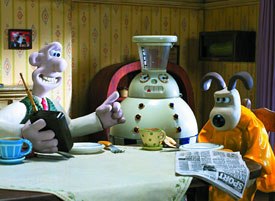
Wallace & Gromit fans were willing to pay for Internet original content. © Aardman Animation. Courtesy of AtomShockwave.
In addition to sponsor-supported programs, AtomShockwave is finding success in areas where others have not ads and subscriptions. A major part of the blame for the downfall of Internet business in 2000 was the pull out of the advertising industry. AtomShockwave boasts it is 100% sold out of spots for pre-play commercials. Where other online sites are getting $10 per impression for a banner ad, AtomFilms nets $25 for its TV-like ads that run before each short.
With subscriptions, Roesche says AtomFilms has racked in solid numbers for the Internet-only Wallace & Gromits Cracking Contraptions. The firm found that viewers were willing to pay for original Internet content that was previously branded in another medium and they couldnt get anywhere else. The Shockwave side of the company has also discovered that gamers are more willing to pay for games than people looking for shorts. The Shockwave model is based on e-commerce. The site contains free versions of most of its games with a premium version with more levels and options to purchase.
Roesche says it was tough for a while, but the company weathered the storm by being innovative in key areas and focused on key parts of the business. Their current success strongly hinges on maintaining high traffic numbers. The combined sites have more than six million unique visitors a month. Thats impressive. In addition, AtomFilms continues to receive hundreds of submissions weekly from artists around the globe. Roesche says the companys internal production remains minimal, nowhere close to where it was in 2000. Internally, the main production focus is on game development with the physical production outsourced. For instance, Sticky 3D submitted their game Hurtle Turtle, which gained a lot of popularity. Later Shockwave gave the job of creating the Radio Shack games to Sticky 3D. On the acquisition front, the company travels the world attending festivals to seek out new content.

Spec game Hurtle Turtle got creator Sticky 3D more work. © AtomShockwave.
With all Internet companies, some focus is placed in taking content to other mediums. In 2000, AtomFilms released a collection of shorts on DVD and, upon a recent check of Amazon.com, it was out of stock. Roesche says they also syndicate their content on other sites with heavy traffic like Microsoft and file-sharing sites like Kaaza and Altnet. Moreover, AtomFilms, with partner Global Media Holdings, is still trying to develop AtomTelevision, a digital network containing films from its library. Roesche also sees AtomFilms as a beachhead location as technology develops, melding the worlds of Internet and cable. Still, Roesche says, the most promising thing about Internet entertainment is the Web allows new people to enter the entertainment market.
When it comes to taking Internet properties to other mediums, no one can claim more high-profile success than Urban Entertainment. Formed in 1999 by former Fox vp of feature film production Michael Jenkinson, the company is mainly using the Net as an incubus for talented individuals to develop content for future exploitation in other mediums. The firm has developed over time from looking at the Internet as a source of revenue to focusing its business on feature film development and production, animation production for a black family audience, direct-to-video animation for an adult audience and television licensing for features, shorts and animation.

Uncover Brother made Urban a legitimate film production company. © Universal Pictures.
Besides assuming that its content is of a superior quality, how else has Urban survived the shift from an Internet-focused business model to a development model when others have failed in doing this same thing? Nichelle Protho, vp of production and programming, said that their key to maneuvering around the burning debris of other dot.com disasters was a multi-faceted attack of multimedia opportunities including feature films, television and video and DVD. Also, a scalable operation with many functions outsourced for flexibility.
So you may be asking why include them? Though their revenue is mainly derived from taking what they start on the Net to films, DVDs and TV, the key is that the content starts on the Web. Protho said, New artists have been approached with the opportunity to create their very own cartoon a real treat to artists. They were given the freedom to write whatever they want. Its this concept of allowing artists the freedom to create unique content outside of the corporate Hollywood structure that attracts the likes of novelist and screenwriter John Ridley, Naughty by Nature star Treach, House Party director Reginald Hudlin, Big Hit writer Ben Ramsey and Why Do Fools Fall In Love screenwriter Tina Andrews.
The Flash shorts start as free content on the Internet. Urbans audience of 100,000 unique individuals a month builds a following for the content, which makes them more attractive to other mediums. John Ridleys Undercover Brother became the first Internet property to make the jump to film. Starring Eddie Griffin and Densie Richards, the film grossed more than $38 million, and has become a cult hit on video. DVD is another land of great opportunity for Urban, with animated collections of Ridleys Those Who Walk In Darkness, Andrews Sistas N the City and Ramseys and Kantzs The Contract making jumps from the Net. Screen Gems released the live-action version of The Contract, entitled Love and a Bullet, in September 2002.
Urban Entertainment has three other animated shows in development at various studios. Ridleys Those Who Walk In Darkness will get a live-action rendition via Warner Bros. and Silver Pictures, based on the Web series. Originally the Web series was based on an unpublished novel, which has now been published by Warner Books. The series follows an elite group of police officers that battle crazed mutants. Pookie Poo, which follows the life of a hopeless player, will head to theaters as Ralph from Imagine Entertainment and Universal Pictures. There Goes the Nation, which chronicles the rise to the White House of a black reality show contestant, is in development at Alcon Entertainment and Warner Bros.

Those Who Walk in Darkness (bottom) may be Urbans next title to hit theaters. © Urban Entertainment.
These kinds of deals are unmatched. And who can blame them for wanting to take their shows to the big screen. Its no different than Marvel expanding its reach by exploiting Spider-Man and the X-Men in other mediums. Most of Marvels revenue isnt made in comics, but made through licensing and developing its properties in film and television. However, people generally dont think of Marvel as anything other than a comic book company. Likewise, Urban Entertainment is still an Internet company at heart.
Protho sees the future of the Net going in a BMW and AtomShockwave direction. In addition, she feels Web toons will be used as marketing tools for feature films and TV programs. Though Urban is mainly using the Net as a launching pad to take shows to other mediums, Protho said, with broadband initiatives from companies like AOL, only time will tell what the future will bring for Internet entertainment. However, she said, In the meantime, we entertain our audience.
Finally, we come to Mondo Media who has found a way to make money off its content without exploiting it in other mediums first. Not so long ago, Mondos main focus was on syndication of its content to high traffic sites. Now, it has shifted its business model from advertising-based to merchandising. John Evershed, co-founder and ceo, said their audience has grown dramatically and he equates the fan base to revenue.
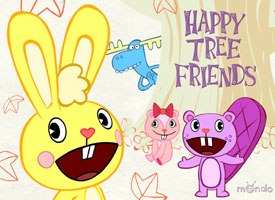
Mondo Media's Happy Tree Friends found a home last year on MTV's Downloaded. The production also served as a basis for Mondo Media's first foray into DVDs and merchandising. © 2000 Mondo Media.
With 30% of all connected households are on broadband, and that number is expected to grow to 50% by the end of the year, Evershed said, the Internet can really launch a property globally. It is the most efficient word of mouth tool. Mondo leverages its content as effectively as it can by making it increasingly easy for fans to direct friends and family to Mondos site. Once they get the new viewers, they push marketing toward the additional eyeballs.
The first title Mondo has merchandised on a major scale is Happy Tree Friends. The DVD, which sells at Tower Records and Best Buys, has already sold more than 10,000 units, very impressive for a property that has no other medium tie-ins other than the Net. Mondo is prepping clothing and other products based on the Happy Tree Friends character to sell globally. This property, Evershed said, proves that the Net can serve as a pathway introducing hip content [and to] grow entertainment properties.
For the production of its content, Mondo has a combination of in-house and outsourced content creation. Evershed said the key is that Mondo owns the rights to the properties; it has total freedom to create merchandise from the franchises. Mondo is airing three shorts Zombie College, Hard Drinkin Lincoln and Poker Night from the defunct Icebox.com. Two years ago, Mondo bought a minority stake in Icebox, allowing it to syndicate its library of shows. In addition, Mondo developed a relationship with the heads of Icebox, which includes King of the Hill producer John Collier, Angel and Buffy producer Howard Gordon and Simpsons producer Rob LeZebnik, in hopes to have them create content for the company in the future.
Evershed insists there is money to be made on the Internet. He says in two to five years, with broadband expanding, especially in foreign markets, Internet entertainment will be able to sustain itself on a merchandising basis. Nonetheless, he says the properties need to be good to warrant merchandise. He points to TV animated series that dont have merchandising possibilities that then lack longevity. Evershed emphasized that Mondo has no delusions of taking over TV, but he feels his company will be in an opportune position when Internet users are swapping TV programs and films with the ease they swap music today. Mondo will have the savvy experience to know how to adapt and give its audience what it wants, which ultimately turns into dollars.
Rightfully so, many people are still scared of funding Internet ventures after losing their shirts only a matter of years ago. However, were not that far away from content available to download off the Internet onto hard drives, which can be played on TiVo-like TV-based devices. AtomShockwave, Urban Entertainment and Mondo Media are finding radically different ways of building revenue. However, at the core of it all, they have content that people want to see and ultimately are willing to pay for in some way, shape or form. Its exactly what Roesche said in 2001, Bare with the industry. The opportunities for talented artists too will be there.
Rick DeMott is managing editor of Animation World Network. Previously, he served as the production coordinator for sound production house BadaBing BadaBoom Productions and animation firm Perky Pickle Studios. Prior to that position, he served as the associate editor of AWN.
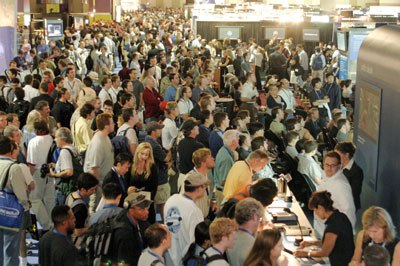
The hordes converge on the convention floor. All photos unless otherwise marked SIGGRAPH.
The first thing you noticed about SIGGRAPH 2003 when surveying the booths at the San Diego Convention Center was how energized and comfortable it was. Attendance was up from last years excursion in hot and humid San Antonio (reportedly 24,332), yet it didnt feel crowded or claustrophobic. Yes, the number of exhibitors has dwindled in recent years and the booths may not be as large and as spectacular as in the past (there were even less goodies available, but Pixar won hands down with its popular Finding Nemo posters and collectible walking teapots). Still, there appeared to be greater diversity on the floor, which is a very good sign that 3D visualization is becoming more and more widespread and a lot more affordable.
Cheaper, quicker and more powerful best described the atmosphere, which is not a bad thing. Its where the industry is at right now. SIGGRAPH 2003 was all about refinement of hardware and software capabilities by the big boys to answer the needs of studios and artists, and to counter the plethora of plug-ins. In the same vein, it was also about consolidation of functionality to simplify pipelines. On the other hand, SIGGRAPH 2003 was dedicated to more mass-market accessibility. In other words, less wow but strategic planning that makes both creative and economic sense.
Thats not to say there werent noteworthy developments from companies large and small. Alias Maya 5 offers a whole slew of rendering enhancements (including native support for mental ray and the ability to choose among four native renderers). Side Effects Houdini 6 delivers significant productivity and efficiency gains via digital assets and enhancements in global illumination, among other things. Discreets 3ds max 6 boasts advanced schematics for mental ray, vertex color painting, design visualization tools and other CAD-related solutions. New Teks LightWave 3D 7.5 allows for more direct manipulation of bones during rendering. Kaydaras MotionBuilder 5.0 features a redesigned Storytelling Timeline that combines 3D animation with audio, video and camera shots. Version 1.2 of SplutterFishs Brazil Rendering System provides a more stable and robust rendering toolset for added cross visualization throughout various markets.
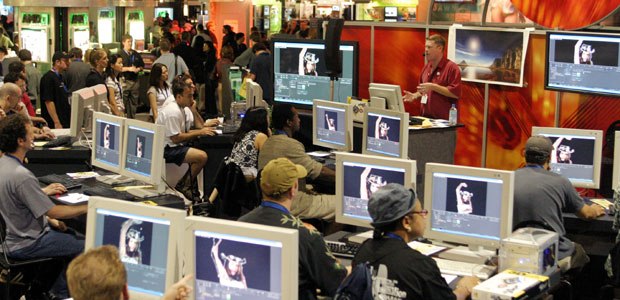
Visitors check out the new develops from 3Dlabs.
But to have Stan Winston proclaim in a user group that everyone should learn Softimage|XSI gave the Canadian company SIGGRAPH bragging rights, especially on the heels of Animal Logic converting its pipeline from Maya to Softimage|XSI during mid-production of George Millers upcoming Happy Feet. Version 3.5 includes increased efficiency and accelerated productivity for the increasingly popular 3D production pipeline software. Plus on the gaming side, Softimage|XSI now allows heavy geometry with greater mapping, helping to close the gap between movies and gaming. Meanwhile, on the hardware side, AMDs new 64-bit Opteron servers and workstations were a standout in terms of their previsualization assistance on the upcoming Star Wars Episode III (performed by George Lucas JAK Films).

Rick DeMott
Animation World Network
Creator of Rick's Flicks Picks