
VFXWorld's Bill Desowitz speaks with Hulk animation supervisor Colin Brady to find out how ILM tackled the giant task of bringing the big green superhero from the comic book page to the theater screens.
Talk about rage. Who would've thought the Hulk would've touched off such a critical firestorm, with people not only questioning the wisdom of director Ang Lee's Oedipal emphasis but also Industrial Light & Magic's CG vision for the popular Marvel superhero? Expectation and perception are everything and a bad buzz dogged the Universal film ever since we got our first glimpse of a cartoony-looking Hulk in the Super Bowl teaser trailer. Yet that was arguably an ill-conceived snippet that was sped up and taken out of context. Even so, after viewing the completed film, few have been willing to cut Lee much slack for creating such a heady, personal comic book movie. But animation supervisor Colin Brady provides some valuable insight into Lee's creative choices and why ILM animated the Hulk the way it did.
Ang Gives Good Angst
The first thing the ILM veteran explains is that Lee was so specific in his direction of the computer-animated Hulk, requiring that he act more like a 4-year-old child throwing a temper tantrum than an out of control adult, that Brady urged him to don the motion capture suit himself. "Ang gave an amazing performance and after reviewing all the takes, we decided that his performance was the best," Brady suggests. "Even for the tank sequence, we built these miniature props and brought in a stunt guy and ex-football player and shot several motion capture sessions, beating the heck out of these tanks and smashing them up. And while all the physical motion was correct, the acting wasn't there. But Ang gave good angst. Even the Hulk beating up the tank with the turret was 99% Ang. He would really emphasize [the less is more mentality] that to me is what I was already drawn to in his films. You look at Hulk. There is very little change that happens on the faces of the actors. We tried very hard not to over animate because that's what Ang stressed."


The Hulk takes some acting tips from director Ang Lee in this ragin' scene. © 2003 Universal Studios. All Rights Reserved. Credit: ILM. Director Ang Lee (right).
For Brady, acting has always been key to animation and the biggest challenge for him is getting a consistent performance. He says it doesn't matter how many talented artists in the world you have working on a project, the problem with animators is that they put so much of themselves in sculpting a performance that you lose consistency from shot to shot. "Ang was really good at reining us in and providing the consistency we needed. It was all about toning things down. My job would be to tell the animators when the Hulk is looking at rocks that it harkens back to when he's a child with his mother in the rock garden. At first they would give him these sad, puppy dog eyes. And I would tell them that this just doesn't work. Also, a big part of my job was to get the animators to feel the role before touching the computer, to get out of their seats, to act out the shots, to feel every shift of weight and bobbleto make it all seem like choreography."
Brady acknowledges that Hulk was a very personal story for Lee, and that the comic book story was merely a backdrop for exploring deeper issues between father (Nick Nolte) and son (Eric Bana). How the sins of the father (in this case the quest for power and perfection) are visited on the son, and how it also touches on the meaning of existence and becoming one with nature. "I sensed that he was into this as a very emotional release during the motion capture sessions," Brady continues. "I would put it into the category of primal scream therapy." Although there are moments that evoke King Kong, Brady says Lee never discussed the legendary monster movie or any other cinematic archetype. It was always about tapping the little boy lost within this angry beast.

replace_caption_hulk03_hulk_pursued_SF.jpg
Building the Perfect Hulk
"Humans are most difficult to animate," Brady explains, "because we see them every day and our eyes are most critical to texture, muscle and movement. A two-year-old can discern very well what's real and what's fake. We started by studying a lot of anatomy, bringing in body builders. We initially thought we were going to be able to sculpt each target pose so well that the Hulk would be more or less automated. We even discussed building from the skeleton out and all the muscle and skin on top of that. The human body is so complicated that you can't really build a model that's going to work for every single pose. We had a task force of shape guys that were anatomy checkers. Animators would give them the first pass and these guys, many of whom are artists and sculptors, would clean up key frames and make sure bone protrudes from the right place and muscles flex where theyre supposed to. We were given a design and model that were predetermined and the Hulk was already pretty exaggerated. You had to take some liberty with anatomy."
Perhaps the most remarkable sequence in the film is the dog fight in the forest, in which the Hulk must protect Betty from some savage beasts that have been imbued with some of his supernatural powers. "Early on, Ang proposed having the Hulk be nude during the dogfight, and I was all for it," Brady says. In many ways, the dogfight is the most primal moment. In my view, it's all about Hulk's adolescence, and Ang would really talk about the Hulk's three stages of development. First there's the 9-foot baby Hulk in the lab; then there's the 12-foot medium-sized Hulk in the forest; and the fully grown 15-foot Hulk who's in control at the end."
Although it was a nice idea in theory, it wasn't very practical for the Hulk to be nude in the forest in a PG-13 film. Brady said it started to look like an Austin Powers scene because of the way they had to carefully place dogs or trees in front of the Hulk's naked body. The last thing they wanted was unintentional laughter. Not when you're dealing with a man-child haunted by memories of his parents arguing behind a door.

Being a superhero is dirty business.
'Muscle Relaxation' Technique Helps Empower Hulk
Despite criticism from the animation community that the Hulk is not convincingly animated (do we still have too much Gollum on the brain?), Brady is most pleased with the facial performance. " For me the biggest surprise is that people make a greater connection between Hulk and Eric than we thought. No one seems to question that this Hulk is Eric." He attributes this to Lee's direction. In fact, in the San Francisco climax, Lee specifically told everyone to reference Kevin Kline in The Ice Storm. " At the very end, Kline has turned around to his family and realizes all the problems his lifestyle has caused and starts to tear up, and Ang wanted to capture that moment right before somebody cries. He didn't want Hulk to cry but talked about a tightness between the eyes and so we would reference that stuff frame by frame, even the little twitch and tightness that happened around the mouth. So you could say there's even a little Kevin Kline in there as well."
In terms of animation, there was some sub surface scattering done to create a certain kind of translucent quality to the skin and ears. ILM utilized a technique called "muscle relaxation" that provided a greater sense of skin sliding over bone and muscle "so that you're able to move the texture of the skin over a muscle surface while retaining the shape of the muscle underneath."
Skin traveling over mass is one of the biggest technical breakthroughs on the film, according to Brady. "The other one is that for the dog fight sequence we brought in attack dogs and motion captured them. This is the first time dogs have ever been motion captured so well, certainly here. We made goofy motion capture suits for dogs, brought in a dog trainer and had massive [mixtures] fight and take down this guy. In the end 30% of the sequence was performed by real dogs."
Brady says for the first time ILM allowed its artists the option of using two animation platforms on Hulk: Maya, its usual software of choice, and Softimage 3.9. It was all part of treating the CG creation like a real actor and using whatever animation tool they felt comfortable with. For Brady, who previously worked on the special edition of Hulk, there are a lot of similarities to the beloved alien in terms of eye movement.
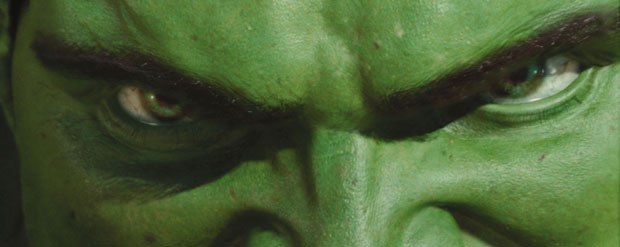
Close-ups show the excellent detail of the animation work.
The Eyes Have It
"It's all about emotion and retaining certain dirt and imperfections that make it seem more believable. E.T. wouldn't move from one pose to another cleanly. He would always have a little bobble. Similarly with Hulk, every time his head would rotate, he would capture some of that real life dirt. Even in video reference, he just kept his eyes constrained to a certain fixed point in space. Like real life, you always are fixing on one object even if scanning a large vista. Your eye doesn't move cleanly from left to rightit pops. Believe it or not, that is a reality breakthrough that early CG characters didn't have. We made big use of these eye constraints in E.T. and called them micro darts. If you study acting, you see a lot of these pops in the eye movement. There are eye twitches in Nick Nolte's performance that we would look at as beautiful dirt. We studied Humphrey Bogart and Ingrid Bergman in Casablanca. If you look closely, there is a lot of fire and intensity that goes on in their eyes that doesn't go on in CG. Why is that? The eye is not a perfect spherical surface, it's actually a bumpy thing, so as the eye is darting back and forth, it's picking up all sorts of new highlights. You see the change in the sparkle.

It ain't easy being green.
"As small of a detail as that sounds, the eyes are the most important thing. You can get sub surface scattering, muscle relaxation and textures to look entirely believable, but if the eyes are all wrong the whole thing falls apart. I had a great discussion with Nolte about eye blink. There's a shot when Hulk first sees Betty in San Francisco and he drops the rock and he gives up. He slowly blinks and there's a real fine line. Do we give him a three frame or five frame blink? And a difference of just a few frames turns him from appearing thoughtful to sleepy.
"Nick said we should consider going the other way and holding that blink and making it a very defeated performance. I thought it was a really good idea. Nick knew all about the importance of a blink and the length of holding your eyes shut. I think it's one of Nick's great performances on this show and the truth is great acting is great animationthey're one and the same. There are frequencies and rhythms that happen that to me are akin to a great jazz performance. For me, the biggest thing walking out of Hulk is that Ang would talk about the Hulk as an actor. Even though it was Ang's performance [that defined him], it wasn't like, 'Move this three frames there or four frames there.' It was like, 'Hey, why does Hulk look sleepy here?'"
Bill Desowitz is the editor of VFXWorld.com.

Bill Desowitz, former editor of VFXWorld, is currently the Crafts Editor of IndieWire.