
Bill Desowitz chats with ILM's Pablo Helman and Steve Rawlins about the challenges of pulling off Indiana Jones and the Kingdom of the Crystal Skull.
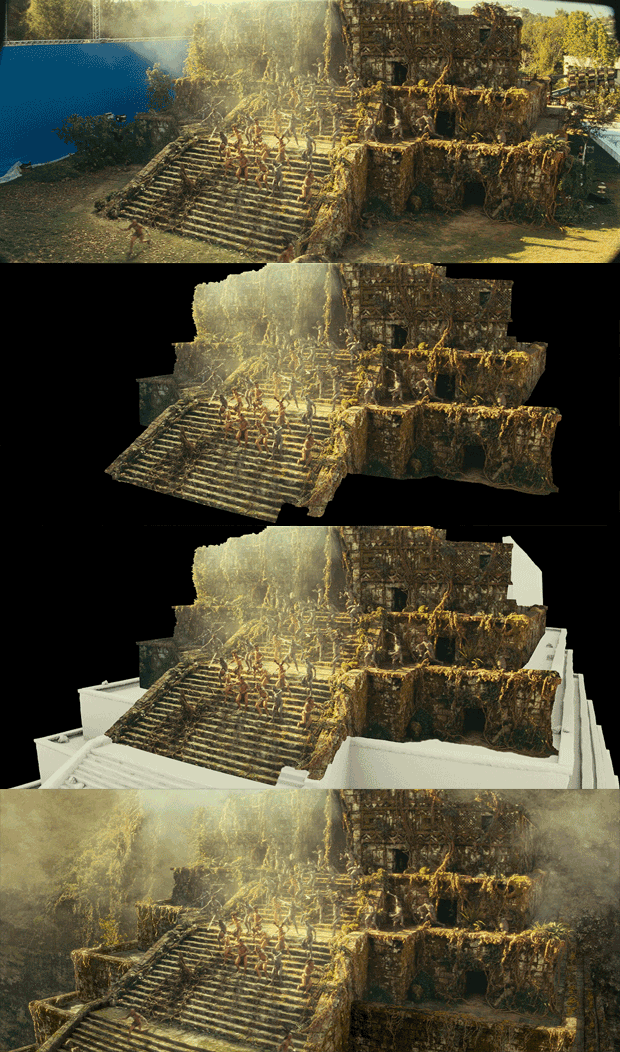
The original mandate for Crystal Skull was to resist much CG, but things changed slightly once Steven Spielberg got on the set. Above is the temple exterior. All images ™ & © 2008 Lucasfilm Ltd.
Remember when Steven Spielberg and George Lucas cautioned about the limited role of vfx -- particularly CG -- on Indiana Jones and the Kingdom of the Crystal Skull (now playing from Paramount Pictures)? The primary objective was to emulate the iconic look and feel of the three previous Indy movies shot by Douglas Slocombe.
However, while the filmmakers remained fairly faithful to their original mandate, the final results required more CG than anticipated. But that's a Steven Spielberg movie for you: once he gets on set, the situation often changes.
"The original premise, even from the first meeting with Steven and George, was to have this one blend in with the other three: to have the same look, the same lenses, the same sense of reality," confirms Pablo Helman, the visual effects supervisor who previously oversaw Munich and War of the Worlds for Spielberg.
"And we did do that. Even though they don't do matte paintings on glass anymore and there's a fair amount of CG, we did take a look at how the other movies were done and the sensibility about geography in the same shots as the mattes. We also followed whatever Steven was doing on the set, including his signature shot compositions and how he marries characters and performance and geography into one epic shot. We carried that into the visual effects.
"It's really scary when you think about it because you didn't know how Steven was going to take this thing on. Once we went on location, we saw him doing what he does best, which is getting inspired at the spur of the moment. From there, things started changing, including how the work was divided. When we were shooting the Doom Town [military test sequence], for instance, there was a lot more CG than you might think. But what you probably didn't realize is that Doom Town is a miniature with a lot of 3D matte work. The Digi-matte department photographed everything so they could build digital sets, since it's all blown up later. There was a lot of second unit work originally planned for Doom Town, which became principal photography once Steven decided to turn the camera around. This became a very organic process for all of us."
Organic is the key word because this '50s-era Indy adventure that takes place during the height of the Red Scare features quite a variety of visual effects: Digital mattes, 3D digital mattes, extension work in the jungle and water falls and temple sequences, as well as plenty of creature animation, including prairie dogs, monkeys, ants, digital doubles and aliens. In all, there were 560 vfx shots and 48 minutes of screen time because Spielberg wanted longer takes. There were also around 300 artists working for eight months at ILM's office in San Francisco's Presidio.
"The most important part of the R&D had to do with particle work," Helman continues. "For Doom Town, there was smoke on the houses, dust and the explosion. In the opening warehouse, there is the gunpowder. The rocket sled had some particle work, but the fire in the back was real at Steven's insistence to get more texture. Inside the temple heart at the end, where the room rotates and breaks away, there was more particle work. And also there is debris surrounding the saucer at the end. So we revamped our fluid engine derived from PhysBAM [now called 'The Brain.'] The engine can do water, fire, explosions. In this case, all the particle work was creature intensive, which required a new approach. The entire temple environment is CG along with many of the characters." In fact, Helman is pleased that the fourth film in the franchise comes full circle in terms of its supernatural climax.
For the extensive jungle action sequence, ILM came up with a new drag-and-drop technique for virtual vegetation generation.
For the extensive jungle action sequence, ILM came up with a new drag-and-drop technique for virtual vegetation generation. "You build your assets (plants, trees, etc.) and then drag -and -drop into a 3D scene," Helman explains. "And then we populate the whole thing and then sim those assets and obviously we painted and lit them and that goes into the scene as well." This is another instance of leveraging technology from the videogame industry.
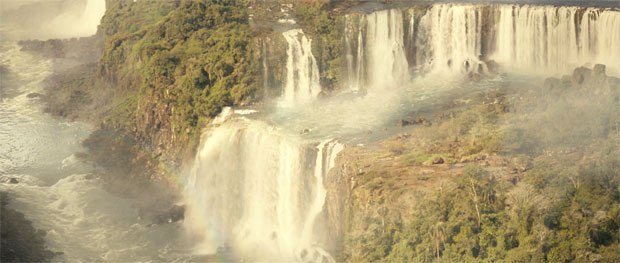
Helman additionally oversaw the second unit filming of the waterfall sequences in Argentina (where he was born) and Brazil. "We dropped those plates into the cliff environment, but everything was put together by the Digi-matte department in 3D," he adds.
As for the supernatural temple climax, that required a great deal of CG. "The anti-chamber inside had to be done in CG because part of it had to be destroyed and couldn't be part of a practical set," Helman suggests. "Fifty percent of it is live-action with rotoscoping and CG. Inside the temple heart was a complete match with production design. That environment is a breakaway with a new tool we created called 'Fracture.' That allows you to break any hard surface model [more realistically], including the walls, in very specific ways because this is work that generally gets done by particle TDs, but because of the way they break, there's lots of penetration, lots of functions that have to be solved by creature TDs. So the whole environment was shared between the two departments.

The supernatural temple climax required a great deal of CG. The environment inside the temple heart is a breakaway with a new tool ILM created called Fracture.
"Then that reveals another environment, which was the interior of the ship. And that had to be done CG because there was nothing practical there for that. But that sequence is kind of weird because it plays inside Spalko's head [played by Cate Blanchett] and what we're seeing is outside of her. Steven just went with…'When we cross, this is going to be a [wild] trip inside her head, so don't worry about it right now.' We did shoot Cate on a stage and she did a great job of acting out things that were not there. We brought in one skeleton just for her to interact with."
Meanwhile, the immense exterior of the temple breaking apart and water coming in at the end ("The Ten Commandments moment," as Spielberg called it) was also pretty demanding. "It was a combination of 3D environment from the Digi-matte point of view and all this particle work that had to be done from particle TDs and creature TDs and all the paint and Digi-matte environment as well as miniatures," Helman adds. "As with the most of the miniature work, it was photographed and then re-projected onto geometry."

Character animation was a challenge for the animation team. The animation director studied a prairie dog zoo exhibit to get right size and fur.
In terms of the character animation, which was mostly keyframed, there were lots of challenges for Animation Director Steve Rawlins (Harry Potter and the Order of the Phoenix, Star Wars: Episode I & II). "This was a small animation show by usual standards," Rawlins admits,"but it eventually grew to more than we anticipated. It began with the prairie dogs, which were the first things out of the gate. That was fun to do, especially the iconic opening [poking fun of the Paramount logo].We ended up doing some early animation, which we sent to Steven for approval. I actually went to the zoo in San Francisco and studied the prairie dog exhibit. The issue that came up was the look of the prairie dog in terms of the size and shape of the fur. The interesting thing at the zoo is that they're all different, with the older ones tending to be fatter. So we had to pick one and floated somewhere in the middle. As far as animation is concerned, we went for the upright, standing at attention pose."
At the end of the Doom Town blast, when Indy is hurled in a fridge, there was a bit more CG reliance than envisioned. "Where [the flying fridge] comes to a stop they ran a rigid simulation and intended on matching it with the real one with Indy coming out. But they wound up using the CG one because it was easier."
However, the monkeys represented the most labor-intensive challenge. In addition to requiring multiple monkeys (ranging from 25-50), they had them interacting with vines in the jungle or actors on the vehicles. "They were fast moving and the volume was large for a lot of the time. They had a system in place where there were separate assets for the monkeys and vines and they could get as many assets as they wanted. But for the vines and monkey tails they borrowed the tentacle tool from The Pirates of the Caribbean: Dead Man's Chest. It was written as a way of rigging quickly and flexibly, so instead of the creature set-up department having to rig the vines and tails with a certain number of controllers, they could do it on the fly and then choose the number of controllers necessary for a given moment.
"Another thing we did as well was run simulations on some of the tails, where the creature set-up guys used quick Maya soft simulation techniques, allowing the animators to run fast, almost realtime sims. This came in handy for the wide shots of the monkeys zipping by."
By the way, the monkeys were of the Capuchin variety, the same species used in Pirates of the Caribbean and Raiders of the Lost Ark.
Interestingly, Spielberg wanted the monkeys swinging on vines; however, in looking at reference and speaking to the animal trainer, Rawlins discovered that's not what they do in the wild. "They jump from branch to branch. The initial animatics contained different breeds of monkeys and a variety of motions, but Steven still preferred them swinging, so it ended up being about 60% swinging and 40% jumping from branch to branch. What we found that made it more difficult is that often when you do a CG-intensive character such as Davy Jones, there is a large amount of development work that goes into getting a character of that level working, and that investment of time and resources pays off over the course of hundreds of shots. But Indy was full of one-offs and the hard part was that they put a lot of effort into it yet there wasn't the time to refine the work. With the monkeys, there also weren't enough of them to run a crowd simulation, so they all had to be keyframed. Shots were swapped back and forth or bridged as needed.
"For monkeys on the vehicles, the layout department had to provide really tight matchimations of each of the characters using digital doubles and paint and rotoscoping work for the action. In fact, in the main shot where the monkey runs over Spalko's face, we put a couple of monkeys in the back as a contrast to all the hyper-activity.
"For the ants, [which numbered in the hundreds of thousands] we used our own [Zeno-based] crowd simulation for the most part, with animation providing simple cycles and hero animation for key moments. This was the first time they used the new crowd system and it was much quicker and able to handle larger volumes than the previous Maya-based system. For shots where they start pouring over the car, there were a few custom hero ones placed here and there to break up the line so it wouldn't look too perfect."

R&D focused on a new approach to particle work like in the opening warehouse where there is gunpowder.
For one difficult shot, where the ants pour off the top of the camera, they did keyframe animation. "Steven was determined to have it look as real as possible. We discovered that ants are so tiny that one of the things that would give them more interest in the wide shots was having the layout department create uneven terrain with bumps for them to navigate through. There were other bits of business, too, such as an ant crawling up a twig."
And what about the ultimate challenge of not having the character animation call too much attention to itself? "The hard part is you're trying to do something that feels natural, but, at the same time, the director is always asking for something that isn't natural. A good example is a shot of a scorpion that crawls on Mutt's hand and stings him. Obviously you start looking for reference and the Internet is a great resource for that. The animator working on that came to me and asked if we wanted a real scorpion sting or a Hollywood sting. And I said a Hollywood sting because people expect to see the tail coming up and striking down, whereas in reality [there's very little movement]. It's one of those moments where if you do what's real, people wouldn't buy it."
As for the mysterious aliens designed by VFX Art Director Christian Alzmann, the only thing Rawlins would say is that they tried to steer a middle ground between the familiar and unfamiliar, at Spielberg's request, meaning that there are definite similarities between Close Encounters of the Third Kind and Artificial Intelligence: AI. One of Spielberg's secrets will have to remain a mystery for now.
Bill Desowitz is the editor of VFXWorld.com.

Bill Desowitz, former editor of VFXWorld, is currently the Crafts Editor of IndieWire.