Alain Bielik meets the visual effects supervisor behind the hallucinatory images of Blueberry, a French western with a twist.
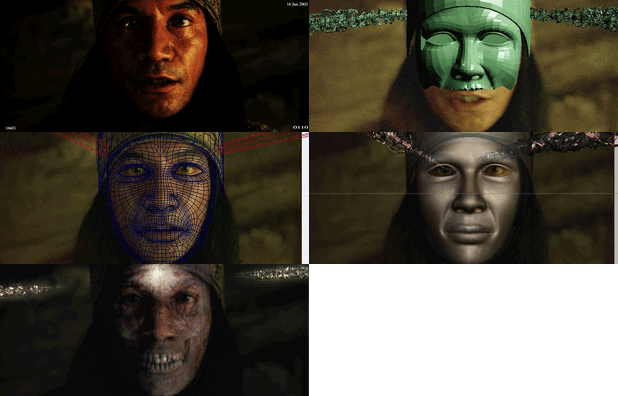
Vfx house Mac Guff Ligne created the shamanistic experience for the French western Blueberry. Here are CG breakdowns for an Indian character. All images © 2004 Mac Guff Ligne for UGC Images / Ajoz Films / La Petite Reine.
When a French filmmaker decides to shoot a western, you can be certain that his take on the genre wont be traditional. Indeed, Blueberry has more to do with Ken Russells Altered States (1980) than with Howard Hawks Rio Bravo (1958). The film draws its inspiration from a popular graphic novel series published in France since 1965 under the supervision of legendary artist Jean Moebius Giraud.
Mike Blueberry (played by French star Vincent Cassel) is a lonesome, troubled marshal who confronts his arch-enemy (Michael Madsen) in a fight for the freedom of the Indian tribe in which he grew up. In order to find the answers hes seeking, Blueberry submits himself to a series of shamanistic rites that open him to a new level of consciousness and to painful, long forgotten memories that will ultimately decide his fate.


Blueberry was directed by Jan Kounen, a provocative filmmaker who initiated a huge controversy in France with his previous outing, the ultra violent Dobermann (1997). Although the Blueberry series never covered shamanism, Kounen came upon the idea of including the theme in the movie after experiencing shamanism himself while filming a documentary on the subject. The experience left him deeply shaken, recalls Rodolphe Chabrier, visual effects supervisor and co-founder of Mac Guff Ligne, the French company that created the films ambitious effects. After each [shamanstic] experience, he would come back more and more changed. It got to the point where most of his friends thought he was getting crazy, says Chabrier. At one point, he even wanted to give up filmmaking altogether. Eventually, he started looking for a feature film project in which he could integrate the theme of shamanism, and Blueberry, with its Native-American characters, was ideal in this regard. Draft after draft, he kept enhancing the mystical aspects of the script. Originally, there were only six minutes of shamanistic trances in the movie. In the end, we have more than 15 minutes!
A Life-Changing Experience
Chabrier realized very quickly that he wouldnt be able to put Kounens visions on screen if he didnt try it himself. Thus, one day, he flew to Peru with Kounen and Cassel to meet a master shaman. The experience had a profound effect on me, although not to the extent of what it had done to Jan, admits Chabrier. However, after my first trance, I was convinced that there was no way this experience could be shown on film. To me, even if you filmed it in IMAX and projected it at Showscan speed (60 fps), it still would only represent 1/1000th of the real thing! I couldnt see how we could possibly do it.
Most people have misconceptions about what shamanism really is. They often associate it with spirituality, while a shamanistic trance is basically a deeply personal journey. Chabrier adds, Its difficult to explain shamanism in a few words, but Jan likes to say that, as NASA takes humans into space, shamans take you to your inner self, to your deepest levels of consciousness. When you live this experience, you never make the same journey twice and two people never make the same journey, which makes it very difficult to describe. Still, the incredible thing is that there are some visions that everybody experiences: spiders, snakes, fractal forms, perception of the immensely small and the immensely large These similarities allowed us to find a common language to describe and share what we had experienced.


The design process of the shamanistic sequences lasted for about a year, with Kounen sketching his visions on paper and Chabrier building animatics in 3D. It occurred very quickly to the latter that traditional storyboards wouldnt suffice for this project. Chabrier explains, During a [shamanistic] experience, you see your environment perpetually modifying itself. Since these changes sometimes occur extremely rapidly, there is not really a possibility for a freeze-frame that could be translated into storyboard form. The only way to visualize it was via 3D animation. Later, these animatics were a valuable tool for describing the concepts to executives who had difficulty to put it mildly in grasping this whole shamanistic thing.
Given the changing, flowing nature of the shamanistic experiences, Mac Guff had to devise a new approach to the effects. Since theres no cut, there are no shots per se, but three sequences that feature non-stop 3D animation, says Chabrier. Thats why its deceiving for us to talk about shot counts. These shots are several minutes long!


Translating Mental Images into Film Images
The design process was followed by a year of R& D under the supervision of Francois Launay. There were many conceptual issues to address, the least of which being the point of view of the sequences. Since the shamanistic experience is what the subject sees and hears and smells and feels, should the camera take the subjective point of view of the character, showing what he sees with his own eyes, or should it take an objective point of view and show the experience from outside, visualizing the hallucinations around the character?
It was a difficult question and we eventually opted for an approach that combined both, comments Chabrier. In the subjective point of view, the image was too confused and too abstract for the spectator to clearly understand what was going on. So what we did was to design the visions for a subjective approach, and then integrate the character into the imagery. Generally speaking, its extremely difficult to represent mental images. To start with, there is no such thing as motion blur in a trance. You see objects or creatures moving at light speed but at the same time, remaining perfectly sharp. If you put this on film, the effect will look completely artificial. The other thing is the infinite depth of field. You can simultaneously see with equal sharpness an ant walking on your eye and the stars on the horizon. Again, thats impossible to translate on film, as, with an infinite depth of field, the images we were creating would have been a mess. In order to address this, we applied various levels of sharpness to the different layers. For example, the foreground will be in focus, while the midground will be blurred and the background in focus. It gave the images a sense of depth and a very rich look without visually overloading the viewer .

replace_caption_bielik08_Blueberry-11.jpg
Chabrier did long research on the Internet to find textures that could form the basis for future 3D images. What he came up with were fractal artworks, mathematical forms, macrophotography, electron microscope imagery and quantum physics concepts. Ultimately, each image of the trance sequences consisted of dozens upon dozens of superimposed textures. All were submitted to various effects such as blur or vibration in order to be stylized. We didnt want the sequences to feel like a ride, or like a comic strip! explains Chabrier.
Casting the Right CG Artists
Completed at the end of 2002, principal photography was followed by a full year of postproduction work at Mac Guff. Heading a team of about 30, digital effects supervisor Bruno Chauffard oversaw the effort of generating hours of 3D animation each image consisting of multiple animated layers and the creation of some 250 invisible effects shots for the non-shamanistic sequences. Those included cable and rig removals, painting out footsteps in the desert, adding light effects and enhancing explosions.


CG animation and 2D effects were assigned to individual artists according to their sensibility. We had long conversations with each one of them about shamanism and mysticism, trying to communicate what wed experienced, recalls Chabrier. Some of them got it right away and developed great concepts. Others rejected the whole thing and gave up after a while, saying: I just dont get it. At Mac Guff, we often have artists single-handedly creating a shot from beginning to end, controlling every aspect of it. This was not possible on Blueberry though, as the amount of 2D and 3D work that was required for any single image obliged us to set up a production pipeline.
The sheer amount and complexity of the CG models required the development of a procedural modeling tool nicknamed X-Frog. It allowed the artists to create the basic structure manually while the repetitive aspects of the model were generated procedurally. Simpler models were created with Symbor, Mac Guffs in-house modeling and animation software.
Complex structures were animated procedurally while simpler objects, such as the creatures, were handled manually. Particle systems were also used for a large number of elements. In several disturbing shots, snakes and other creatures take on the shape of the moving face of the main characters. For those, Mac Guff resorted to a different technique. We shot each actor on our stage with three synchronized cameras, one in front of him, one on each side at an angle. This tri-cam technique allowed us to capture facial movements in three dimensions and to apply that information to the CG animation. Whatever objects were forming the shape of the face would then follow the movements of the actor. It would be a 100% CG face, but the actors performance would still be there. Rendering was done by proprietary software, nicknamed MGLR, using either radiosity or ray tracing.

replace_caption_bielik11_Blueberry-01.jpg
Deep CG Exploration
When the initial result was judged to be unsatisfactory by Kounen, single effects or parts of a sequence could be abandoned altogether. Jan wanted to use 3D animation as if it were regular live-action takes, says Chabrier. If he didnt like it, hed ask for another CG take. Usually, on a project of this magnitude, all the CG shots are locked very early in production. The director cant change his mind without inflating the budget. On Blueberry, Jan was constantly exploring new ways, reacting on what we would show him. Sometimes, he would get excited about one particular texture or layer among many others in the frame and ask us to redesign this part of the sequence around it. This one layer would then form the basis of a new animation. The reason why the budget didnt spiral out of control with this approach is the way we work at Mac Guff. Most of our (Linux-based) software is proprietary and organized around a nodal architecture. Plus, we have the processing capacity to handle the extra work.
Its obvious that, after such a life-changing film experience, getting back to regular commercials and film projects could have been depressing. Fortunately for Chabrier and his crew, Mac Guff is now deep at work on a very ambitious movie by Gaspard Noe while also developing several CG animated feature films, a perspective exciting enough to ensure a smooth post-Blueberry transition. Still, Blueberry will remain a very special film for all involved, not only because of the startling results of their work, but most of all because of the way it was handled. Its been a very unusual project in the sense that, for once, we had to work with our feelings, not with our perceptions.
Alain Bielik is the founder and special effects editor of renowned effects magazine S.F.X, published in France since 1991. He also contributes to various French publications and occasionally to Cinefex.