
Bill Desowitz talks with visual effects supervisors from Harry Potter and the Prisoner of Azkaban, I, Robot and Spider-Man 2 about each others work.

Tim Burke for Harry Potter and the Prisoner of Azkaban, Andrew Jones of I, Robot and John Dykstra of Spider-Man 2.
For the second consecutive year, VFXWorld asked three of the Oscar-nominated visual effects supervisors to evaluate each others work: Tim Burke (Harry Potter and the Prisoner of Azkaban, the first in the popular franchise to be nominated), Andrew Jones (I, Robot) and John Dykstra (Spider-Man 2). Their responses are indicative not only of what stood out last year among the nominees for best visual effects but they also touch on the vfx zeitgeist.
Bill Desowitz: What impressed you most about each others work?
Tim Burke: In Spider-Man 2, I particularly liked the use of dramatic sweeping camera moves, which followed Spider Man through real and CG environments, giving his movement and the film great energy. I thought the design and technical accomplishment was very well executed. I also really liked the animation developed for Doc Ocks tentacles; the character that the animators managed to convey through such relatively featureless objects was superb.
In I, Robot, the character and range of emotions portrayed through the facial animation of Sonny worked very well, given his smooth and fairly featureless design. It allowed for a subtle contrast with [more] emotional robots. The destruction of the mansion house was also an exciting and well executed scene.
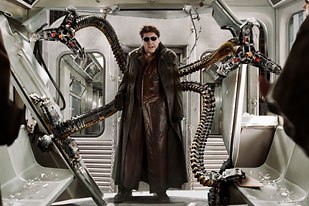
Spider-Man 2 made huge improvements from the first film on its CG characters. & © 2004 Marvel Characters Inc. © 2004 Sony Pictures Digital. All rights reserved.
Andrew Jones: In Spider-Man 2, the virtual camera work and the backdrops in general I thought were amazing. Just the fly through the city on the train disaster the fact that were looking at pretty much all-CG shots was pretty amazing. Doc Ock impressed me quite a bit both the metallic of the CG arms and the realistic look of his face. As far as Azkaban, my favorite part, of course, was the Hippogriff. The animation, by far, is some of the best that Ive seen on a creature. In terms of making a creature like that look real in terms of weight and movement, and the integration of the character into the scene was just beautiful. Secondary to the story, what I really liked is that many times the camera would be following the actors talking and the Hippogriff would be moving around in the background, out of focus, and it just fit they didnt go out of their way to feature it.
I thought the work on The Dementors was impressive too. The first introduction of the hand on the train, especially, looked incredible. In general, this Harry Potter was superior to the others in many ways. All the varied effects are all done so well.
John Dykstra: The most impressive thing to me in the Harry Potter movie, oddly enough, wasnt The Dementors, which they are touting, but the environments. I liked the job they did of placing the Hogwarts castle into the environments for approaches and departures. Of course, I liked this film in general more than the others. A really good part of visual effects is how well they support the story. And, of course, how good a story is determines to a certain extent the result of the effects. I thought The Dementors were a very cool effect and that theres a complexity there that the people who made it were expecting people who werent conversant to understand. In other words, there was probably more to it than meets the eye.
BD: What disappointed you?
TB: Nothing really disappointed me about Spider-Man 2. I thought the film and effects worked well. There were only a few occasions when the CG Spider Man didnt quite sit well in his environment, possibly through a mixture of lighting and compositing.
With I, Robot, again, a great combination of live action and vfx work. On occasions, the CG environments felt a little too stylized,but then thats more a matter of personal taste.
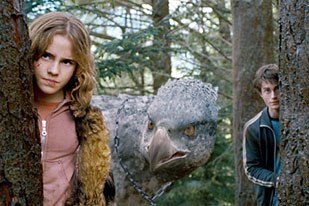
The Hippogriff is one of the many CG creatures that make the third Harry Potter installment stick out. All Harry Potter images © 2004 Warner Bros. Ent. Harry Potter Publishing Rights © J.K.R. Photos: Murray Close.
AJ: I think were still limited like some of the rig shots for the Hippogriff, where the characters are supposed to be riding its back, it hurt the motion a little bit because it was limited to what the rig could do with the actors at a certain speed. With Spider-Man, it was more of an aesthetic call than anything else, but the animation seemed a bit fast for my taste. Ive been in that situation many times where its correct to have the weight and speed and physics of it and the director says its not interesting enough so speed it up, so youre in that realm of superhuman speed and it starts to lose some of its weight.
JD: Again, with regard to The Dementors, I think they did a terrific job of execution, but, as artists, we always see the work in a separate environment as an audience. The real key is try and keep the emotional content there, and thats what all three of these films do real well. Critical components are characters created from whole cloth.
BD: Were there any surprises?
TB: That The Day After Tomorrow didnt get nominated.
AJ: I think that some of the technology on Spider-Man in terms of the image-based rendering they worked on with Paul Debevec. It didnt surprise me as much with the film, which didnt showcase it as well as some of the later SIGGRAPH conferences. But the technology is pretty amazing to render a face purely from photographs, which started with The Matrix films, and theyve taken it a step further with Spider-Man in terms of more realistic-looking characters. And then, as I said with Azkaban, the way they moved the Hippogriff was outstanding.
JD: Boy, its very hard today to surprise people and its not because surprising things arent done; its because surprising things are the norm. I dont think theres anything in either of the films that was an out of left field issue for me in terms of good things or bad things. I guess Im constantly amazed at how much more work goes into visual effects these days. A substantial amount of screen time goes into visual effects and that surprises me. Image wise, were all going for the same sense of scope. No, theres nothing that stands head and shoulders above the rest of the work they both have some really incredible stuff in them.
BD: All three nominees share in common outstanding 3D character animation. What are some of the factors that made this possible?
TB: Powerful rendering allows animators and supervisors to see work in progress more often and in context with other shots. This all helps creatively, with more immediate feedback. The animation tools themselves are constantly improving as are technical advances in the development of muscle systems, skin, fur, hair and, of course, feathers. Which all combine to make more believable and realistic creatures.
AJ: Aside from the technical advancements, I think its the result of how far weve come in integrating 3D characters into films. I think directors are finding ways to use them more. And I remember talking to Alex Proyas about I, Robot, and he said he never wouldve attempted this film a few years ago because his main character is a computer-generated character and if that believability fails, the film will never work. And the same principle applies to Azkaban and Spider-Man. Unless the 3D characters look real, it completely falls apart. If the characters and environments in Spider-Man dont work as well as they do, it would collapse. I think because we are able to make things look more real and characters and their animation look more believable, its opening up broader ways for directors to tell their stories.
JD: This gets back to the issue of, Were going to make things that youve never seen before, and that really is in the script when you read it for the first time So its [a matter of] taking everything to a level of believability based on physics, physiogamy of the human form in the case of the Hypogriff and taking everything beyond that. The second challenge is to do things what normal human beings and animals dont do, and I think establishing that baseline is the most difficult thing to do in animation.
BD: Where do you see us headed in this integration of live action, animation and visual effects?
TB: I think there are already several different movie styles developing that involve CG work. There are the animated features, relying on full-CG, and there are the full-CG movies that are almost, but not quite, photorealistic. There are the hyper-real movies, where live action is supplemented with CG, but often the work is very stylized, and then there are movies where the CG is so seamless that you believe that it must be real. I think further genres will develop as the boundaries of limitless possibilities are pushed back through imagination and technology.
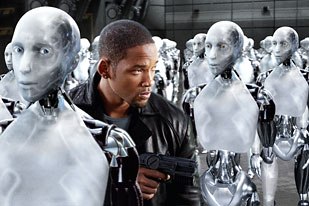
Many see digital acting, as like with the Sonny character in I, Robot, becoming a bigger part of visual effects work in the future.
AJ: To me its very intriguing what we did with I, Robot in having one of the main characters being computer-generated. I think we will see more stories going that way. I know its been coming to a head, especially with Gollum doing so well, and with the success of I, Robot and Spider-Man. The one Im on now, Superman Returns, is very similar effects wise in terms of creating these big action sequences that previously couldnt be done. Im not sure where its all going, but I definitely like the idea of actors like Alan Tudyk, who played Sonny, being able to play these roles even though they dont physically look the part. Im hoping that will open up a lot more roles for actors who dont look correct.
JD: Filmmakers have never restricted themselves to the use of technology. Just as a rule, we are the early adopters. I dont think there is any restriction to how we can make movies. But the thing that drives all of that is the story. And my preference is a component that has not been done before, and figuring out how to bring that to the screen in some believable way. What really excites me is that there are currently seven or eight films a year at this level of sophistication, and that doesnt even count the indies.
BD: What excites you most about the ability to improve even more?
TB: Its very exciting to be able to give directors and script writers limitless scope to their imaginations, to allow them to develop and make films that only a few years ago simply wouldnt have been dreamed of. There should be no boundaries to what is possible, no restrictions to originality.
AJ: I think its where everything is being pushed right now with cloth dynamics and hair and programming crowd behaviors, which get increasingly better with each film. The fur, by far, looks incredible now. All the pieces in the puzzle have come together to be able to do whatever you want continues to improve beyond what you thought they needed to, and its an encouraging step forward. So is that fact that were becoming a bigger part of pre-production and production than post-production.
JD: I guess its the kind of stories that you like. Of course, I grew up with science fiction and fantasy and those films were not easy to make in the era where I sort of matriculated into the visual effects business. The optical process, as sophisticated as it was then, was prohibitive in terms of time and cost, and the generational loss as you went through the various steps of film was daunting, to say the least. And I think there were a lot of stories that couldve been told that werent because the technology didnt exist. With digital imaging and the ability to create the image one pixel at a time, you can virtually do anything that you can conceive of and I think that has opened up genres of film that were closed to us before. So I think that is a huge thing and thats very exciting to me.
Bill Desowitz is the editor of VFXWorld.

Bill Desowitz, former editor of VFXWorld, is currently the Crafts Editor of IndieWire.