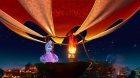
Belgium filmmaker Raoul Servais, who recently completed his first feature, talks with Philippe Moins about his films, international festivals, and the problems of making features, among other things.
Translated by Annick Teninge

Raoul Servais, whose presence in the animation world cannot be ignored, is scheduled to be the Honorary President of this year's Hiroshima International Animation Festival. A painter and filmmaker, Servais studied at the Royal Academy of Arts in Gand, Belgium. In the 1950s, he worked with painter René Magritte and documentary filmmaker Henri Stork. His films have won more that 40 national and international awards, among them the First Prize at Venice Biennial in 1966, the Jury Grand Prize in Cannes in 1971 and the Palme d'Or in Cannes in 1979.
In addition to his filmmaking activities, Servais started the Animation Department of Gand Royal Academy of Arts, as well as its Animation Study Center. He has also been involved with the Raoul Servais' Foundation, which is also located in Gand, which organizes animation courses for elementary and middle schools. From 1985 to 1994, he served as President of ASIFA-International, the international animation association.
Currently, after the long gestation period required for his first feature film, Taxandria, Servais has returned to his first love, short films.
I recently had a talk about this and that with this wise practitioner.
Moins: How did it happen to that you got involved in animation in a country where there were no animation studios?
Servais: It was not by chance. I contracted an early virus, thanks to my father; he was an amateur filmmaker who used to screen a 9.5mm print of a Felix the Cat cartoon at home. I used to unwind the print without his knowledge and glance through the frames to try to understand the mystery of animation. It is this miracle of the inanimate which becomes the motion picture, the magic of the cinematograph which made me decide me, at the age of 5, to become a filmmaker.
Moins:
Your filmography shows a great eclecticism in terms techniques.
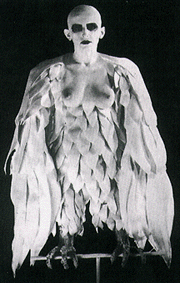
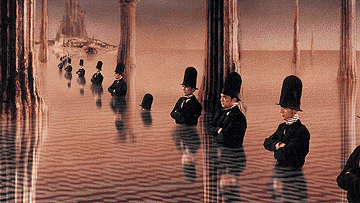
Servais: I mostly made cartoons, but I often changed my drawing style in order to create new experiences. For Harpya, I brought in a human/real character by including him in a painted setting, and handled him like a drawing. This real character was composited with different techniques. I also created an optical system inspired by front projection. For Taxandria, I created a system I call the Servaisgraphie, though, for various reasons, it was only used for the sets. The compositing itself was done using computers. Unless I am mistaken, until Toy Story, Taxandria used more digital images than any other feature film.
Moins: What sort of themes do you deal with in your films?
Servais: I deal with various themes, but what they all have in common is mankind, his longing for freedom, peace and justice. I have always tried to emphasize the dangers which threaten humans. Despite the many script revisions Taxandria went through, the basic message has been retained: a warning against intolerance and authoritarian ideology.
Moins: Taxandria will be previewed at Hiroshima, but, in fact, it is not an animated film?
Servais: In a way, Taxandria went off in a different direction than I had originally planned. At first, I thought about making an animated film using live action, as I started to experiment with in Harpya. But the producers turned this option towards a more realistic way, a live-action movie using some animation. They had a lot of experience with live action and did not fell very confident about animation. This is the reason why I do not ask for the sole authorship for the film. But it does not mean that it is not an important movie. The production had many ups and downs and we had to revise the script several times. Taxandria has had a noticeable success and has already won several prizes (in Porto among others), but it is mainly screened in art houses. People usually appreciate the fact that they don't notice the use of the computer. The images remains alive and don't suffer from the coldness usually associated with full digitalization.
Moins:
Why did you switch to feature films ?
Servais: Many people think that a short film director who makes a feature film comes out of puberty. This is especially true if you speak about live action, but I don't share this opinion. I made a feature because the script I wrote was too long to be done as a short. A feature-length film was an artistic necessity. [However] while making it, I knew that I would subsequently go back to doing shorts.
Moins:
What would you like to say to experienced animators who want to make a feature film?Servais: First of all, be sure that the producer knows and likes animation. You can find very good producers who are not mad about animation. When you are used to working as an independent filmmaker working alone or with a small team, you have to learn to delegate, which may be difficult for someone who is used to wearing many hats. You have to have a true dialogue between the director and his team; it is a habit one has to acquire. For a short, it is easy to supervise the whole thing, but sometimes with a feature, one may get lost in the details and not remain in control of the whole. This is the main danger.
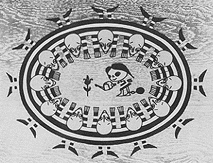
Moins: You are a big festival fan. How many times have you been toHiroshima?
Servais: I never counted! I attended all the Annecy festivals since they started, except for one. I did Mamaia every time, almost all the Zagrebs except the last two, almost all Varna, two Ottawas, but this only my second visit to Hiroshima.
Moins: Do you remember the first animation festival you ever went to?
Servais: It was the first Annecy Festival, which was the only one at the time. I remember it perfectly, because I was a little disappointed. I had submitted a film to the selection committee and it was only when I came to Annecy did I learn that it was not picked. A few months later, my film (Chromophobia) won the Lion de St. Marc at Venice.
Moins:
Since you have begun going to festivals, what changes have you noticed?
Servais: Mainly a quantitative change. There are many festivals now and in each of them there are always more films in competition, in retrospectives, etc. This is rather surprising, as the short film situation is always getting worse. Maybe the increase is due to the greater number of animation schools. The percentage of student films is very high in animation festivals. Somehow, I regret this increase in the number of festivals; some of them have become so big that they have lost a good part of their friendliness and become a little impersonal.
Moins: What is your impression of Hiroshima ?
Servais: From now on, I can only talk about the first one, which pleasantly surprised me: a perfect organization, many people, well-done programs--for a first edition, it was a total success.
Moins: You have met many of the giants of animation history: Norman McLaren, Paul Grimault, etc. Which one made the strongest impression?
Servais: That's a difficult question. Many of them made a strong impression upon me. McLaren wrote something very nice about one of my films. I had a very friendly relationship with him although we only met 3 or 4 times. I can say that Paul Grimault was my friend. I remember the 14 days we spent together in Japan when he was the Honorary President of the Hiroshima Festival. Karel Zeman really moved me, I got on well with him in Teheran. We discovered that we were using the same type of camera and we exchanged some tips. He really liked what I was doing and the feeling was mutual. We had the same approach to the animated film, going beyond the cartoon and try to incorporate live action in animation, what he did so brilliantly in his Invention of Destruction. Bretislav Pojar is a very close friend, he comes to my home and I go to his, he is such a lovely guy.
One could also mention Frédéric Back who I greatly admire. We correspond regularly. He is so modest and so talented. More recently, I had a nice meeting with John Lasseter. And also with Ivanov Vano, Fedor Khitruk, who I have met quite often; but I will not name everybody ...

Moins: Which lessons did you draw from your nine years as head of ASIFA?
Servais: The presidency of ASIFA is a lot of work. Fate willed that this happened at the same time as I was doing my feature film. I was not totally free to take care of ASIFA. I have been helped by Nicole Salomon, who was an excellent secretary general. I have realized the strength of ASIFA in [facilitating] international contacts and relationships, as well as its major weakness: the lack of funding.
Moins:
Now you are going back to short films?
Servais: Yes, I have started a new film, called Papillons de nuit (Butterflies of the Night). It is made in Servaisgraphie, the compsiting technique that I devised for Taxandria. It is a tribute to the Belgium surrealist painter Paul Delvaux. If everything goes well, it will be completed within the course of the next year. Then, I have other projects in my portfolio.
Moins: What would you say to young professionals who dream of making their own short films?
Servais: If they really want to do one, then they should. But they should not underestimate the major problems they will encounter. If they do it thinking that they will make money, then they should give up on the idea right away.
Moins: Is it easier today than when you started at the end of the fifties ?
Servais: Yes and no. Yes, because today there are many animation schools, lots of technical literature, and the real possibility of taking a training course in a studio. When I started, there were no schools. We can say that in Europe, it was totally disconcerting to enter a studio; what happened in there was almost "top secret." We almost exclusively taught ourselves. I was 10 or 15 years behind everybody else. At the Gand Academy, where I taught, my students learned in 3 months what I had acquired in 10 years. On the other hand, when I started, if someone succeeded in making a short film, there was every chance that it would be shown in movie theaters. This type of programming was common. This phenomenon has totally disappeared and contributed greatly to the marginalization of the short film .

Moins: What are your favorites among current productions?
Servais: Frédéric Back and his last film, The Mighty River, thrilled me to bits. It is a documentary, but there is so much skill in the drawing; I am astounded to see that he did it with a pencil on cels. Computers will never equal this man. We can definitely say that Frédéric Back is a genius.
Moins: And what don't you like?
Servais: [Sigh] I can't bear Disney clones. Unfortunately, there have been all too many. I also hate computer films when they are made by good technicians who do not have any artistic sensitivity. Fortunately, we have started to turn the corner in this area.
Moins: What is the future for animated film ?
Servais: I am not a prophet. I think that the computer will inevitably play a part, a positive one, as it allows one to do things which were not workable before. We will certainly be able to avoid this lack of personality characteristic of computer images. More and more, filmmakers will get into it. Unfortunately, this will be to the detriment of labor. Many people will lose their job in such tasks as inking, coloring, inbetweening ... Socially speaking, this development is rather sad.
Raoul Servais Filmography Live-Action FilmsOmleiding November (November Diversion), 1962
Animated FilmsHavenlichten (Harbor Lights), 1960De Valse noot (The False Note), 1963Chromophobia, 1966Sirène, 1968Goldframe, 1969To Speak Or Not To Speak, 1970Operation X-70, 1971Pegasus, 1973Halewyn, 1976
Special Effects FilmsHarpya, 1979Taxandria, 1995
To purchase a Raoul Servais video, visit the AWN Store.
Philippe Moins is the founder of the Brussels Festival of Cartoons and Animated Films. A writer specializing in animation based in Brussels, he was Editor-in-Chief of ASIFA News (published by ASIFA-International), and is now Editor of La Gazette du Loup, a quaterly newsletter on animation.