
Karl F. Cohen continues his investigation into animation being used as a tool in the Cold War with this look at a selection of films produced in the 1950s.
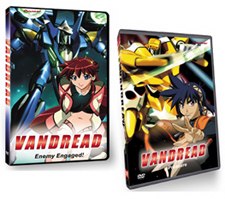
The personal relationships between characters make Vandread special. © Takeshi Mori * Gonzo/Media Factory * G.D.H.
Around 1995, Japanese animation (anime) began pouring into North America, Europe and across the globe in video form. Most of these titles were unknown outside of Japan and never covered by animation journals. Whether a title is highly popular or very obscure, a high-quality theatrical feature or a cheap and unimaginative direct-to-video release, they all look the same on a store shelf. Therefore, Animation World Magazine will regularly review several new releases (including re-releases not previously covered) that have merit and about which our readers should know.
Vandread. V.1, Enemy Engaged! V.2, Nirvana. V.3, Great Expectations. V.4, Pressure.
TV series (13 episodes), 2000. Director: Takeshi Mori. V.1, 4 episodes/100 minutes; V.2-4, 3 episodes/75 minutes. Price & format: DVD bilingual $29.98. Distributor: Pioneer Entertainment.
Vandread: The Second Stage. V.1, Survival. V.2, Sacrifice. V.3, Revelations. V.4, Final Assault.
TV series (13 episodes), 2001-2002. Director: Takeshi Mori. V.1, 4 episodes/100 minutes; V.2-4, 3 episodes/75 minutes. Price & format: DVD bilingual $29.98. Distributor: Pioneer Entertainment.
Vandread proves that a 13-episode TV series which ends with a cliffhanger can be popular enough to return for a sequel. The Vandread interstellar adventure serial was broadcast on the WOWOW satellite channel from October 3 through December 19, 2000, ending with our spacelost heroes racing back across the galaxy to their home planets to warn of impending doom. Vandread: The Second Stage, the final 13 episodes, finished the story from October 5, 2001 through January 18, 2002.
Vandread follows the basic sci-fi comedy/adventure formula of 1996's mega-popular Martian Successor Nadesico series. Put a mid-adolescent male protagonist who is nervous around girls (in this case, Hibiki Tokai is from an all-male planet and does not even know what women are -- they are ferocious monsters in his world's folklore) in a spaceship whose crew is mostly giggling teen girls, and watch the fun -- until the unknown alien menace that they set out to battle proves to be so grim and overpoweringly deadly that all humor disappears and they must learn to work together as true partners to defeat it.
Hibiki, a lowly apprentice mechanic, is from the all-male (cloned) planet Tarak, which has been fighting a space war for generations against the all-female (artificial insemination) planet Mejale. Both planets were settled generations earlier in a wave of semi-forgotten space colonization from legendary Earth. Hibiki is aboard Tarak's new space navy dreadnaught, powered by dimly-understood ancient technology, when it is attacked by a pirate ship from Mejale. The confused action leaves Hibiki and two other teen male cadets (Duero McFile, a pretty-boy medic, and Bart Carcus, a boastful navigator), plus all the female pirates, aboard a bewildering merger of their spaceships, which has warped to the other side of the galaxy. The traditional enemies are forced to work together as they return home. There is considerable early-adolescent mildly risqué humor (rated "13+") as the boys and girls embarrassedly explore gender differences ("What are those things that men have between their legs?"), and Duero is fascinated by the medical process of natural birth. As they pass through the galaxy, they find many other planets that were colonized long ago, all of which have some serious social disorder that is slowly leading to inevitable human extinction -- which they realize is also affecting their own worlds. Worse, there is an awesomely powerful alien force expanding in their direction, which is literally harvesting the human worlds for their organic components. Can the Nirvana return to Tarak and Mejale in time to persuade their peoples to put aside their differences and organize a united defense?
What makes Vandread so popular is not so much the plot as the emotionally-varied cast and their developing personal relationships: Hibiki, Duero, Bart, and the many women; gruff-but-motherly pirate Captain Vivan; master mechanic Gascogne Rheingau who becomes a Big Sister to Hibiki; ace fighter Meia Gisborn who wants nothing to do with men; ditzy Dita Liebley who is fascinated by Hibiki as a Roswell-UFO type "Mr. Alien" and quickly develops a crush on him; and numerous others with such "sci-fi" names as Barnette Orangello, Jura Elden and Parfet Ballblair. And also the CGI effects. Vandread was produced by Studio Gonzo which burst into Japan's animation industry with its CGI-intensive Blue Submarine No. 6 in 1998. Vandread has even more CGI in its spectacular space clashes between the Nirvana's boys and girls in their Van and Dread giant robot battle armor and the mechanically ominous death-bots of the alien fleet.

The audience for Fancy Lala expects to see a realistic view of the entertainment industry. © Studio Pierrot Bandai Visual TV Osaka. Under license by Bandai Entertainment Inc. All rights reserved.
Fancy Lala. V.1, A Star is Born! V.2, Sharing the Spotlight. V.3, Taking Center Stage. V.4, Double Duty. V.5, Rise to Stardom. V.6, A Passing Dream.
TV series (26 episodes), 1998. Director: Takahiro Omori. V.1-2, 5 episodes/125 minutes; V.3-6, 4 episodes/100 minutes. Price & format: DVD bilingual $24.98. Distributor: Bandai Entertainment.
The "magical little girl" TV anime genre goes back to the 1960s, but Studio Pierrot made so many of the most popular of them in the '80s that "a typical Studio Pierrot magical girl show" has become a catchphrase. Magical Stage Fancy Lala was a 26-episode updated reprise for the late '90s (April 5 to September 27, 1998). As director Omori and character designer Akemi Takada explain on one of the DVD extras, today's little girls are more sophisticated than their earlier counterparts. Where a 1980s young audience would accept a third grade protagonist who can magically transform into a 15 to 18 year old immensely popular model or singing star, today's kids know that making it in the entertainment industry means hard work. Earlier magical girls appeared in one gaudy stage dress for all occasions including street wear, while today's magical girl is expected to have a varied and more realistic wardrobe.
Third grader Miho Shinohara is introduced to two sprites who look like cute plush dinosaur dolls, who give her a magical pen and sketchbook. When she draws clothing for a teen version of herself and says a mystic chant, she turns into 15-year-old Fancy Lala. She is immediately recruited by a struggling new talent agency, Lyrical Productions, to promote as their new star ranging from an advertising model to TV actress to pop singer. But this means less glory than long days of rehearsals, jealousy of professional rivals, irresponsible or malicious fan-magazine gossip, and humorously creepy stalker-fans. Lala/Miho becomes exhausted accomplishing this plus transforming back to keep up her regular life as an elementary school student. Miho's own mother is a TV producer, and meeting her as Lala on an assignment gives Miho added insight into the emotional pressures on a mother who has a professional career.
The viewpoint is always that of a young girl, whether an episode is about Miho in Lala's body getting a backstage observation of the real entertainment industry, or about Miho as herself with her third grade best friends cheering the elementary school's baseball team or trying to discover whether two of their school's teachers are dating each other. There is a three-episode sequence in which Miho is allowed to travel alone for the first time, on a vacation to see her grandparents in a farming village, and has the temporary fright of getting on the wrong train. This sequence is a pleasant travelogue introducing modern Japanese urban children to the rural countryside. In the "Miho" epsiodes such as these, Lala and the dinosaur sprites make only a token appearance. A significant difference between Fancy Lala and the earlier magical girl TV series is that the earlier ones emphasized the glitter and glamour of fantastic adventures, while in Fancy Lala the magic is a prop in allegorical domestic or vocational scenarios to show 10 year old girls what to expect or what they may realistically hope for as they enter adolescence.

A new kind of vampire terrorizes Great Britain in Hellsing. © Kouta Hirano * Shonen Gahosha Co., Ltd. / Hellsing K.G.
Hellsing. V.1, Impure Souls. V.2, Blood Brothers. V.3, Search and Destroy. V.4, Eternal Damnation.
TV series (13 episodes), 2001-2002. Director: Yasunori Urata. V.1-3, 3 episodes/75 minutes, V.4, 4 episodes/100 minutes. Price & format: DVD bilingual $29.98. Distributor: Pioneer Entertainment.
Hellsing (adapted from the manga by Kouta Hirano) was an adult after-midnight TV series (13 episodes, October 10, 2001 to January 16, 2002) analogous to MTV's Spawn in the U.S. It is a vampire horror thriller clearly designed for shock value (the DVD rating is 16+), with lots of implied off-camera gore and sadism. Some episodes involve snuff videos, homosexuality, prostitution and child molestation. However, it is well-directed and suspenseful, emphasizing intelligent, mature dialogue. The animation (by Studio Gonzo) is unexceptional, but the character designs (by Toshiharu Murata) are popular enough that Hellsing-character costumes are currently "in" at the anime fan conventions.
Present-day Britain is unexpectedly beset by a horrific wave of gruesome mass killings. They are actually the work of vampires, which is kept secret from the public. The first episode establishes that Britain has had a top-secret anti-vampire force for over a century, the Royal Order of Religious Knights, whispered of in the highest government circles as the Hellsing Organization because its leadership is hereditary in the Hellsing family. This is at least partly because the Hellsings personally command the service of a powerful vampire, Arucard, who kills other vampires at their orders. Arucard is a sardonic individual whose attitude and dialogue make it clear that he is serving the Hellsings for motives of his own, not because he is under any compulsion. A vampire slaughters an entire English village, as well as an elite police force sent to investigate with the exception of young rookie policewoman Seras Victoria. Arucard is forced to kill Victoria to get the vampire; to save her life, he turns her into a vampire but leaves her with free will. (Normal vampire victims become mindless cannibalistic ghouls; one of the Hellsing Organization's duties is to completely destroy the bodies of all vampire victims.) The H.O., with considerable misgivings, accepts Victoria under Arucard's sponsorship as a new recruit to its private paramilitary army. Much of the action in subsequent episodes, plus what is revealed about the situation, is seen through Victoria's traumatized point of view as she tries to adjust to the secret human-vampire war within England while coping with her own new vampiric abilities and needs.
This new wave of killings is caused not by traditional "natural" vampires but by decadent thrill-seekers who have voluntarily undergone an artificial transformation, lured by promises of eternal life and pleasure. As the plot thickens, it appears that the criminal mastermind creating what Arucard calls the "trash" vampires has two goals: to undermine British society, and to expose the Hellsing Organization to the public and frame it as the culprit. An additional enemy is the Vatican's intolerant rival anti-vampire "secret bureau, Section Thirteen", a.k.a. The Iscariot Organization, which despises Hellsing for working with Arucard and Victoria ("There are no 'good' vampires"). Rome's top vampire slayer, Father Alexander Andersong, makes disposing of Arucard his top priority.
Hellsing raises many intriguing questions, none of which are answered as the series ends with a frustrating "cannot yet be revealed to the public" cliffhanger. Despite this, the story is unique and gripping enough to be enjoyed by all fans of serious vampire/horror movies.

Gigantor is of interest to anime fans, TV history buffs and those into nostalgia. © Rhino Home Video. 2002. All rights reserved.
Gigantor. Part 1, episodes 1-26. Part 2, episodes 27-52.
TV series (52 episodes), 1965-1966. Directors: Yonehiko Watanabe & Tadao Wakabayashi (Japan); Fred Ladd (U.S.). V.1-2, 4 discs/26 episodes/650 minutes. Price & format: DVD English $59.95. Distributor: Rhino Home Video.
Gigantor is laughably old-fashioned by modern animation standards in America or Japan, but it is definitely of historic interest. It was the second significant TV animated series in Japan (as Tetsujin 28-go or Iron Man No. 28), and the first production of Japan's second TV animation studio, TCJ (Television Corporation of Japan). It was an adaptation of one of Japan's most popular juvenile sci-fi manga of the 1950s and '60s, by Mitsuteru Yokoyama. It ran for 83 episodes in Japan (October 20, 1963 through May 27, 1965), but only the last 52 were seen in America; and those were so revised for American broadcasting demands (reduction of violence; removal of cliffhanger endings to convert serials into stand-alone adventures) that many were subsequently shown in Japan as new episodes. The third Japanese TV cartoon series to be syndicated on American TV as just another kid's cartoon (not recognized as "anime" at the time), Gigantor debuted on January 5, 1966 and was popular until around the mid-'70s when all black-&-white TV cartoons were phased out.
The story as revised by American producer-director Fred Ladd is set in the "future year 2000." Jimmy Sparks is a barely-adolescent boy detective who has been entrusted by inventor Bob Brilliant with the controls of Gigantor, a giant robot, to help him fight crime as the assistant of Inspector Ignatz Blooper of Interpol. Inspector Blooper and Jimmy (with Gigantor) travel all over the world (often accompanied by Prof. Brilliant and sometimes by secret agent Dick Strong) to combat would-be world dictators, mad scientists and international crime gangs. Many adventures involve plot variants of the villains trying to steal Gigantor's control box to use for themselves, or trying to steal its blueprints so they could build their own Gigantor (or an army of them) for criminal purposes.
Many producers of the Americanized anime TV series of the 1960s threw out their production elements as their licenses expired. But Fred Ladd bought the rights to Gigantor permanently and kept all the production materials. Rhino's DVD release is from the restored original film negatives. It is aimed equally for the nostalgia market for early American children's TV, and for the anime fan and serious TV historian. The DVD extras include half-hour video interviews with Fred Ladd and "anime historian, Fred Patten from Animation World Magazine, " and a profile of Gigantor creator Mitsuteru Yokoyama. So there is much information about the Japanese origins of Gigantor and how Japanese TV cartoons came to be imported into America in the 1960s, and on the considerable differences between the Japanese and American versions of Gigantor, even if only the Americanized version is presented here.

Dragon Half has many American fans. © 1993 Ryuusuke Mita/Kadokawa Shoten Publishing Co., Ltd./Victor Entertainment, Inc. Licensed by Victor Entertainment, Inc. All rights reserved.
Dragon Half.
OAV series (2 episodes), 1993. Director: Shinya Sadamitsu. 50 minutes. Price & format: DVD bilingual $24.98. Distributor: A.D.V. Films.
"THE FUNNIEST ANIME EVER MADE -- Just about everyone, actually"
That is the DVD's back-cover blurb. In this case the blurb is close to the truth, at least in regard to American tastes. Dragon Half was originally released in America on video in August 1995. Most fans have watched it multiple times. I have seen fans at an anime convention break off conversations to go enjoy it again in the video room. And this is despite the fact that the production was never completed! Dragon Half was planned as a four-episode OAV series, but the first two 25-minute videos (released in Japan on March 26 and May 25, 1993) bombed and the final two were never made. Japanese and American tastes certainly differ in this case; the American fans cannot get enough of it.
This zany parody of fantasy role-playing stereotypes (based on a comedy manga serial by Ryuusuke Mita in the Japanese gaming Monthly Dragon Magazine) features Mink, a teenybopper human-dragon halfbreed (her dragon-slaying father eloped with the dragon he was supposed to kill), who develops a crush on Dick Saucer, the handsome blond pop-singer/dragon-slayer media idol. Mink is a cute girl whose dragon wings and tail and flame breath give her secret away. She is also plagued by the minions of the stupid king who keep interrupting her attempts to get close to Saucer to get his autograph and maybe a kiss: Rosario, an inept sorcerer ("Here, little girl, have an apple!" "Do you think I'm stupid? It's probably poisoned!" "Curses; my Snow White strategy has failed!"); Princess Vina, Mink's rival as President of the Dick Saucer Fan Club (she's also an evil sorceress); and Damaramu, a hulking all-brawn, "very compact" brained warrior. Learning that Saucer will give a big concert in ten days in the capital, Mink enters "The Brutal, Killer Martial Arts Tournament" hoping to win enough money to travel there and buy a concert ticket. Mink wins, but the warriors whom she defeats swear revenge and join her enemies. This is where the production ends. The music over the closing credits is a has-to-be-heard-to-be-believed bouncy bubblegum-pop arrangement (by Kohei Tanaka) with nonsense lyrics of the main musical motifs from several of Beethoven's Symphonies. Both the dialogue and the visual gags are snappy and funny. The majority opinion of American fans is that Dragon Half is a must-see even if the story is incomplete. I concur.
Dragon Half is also notable as an early production of Production I.G, known today for its raw imagination and experimental advances in both plotting and animation technology with such productions as Ghost in the Shell, Jin-Roh, Blood: The Last Vampire and FLCL.
Fred Patten has written on anime for fan and professional magazines since the late 1970s. He wrote the liner notes for Rhino Entertainment's The Best of Anime music CD (1998), and was a contributor to The World Encyclopedia of Cartoons, 2nd Edition, ed. by Maurice Horn (1999) and Animation in Asia and the Pacific, ed. by John A. Lent (2001).