World's first side-by-side ARRI ALEXA and RED MysteriumX camera test
For our current film, Roland Emmerich's "Anonymous", a drama about Shakespeare (yes, you read this right. No destruction. No end of the world.), we just finished up three days of camera testing.
Not just any camera test, but the world's first side-by-side test of the new RED MysteriumX (which is the REDONE camera, with a brand new chip and a new software codec to go with it) and the ARRI ALEXA (which is a brand new camera, very different and way more compact than the current ARRI D-21). We were privileged to be provided by ARRI with a prototype of the camera, and by RED with one of the first delivery models of the Mysterium X.
Before I dive into the specifics, ladies and gentlemen, let me announce right here, on this blog, that
2010 IS THE YEAR THAT CELLULOID DIED.
Yes, all you physical-analog-film-lovers, I said it. Touch the smooth plasticky emulsion one last time and relish the memory. Both these two digital cameras simply blow film out of the water. Period.

Now, to be honest, I wish the names of these two would be more celebratory for such an event (my guess is the "mysteriumX" was named by the creators of "Godzilla vs Mothra", and the "ALEXA" for somebody's girlfriend?). But that's beside the point.
The point is, both these cameras can do what you could not accomplish with any film stock, not in your wildest dreams. Here's how they work:
The RED and the ALEXA, while accomplishing approximately the same amazing feat of creating clean, VERY low noise, pictures in candlelight conditions, work in slightly different ways.
The RED still has a chip that's basically rated at 320 ASA (or more like 200 ASA practically, as many DPs told me), but you can underexpose it in extreme ways with only very little addition of noise.
For instance, we shot two stops under (equivalent of 800ASA) without any significant addition of noise.
3 stops under (1600 ASA!) is still absolutely feasible, with more noticeable noise, of course. Even 4-5 stops under (3200/6400 ASA) is not out of the question, if you use a good noise removal tool (we tested with ARRI's Relativity software and The Foundry's Furnace for Nuke) and are OK with loss of detail ion the blacks. But it's possible.
The ALEXA has a chip rated at 800ASA. But even with that starting point, it's possible to underexpose significantly with only little loss. We actually went so far to test 4 stops under, the equivalent of 12,800 ASA! And, while of course extreme, I would not be beyond saying it's usable for a certain type of shots (documentary style). Basically, I was absolutely blown away that we even saw ANYTHING on the footage.
We recorded the RED footage on CF cards, at a data rate of 42MB/sec (the highest data rate RED offers). The ARRI footage was recorded on CODEX portable machines. The CODEX records on little removable harddisc RAIDs with a capacity of up to 5 hours each. The RED records to their own RED RAW format, at 4480x1920 resolution, which is currently only supported via the redcineX (in beta) software, but is already also being implemented by other software packages, such as Digital Fusion and Baselight.While ARRI would not say what on-board recording solution they will show at NAB, in our test the ARRI output a 4:4:4 dual-HD-SDI stream at 1920x1080 resolution, which can be recorded by any HD recorder. The CODEX that we used, creates internally their own implementation of a JPG2000 file. During output via Ethernet or other means, it creates 10bit DPX files from the JPG2000s. In terms of file size, the Redraw 42 and JPG2000 are fairly similar. JPG2000 is a 1:4 compression, so about 2MB/frame. The Redraw comes to about 1.75MB/frame (at 24fps).
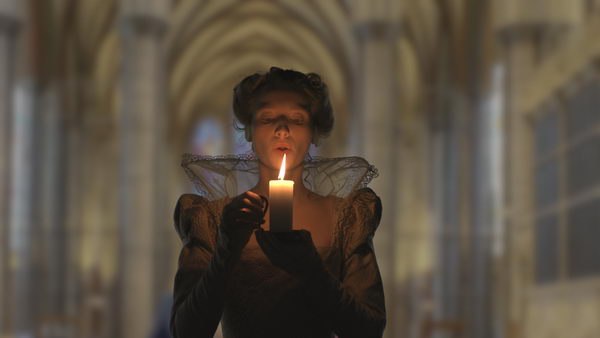
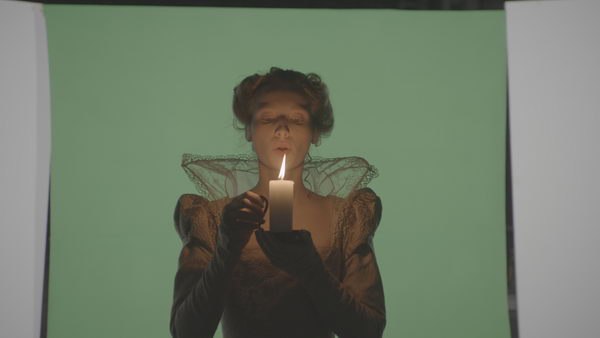
The DP for "Anonymous" is Anna Foerster. Anna started with Roland as DP for the miniature shoot of "Independence Day", and advanced to second unit director on many of his films, and is now also a director (she directed episodes of "Criminal Minds"). She prepared several lighting setups, one being a Vermeer-painting-like interior scene (pictured) and the other a greenscreen test setup, obviously of great importance to us. (attached are before-and-after pics of the greenscreen test).
At this point in time, I don't want to publish exact comparison details, because the ARRI ALEXA is a prototype camera. It will be shown at NAB and delivered in June this year. So not all the specs are finished yet. But I have to say, no matter what the final details will be - this is a damn fine camera, and the range of the chip is simply incredible. The RED Mysterium X is already shipping, and all I can say is - go out and test it for yourself, you'll be amazed.
So, it turns out that both cameras, in terms of performance of the chip, are very similar. And I'm not saying this for some bullshit political correctness reason, but because it's the truth. Since the ARRI is a prototype, and the RED software is still in beta, I don't want to go into the finer details that we found, because they can change at any point in time.
I've attached some pictures from the test shoot, a daylight/candlelight scene and a greenscreen shot (the raw, uncorrected footage and the keyed result). Do to the limitations of this blog format, these are just downrez'd JPGs, but even here you can see what I'm talking about. I will prepare links to high-rez files soon. The greenscreen footage of both cameras was very clean and - especially for 800 ASA, had very low grain/noise. While you still need post noise reduction to get a perfect key in hair details or the semi-transparent collar of the lady in the picture, we only had to apply very little NR, and it didn't create any visible softness in the picture.
"Tracking Marc" will return next week: Shooting HDRIs for CG lighting and textures.


I feel stasfiied after reading that one.
so both the cameras can shoot well even when they are highly under exposed. You spoke of how the output format for both the cameras work and in one sentence explained as to how good both the cameras work. Wish you could have given us more information and comparisions between both the machines.
Hey I love shooting film - shot 1000 rolls on 7245 - love it ... but recently did a camera test - Arri D21 with 444 SR deck record - wow ...
Maybe its not for a feature... but wow - Arri have done there homework = no tricks, bells or whistles - just an amazing image...
In the end I really dont care the format - Black Swan could have been shot on D21 and 5D and I wonder if the audience would have had any different response.
Film colour space and grade and latitude is amazing but just a thought...
Best Jason
I'm reading here a LOT of BS... holy cow.
It's incredible how many wannabe lamers are commenting here who have absolutely NO experience in the field. You can tell it from the affirmations COMPARED to the scientific and artistic truth.
1. EVERYTHING BOILS DOWN TO SNR !
Film has random grain ? No kiddin. No matter how good the shot, the transfer the lens, FILM is in terms of the information recorded (SNR!!!) waaaaay back.
And no, the dynamic of film is not unique. It is 100% (not 99%!) copied by these cams in cinema profiles.
2. Bayer is NOT a problem. Film has full color coverage, yes, but the Bayer sensors are, WAY better at sensivity, to at least 4-5 stops. So here SNR again wins.
3. I see how many commenters here who defend film, NEVER worked with film, cause they dont have ANY clue what it is like and dont know how many TDs are already crazy about the whole film procedure and the bad things about film (there are A LOT)
4. Film has NOT a better look now (compared to highend cams). Only who has never worked with a Kodak or seen it only from documentary can affirm this. Film is easy to replicate cause it has only 3 diferrences: grain multiplexy, particle blending, contrast dynamics and light diffusion. EVERYTHING can be digitally reproduced perfectly at at least 3 fstops above film!!!!
Please for God's sake, document yourselves, read wikipedia at least before posting, or better get books with cinematography and digital cinema details and techniques.
And yes, i worked with film, 16, 35 so WTH ? It over guys. Technically, AND artistical.
At the guys who want to remain true to film. Do it. It's your right. But keep it sincere. It's over technically.
Have a nice day.
Flavius
I own an Aaton XTR Prod, and an Arri 35-3, and a Panasonic 3700. The Panasonic pays the bill, but for the highest end work, nothing touches film for me. It has a nuance and ineffible quality that video is always chasing despite how far the digital formats have come. I think ultimately, part of films magic lies in the fact that on the molecular level there is still a degree of randomness as opposed to digital in which pixels are aligned in a mechanically perfect linear pattern on a CMOS sensor or CCD. Random specular highlights and dynamic flares etc., always look more aesthetically pleasing to my eye. I have been shooting for thirty years and will end my career shooting film as my first choice..
I disagree.
The video enthusiasts(and I've worked with video since the days
of Plumibcon and Saticon tubes) have been singing the funeral
dirge of film's death since the 70s.
Film ain't going anywhere soon. A friend who works in the
front offices of Panavision Woodland Hills told me recently
that 35mm 4 perf acquisition is still the most cost-efficient
method of capture.
So, when one factors in the daily rental costs for an Alexa,
or a Genesis (both incredible cameras), it is much, much cheaper
to rent film equipment. I shoot it, send it to the lab, get
the telecine done and I finish on Final Cut Pro.
I am in awe of what digital can do to enhance the look of
film. The DI has given Super16 new life.
I spent most of my adult life working in video, because I
couldn't afford film. At this point, I would agree with you
that the dynamic range afforded by awesome cameras such as
the Genesis, Sony F35 and Red's new Mysterium-X sensor will
cause film to become rarer over the next 2 to 3 years.
It is basically an artistic choice. You say you prefer the
look of digital to film. That's fantastic! Isn't it great
to have your choice of tools?
I prefer film, and that also is my artistic preference.
I firmly believe that both technologies (film and video)
offer a range of choices that should make anyone happy.
But don't assume that cinematographers that shoot film
will be "dinosuars" as if they are clueless to video
production. Just the opposite - the reason the bar is
so much higher now is that the digital camera manufacturers
are listening closely to these film DPs, and tweaking the
dynamic range, resolution and ergonomics of their cameras
to provide the quality that film has owned for over 100
years.
Respectfully,
-Jerry
I think that considering the nature of work flow these days, film will be increasingly removed from the mainstream. Its the same thing Ive seen being a DJ. Sure vinyl is great and it died a glorious death but it is dead. Now DJs spin on vinyl time code just so they can pretend its vinyl.
The reason is that even thought its analog when you start looking at aproximating with flac or wave you get so close it doesnt matter and the flac and wave allow open up new vistas that vinyl did not. Such as working in a digital enviornment like ableton. Same thing with film. There is so much of the current method of production that is highly digital that it will just go that route.
I personally prefer the look of digital to video. I think the purists are on the way out. The masses CANNOT distinguish the difference and the elite look of film will be a treat for those who can appreciate it, like wine.
However movies need to be maintained by mass "consumption" or in other words they need to be marketed to the consumer.
All the big companies are switching to digital, Avatar was shot on f35's. Film is done except for art students and for those who are learning it, be prepared to be dinosaurs in an industry that is increasingly being dominated by digital.
Personally I am in heaven. It was the "digitlization" of the the cinematographic workflow that allowed me to get into producing. Viva la Digital and these new cameras are the crowns of the new generation of production.
RedRaw is JPEG2000. Up until recently you could use a JPEG2000 decoder to play R3D files
Ha ha. Thats a perfect echo of Digital Vs Film in photography a few years ago. Film will die. A slow death but it will die.
I'm graduating film school and I've shot only one project on film. Everything has been digital. I've forced myself though to not overshoot. To be precise and that's something I force myself more and more with each project.
I read in the thread that my generation will kill film because they were educated with digital and that will be the tool of choice because that is what they've learned with. I disagree. In film school all the kids that can afford to shoot film always have a halo on their heads. Kids who cannot afford--who are the great majority-- envy them. So I guarantee you that film students coming out from college whenever they are in position where they can afford film I guarantee you they will. Film will never die.
End of discussion.
Post new comment