While the weather might be cold, wet and rainy, Vancouver has turned into a hotbed of animation activity. Schools, festivals and a wide range of companies have all taken root on Canadas west coast. Leslie Bishko reports.
Written histories inform us that the animated film has existed for roughly one hundred years; however, nearly one-third of animation's history is represented by rubbery, pie-eyed figures cavorting in silence. In lieu of voices, animated creations spoke through the lively tinkle of piano keys, bellowed their anger via the tuba's basso profundo, or danced to the trill of the piccolo. Their movements equaled those of the violin's measured bow, and the accidents that befell them resounded on the snare drum while the stars that floated above their heads drifted to the wavering tones of a dreamy harp. If these blandishments did not get the point across, animators could use an array of "surprise" lines, floating question marks, and tiny daggers traveling on pointed lines. These expressive devices were apparently contained within each and every painted little skull until cartoon evolution took its course and sent them the way of the whale's phalanges.
The animated film with sound effects and voices has existed for only seventy years. During that time, hundreds of men, women and children have given voices to the ink, paint and digital creations that we lovingly call cartoons. Voice artistry has evolved along with the animated film. The first voice artists were simply people who worked in the studio; whoever was available did voices. Later talents migrated over from vaudeville, radio and then television. Finally voice artists became specialists who geared their training toward the goal of becoming someone -- or something -- else's voice. When voice and character merge perfectly, the effect can be astounding; an unworldly synchronization kicks into place and the character can no longer be visualized without hearing the tones of the actor. To see the character and hear another voice would seem almost a violation of nature. If you doubt this, picture and then try to hear Droopy. Then Fred Flintstone. Now do so again while reversing their voices.
This, then, is the ability of the greatest voice artists: They do not merely complement an animated character, they complete that character and give it a life as real as our own. Over the past seventy years animation has been enriched many times over by these gifted folk, and this is a decade by decade review of the very best. As always, these choices represent my personal opinion and may prove controversial; so much the better. There are many exceptional names that will not receive mention (at least this time) due to space limitations, but all voice artists have my admiration; making it as a specialist in the performing arts is no easy endeavor.
The 1930s
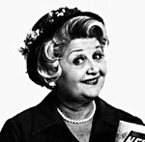
Boop-oop-a-doop! Mae Questel was not the original voice of Betty Boop, but when she took over the job in 1931 Questel helped propel Fleischer's pouty flapper to international stardom. Questel shone again in 1933 as Popeye's object d'amour Olive Oyl. Questel turned Olive, a supporting character, into a vital component of the Popeye cartoons. Mae Questel was not the only strong voice on the Popeye series; the sailor himself was indelibly voiced by Jack Mercer, an in-betweener at the Fleischer studio who landed the job after two other "voice artists" were fired. Mercer's versatility was impressive; he was able to soften his voice over time without losing any of Popeye's comic tones, and one of the joys of watching old Popeye cartoons is catching Mercer's ad-libs and asides. Mercer and Questal would hold these jobs virtually for life. After Jackson Beck replaced Gus Wickie as the voice of Bluto, one of the first great voice ensembles was complete.
At Disney, two characters in need of distinctive voices found the best possible providers. It would be difficult to imagine Goofy without the rube-in-the-backwoods inflections of Pinto Colvig. The original master of the "duh...shucks!" school, Colvig (beginning in 1931) made Goofy endearing, naive, and quite lively despite the character's slow demeanor. Meanwhile, a newly created cartoon duck named Donald met up with a talented human named Clarence Nash. Nash's manic squawks left audiences guessing at what Donald said in his rages -- when they weren't rolling with laughter. And they would laugh for nearly fifty years. Finally, when Warners welcomed newcomer Mel Blanc to their studio, little did they know he would become the greatest voice artist of his time. Blanc's first major contribution was to lend his voice to a humble, stuttering pig named Porky; it would by no means be his last.
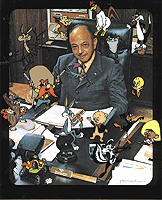
When Walt Disney's Pinocchio opened in 1940 audiences were treated to the talents of one Cliff Edwards. The former "Ukulele Ike" did not voice many films, but his turn as the happy-go-lucky everycricket known as Jiminy was one of the finest ever in an animated film. From his snappy tones to his sweet tenor, Edwards proved that an inconsistent conscience can still be a thorough delight to the ear. As the Warners stable added new characters Mel Blanc mixed up a tangy combo of accents (Brooklyn and Bronx) and turned Bugs Bunny into a sassy sensation starting in 1940. Bugs was only one of many voices that Blanc developed at Warners during this decade, all of them outstanding. Blanc and Bugs were fortunate enough to be teamed with Arthur Q. Bryan, who was vewwy instrumental in bringing Elmer Fudd to stardom as Bugs chief antagonist.
At MGM, Bill Thompson modified a voice he had used on a popular radio program and lent it to Tex Avery's Droopy Dog in 1943. Thompson's fuss-budget drawl provided a hilarious contrast to Avery's frenetic action and is one of the quintessential pieces of cartoon voice work. Paul Terry never had many hits but one exception was Heckle and Jeckle. The boisterous magpies were doubly fortunate that Dayton Allen was on hand; by giving one magpie a streetwise "Noo Yawk" brogue and the other a fruity British dialect, Allen helped give Terry his strongest cartoons. Walter Lantz always thought that Woody Woodpecker's voice could stand improvement; his wife, Grace Stafford Lantz won the job following a blind audition! Grace managed to give Woody playfulness and stridency in equal amounts, no easy task. Finally, no discussion of the decade can be complete without mentioning Jim Backus. UPA managed to produce only two cartoon stars...and one didn't speak. The other, Mr. Magoo, became a major star on the strength of Backus' exuberant vocal work. No other cartoon star in history was as contrary, contentious, or loveable, as Magoo, and Jim Backus saw to it that this myopic misanthrope charmed us for decades, beginning in 1949.
The 1950s
Mel Blanc continued to hit his stride, redefining some characters while developing new ones. Blanc added a harder edge to Daffy Duck that suited the character's newly found egotism, and balanced this by giving said duck a more comical, sibilant lisp. Blanc's funniest creation of the Fifties was a Gallic accent à merveille, and it issued from the lips of one Pepe Le Pew. 1957 could have been the saddest year in the lives of Bill Hanna and Joe Barbera but the two directors turned disaster into triumph by establishing their own studio after MGM handed them a permanent layoff notice. Hanna-Barbera was bolstered by two veteran voice artists, Daws Butler and Don Messick. Butler took the voice of a laconic Southern wolf he once did for Tex Avery and recycled it to fit a friendly blue hound named Huckleberry. He also turned a peppy imitation of a popular TV actor into Yogi Bear, and Hanna-Barbera's first great stars were born.Also, a favorite among many is Mr. Jinks, a sly, orange cat who "hates meeces to pieces!" Messick voiced Yogi's sidekick Boo Boo, as well as a host of other new stars and supporting players.

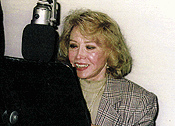
At the same time, a small independent studio was preparing to unleash one of the best cartoon series -- and voice ensembles -- in the history of modern animation. Rocky and His Friends (1959) was a scaled-down version of the series that producers Jay Ward and Bill Scott originally had in mind, but what matter? With June Foray, Paul Frees and the aforementioned Bill Scott handling the voice work, success was guaranteed. Foray was already a veteran when she was hired. Her naive, boyish portrayal of Rocket J. Squirrel played perfectly against Scott's cheerfully twee Bullwinkle J. Moose. Frees' borscht-red Russian accent enlivened villain Boris Badenov, and Foray provided a deliciously distaff version of the same accent for his partner-in-crime Natasha Fatale. If that was all the trio had done, it would have been monumental, however, they went on to voice every segment of the show including Dudley Do-Right, Fractured Fairy Tales and Peabody's Improbable History. As Bullwinkle said, "Don't know my own strength!
The 1960s Some of the best vocal performances of this decade came from the mouths of Neanderthals. Alan Reed, Mel Blanc, Jean VanderPyl and Bea Benaderet were the voices behind The Flintstones (1960), arguably the best series ever produced under the aegis of Hanna-Barbera. No primordial grunting here -- Reed's Fred Flintstone could go from bluster to contrition in the same breath, and Blanc's Barney Rubble had the friendliest voice ever to waft over a neighbor's fence. VanderPyl, as Wilma Flintstone, responded to Reed's acting with an impressive range of her own, and Benaderet's performance as giggly Betty Rubble was, on second listening, surprisingly nuanced. As a cast, the four performers had flawless chemistry.
The big screen brought us Betty Lou Gerson's unforgettable performance as Cruella DeVil in Disney's 101 Dalmatians (1961). Her uncanny ability to balance menace and over-the-top comedy stole the movie. Two outstanding jobs were turned in by performers with virtually no experience in cartoon voice work. 1964 saw Burl Ives' outstanding performance as Sam the Snowman in Rankin-Bass' production of Rudolph the Red-Nosed Reindeer. The venerable performer would have been charming enough even without singing musical numbers, but fortunately for us, he did that, too. Boris Karloff's narration of the 1966 holiday special How the Grinch Stole Christmas revealed the great horror actor to be a golden-voiced storyteller. Sterling Holloway lent his warm story-time tenor to Winnie-the-Pooh for the first time in 1966, giving the silly old bear a truly memorable voice. Finally, Don Messick dug up a garbled comic voice he created for Astro the Dog in Hanna-Barbera's The Jetsons and put it into a goofy Great Dane named Scooby-Doo; one might question the quality of the series, but "Rat rog ruz rate!

The 1970s & 80s
With Saturday morning settling into a rut, cable TV still in infancy and feature animation all but kaput, these decades still produced a few gems. Working at several studios, Frank Welker became the go-to-guy for any sort of animal voice needed. Whether the beast was real, imaginary or extraterrestrial, Welkers vocal trickery could fill the bill. Alan Young first provided Scrooge McDucks comic Scottish brogue in 1976; it remains one of cartoondoms funniest. Not to be overlooked was Don Adams supremely confident portrayal of DIC star Inspector Gadget. Garfield the Cat met up with Lorenzo Music for the first time in 1982 and today it is difficult to read the strip without hearing Musics mordant tones. Hows this for an ensemble: Don Messick, Lucille Bliss, Frank Welker, June Foray, Susan Blu, Charlie Adler and Alan Young? This all-star line-up, among others, contributed regular voice work to the 1981 series The Smurfs. What a show of talent! Hows this for an ensemble: Charlie Adler, Susan Blu, Frank Welker, Ellen Gerstel and Ron Palillo? This awesome cast worked on the 1987 series The Little Clowns of Happytown. What a waste of talent!

The 1990s
Series tended to come and go with amazing speed during the 1990s, and few lasted for very long. Voice artists became traveling free agents, stopping long enough to do memorable star turns for whoever was fortunate enough to hire them. Among the more memorable nomads were talents like Jim Cummings and Kath Soucie. Tress McNeilles coo-coo cooing as sweetly destructive Dot Warner was a high point of Steven Spielbergs Animaniacs. The same show brought us the spectacular team-up of Rob Paulsen and Maurice LaMarche as Pinky and the Brain. Charlie Adler put on the best one-man show of the decade for Cartoon Network when he joined David Feiss series Cow and Chicken. Adlers testy chicken, whiny cow and unctuous "Red Guy" comprise a clinic for aspiring voice artists.
Dan Castellanetta (Homer), Julie Kavner (Marge), Nancy Cartwright (Bart) and Yeardley Smith (Lisa) were well worth the money paid to keep them on The Simpsons, one of the last great voice ensembles to date. Robin Williams performance as the genie in Disneys Aladdin (1992) made one wish that the popular comic had chosen voice work as a full-time career. Nickelodeons Rugrats boasts a stellar vocal cast, among them Cheryl Chase as cousin Angelica, the gangs harridan-in-training. To end this review, a tribute: The late Mary Kay Bergman provided no less than nineteen different voices for Matt Stone and Trey Parkers South Park. Each voice was different in tone, timbre and inflection, a virtuoso performance that serves as Bergmans legacy to her art.
Voice artists today are expected to develop a wide range of characters without repeating themselves, making their craft a challenging one indeed. Theirs is a specialized field, but of late there has been a trend by producers of animated shows to hire increasing numbers of TV and movie celebrities to supply voices; the goal is to build a shows "appeal." This is not objectionable if done on occasion, but in the long run it is a questionable practice. As delightful as it may be to hear, say, Tom Cruises voice issue forth from a cartoon pig, the art of voice work belongs -- and should belong -- to the professionals. Voice artists devote their lives and careers to a single goal: The art of turning an imaginary character into a true actor. Whatever rewards may come in the form of fame and money are richly deserved, and perhaps we should add "turf" as well. The poet Robert Frost once observed, "All the funs in how you say a thing." His quote surely applies to these playful professionals we call voice artists. Our fun lies in simply listening to them.
Martin "Dr. Toon" Goodman is a longtime student and fan of animation. He lives in Anderson, Indiana.