
Peter Jackson and Joe Letteri describe the brave new virtual world they've created at Weta.

Watching The Hobbit: An Unexpected Journey is like returning to Middle-earth only with greater clarity. That's because Weta Digital has come a long way technologically in the decade since The Lord of the Rings and because of the controversial higher frame rate of 48 fps, which is like peering through a window. It heightens everything, even though it might be jarring at first and not aesthetically pleasing to everyone.
Yet director Peter Jackson defends the higher frame rate (which added to the time and cost of the rendering but which he personally covered) as integral to the 3-D experience. I find it a much more gentle experience because the 3-D at 24 frames is forcing your brain to process all this blur and strobing and I find that a lot more assaultive. Forty-eight to me is a lot smoother and more genuine. It's not just the movement but the clarity, which is why filmmakers chose to shoot in 65 mm or continue to shoot sequences in IMAX. Fortunately, the Red Epics were designed alongside The Hobbit so they gave us everything we needed."
But Jackson embraced the fact that this was not Lord of the Rings and wanted to be faithful to the way the story originated, which was written by Tolkien as a children's story, so the movie's looser and lighter in tone. "But at the same time, I wanted it to feel like we were the same filmmakers returning to Middle-earth again," he adds. "I didn't want to change my directing style. The advantage of doing the prequel the other way around was echoing Lord of the Rings. You see the genesis of threads, which I like because that'll make the unity all the more resonant when viewing the two trilogies sequentially on Blu-ray."
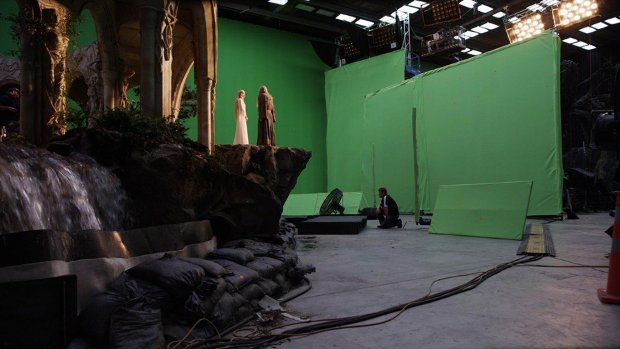
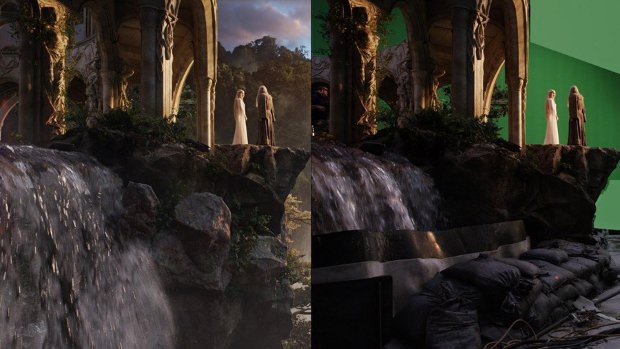

Meanwhile, Jackson says the gift of where visual effects are today is that anything you can imagine can be put on screen. Miniatures were used a lot on Lord of the Rings yet are missing totally from The Hobbit. "There's a romantic notion about building a model, lighting it and shooting it," Jackson notes. "But the beauty of the miniatures being digital is that I could literally keep developing the sequences and design camera shots once I saw the digital miniature finished. I can look and see exactly what it was, explore it with cameras and design the shots to fly past things and through things that would've been impossible to do with real miniatures. It's another piece of freedom."
According to four-time Oscar winner Joe Letteri, Weta's senior visual effects supervisor, "Things that we used to look at 10 years ago as being impossible we're almost in the next generation of really understanding what it is that we're trying to put up on the screen. Now forced perspective has to be dynamic, where the stereo camera is moving on a crane rig so we need to slave two motion control systems together: one to encode the motion and one to repeat the motion at a different scale. So you have two stages operating simultaneously, one with Ian McKellen on a green screen stage as Gandalf; and one with the dwarves on a dress stage for their scale; seeing the composite live in the cameras so that the camera operators and Peter now having a sense of what's going on and figuring out how to get the actors to work together.
"Logistically as well as technically, it gets quite complicated, especially for the actors, who have to keep all this in their heads and imagine the 3-D space in front of them where all these missing actors are going to be placed and making sure they don't walk through them," Letteri explains.
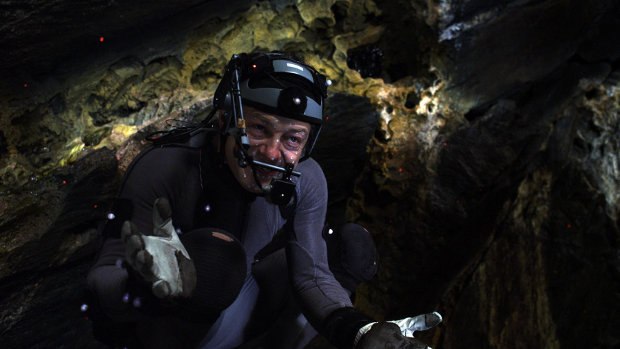
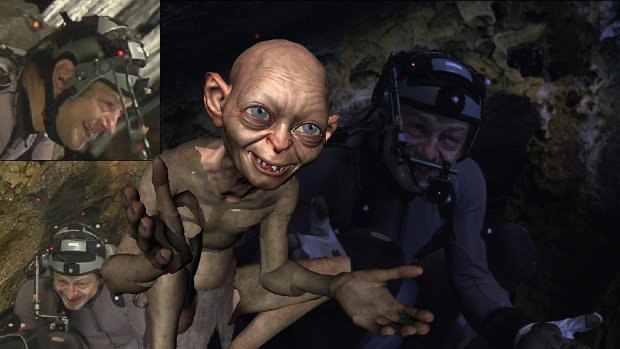
However, the highlight of The Hobbit occurs when Bilbo meets Gollum in a cave and accidentally gains possession of the precious ring. In fact, they shot the Gollum scene first for an entire week, which Jackson says was like being at the bottom of a mountain looking up into the clouds -- the beginning of a long journey. "It was a great way for Martin [Freeman] to find the character of Bilbo right at the outset in this Riddles in the Dark scene," Jackson explains. "And he had Andy Serkis coming at him with full energy. I felt sorry for Martin -- he had to stand his own against Andy. But I'll tell you what: it was good. And what I did to help Martin is that I staged the scene, which is around nine minutes long -- the longest scene I've ever done -- as one continuous performance. Fortunately, with the Red Epic cameras we had 20-minute capacity on the cards, so I was able to run the whole scene continuously from different angles, which allowed us to cut them together. I just let Andy and Martin go for it and Martin spent that whole week exploring. By the end of that scene, Martin knew who Bilbo was."
The scene is really a benchmark for Weta. Gollum alone is the sum of all the advances in animation and lighting they've achieved, while the Higher Frame Rate 3-D enhances the believability of the creature. He no longer looks like a CG creation but another actor in a stirring performance."

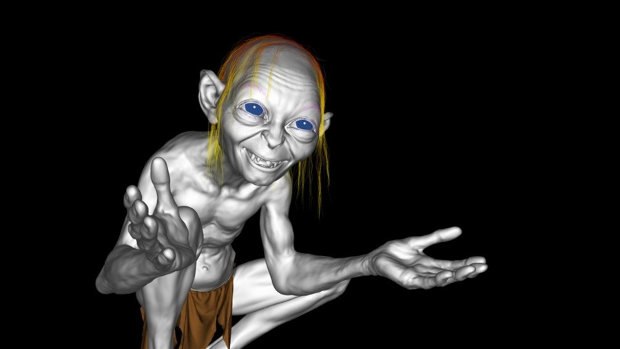
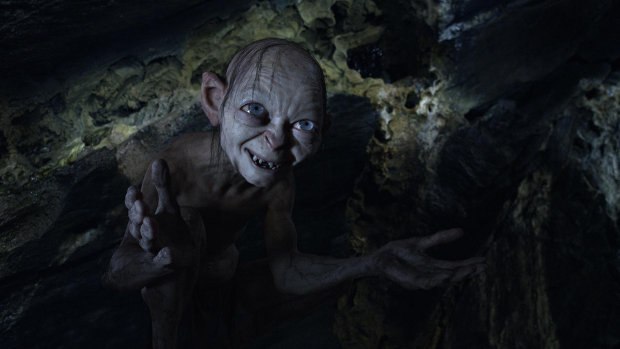
On the surface, Gollum looks the same, which was deliberate. "We played with the idea of de-aging him 60 years earlier with more teeth and hair, but none of it seemed to feel right, so we went back to the way he was," Letteri admits. "But now he's an integration of everything we've done since Lord of the Rings and making it work for this. After Avatar, we studied more about skin, muscles, eyes, and hair, and light transport and dynamics, and simulation; and on Rise of the Planet of the Apes, we figured out how to bring all of that to a live-action stage.
"And now on The Hobbit, it all comes home. You've got Andy and Martin in the very first scene that they shot with the performance capture integrated with the live-action set. It's all being recorded at a higher frame rate of 48 frames, we can recreate Gollum with now proper physiology for his muscles and bones and eyes and skin and teeth.
"We started off with Gollum and as soon as you heard Andy's voice, you were back in Middle-earth," Letteri concludes.
--
Bill Desowitz is former senior editor of AWN and VFXWorld, the owner of Immersed in Movies (www.billdesowitz.com), a columnist for Thompson on Hollywood at Indiewire and author of James Bond Unmasked (www.jamesbondunmasked.com), which chronicles the 50-year evolution of 007 on screen, featuring interviews with all six actors.

Bill Desowitz, former editor of VFXWorld, is currently the Crafts Editor of IndieWire.