
Double Negative and The Senate discuss updating the Philip K. Dick sci-fi classic for the 21st century.

How to recall Total Recall? Why, more photoreal, of course. So in keeping with director Len Wiseman's new Earth-bound vision of Philip K. Dick's mind-bending, dystopian future, Double Negative was charged with building the two distinct London environments designed by Patrick Tatopoulos: The United Federation of Britain (UFB) and The Colony.
The UFB is a neo-classical rendering of upper crust London. It's a very grand but sterile world, with lots of holograms and glass, big concrete plazas, fountains, open walkways and freeways threaded throughout with magnetic cars. Fortunately, they had plenty of photographic reference in London to utilize. By contrast, The Colony is a grittier low rent district: it has a very underground, funky vibe, with lots of neon lights; it's polluted, constantly overcast with noxious gasses and it's always raining.

VFX was overseen by DNeg's Peter Chiang along with the London VFX house's Adrian de Wet and Graham Jack. For the first time, DNeg used CityEngine software to help them build the entire UFB. CityEngine was made to fit in with the pipeline that consists of Maya (modeling, animation, VFX), Mari (texturing), Houdini (VFX) and Nuke. They could create any layout of buildings and draw from their assets and mix them up to design UFB. So instead of mapping out every single buildings in a view, they could get a gross structure by pulling various 3D points around, and then assign a randomizer to it that would take the assets from the buildings selected by Wiseman, which would wallpaper it together to create individual buildings. They drew upon 20 different assets that are close-up, 40 that are mid-distant and then relied on matte paintings to give the appearance of going off into infinity. They then added the fine details of stanchions, elevators, streetlamps, road signs and tiny barriers.
"The UFB is built upwards into the sky and beyond the skyscrapers there were massive platforms with clusters of buildings and also trees that branch off into further clusters of buildings," explains CG supervisor Vanessa Boyce. The idea was that when you look close up, it should look like London."
Fortunately, DNeg learned a lot from the Oscar-winning Inception about rendering such full detail. "It's a perpetual nighttime in The Colony, so the challenge with that was making it a shiny city with all the water everywhere and everything's reflective," she adds. "Rendering wise, it was a challenge to get these shots through. And with UFB, when Len saw The Colony shots coming through with all this nice water, he really loved seeing sheen on buildings, so he asked us to go back to UFB and wet it all down."
As for The Colony, the set accounted for one level, and they extended it up or down in CG, using green screen to varying degrees. The bottom level was usually water.

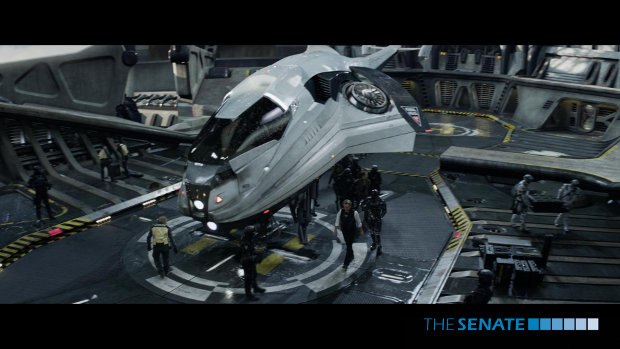
Meanwhile, The Senate of London was called on to work on 250+ shots encompassing 3D environments, 2D digital matte paintings, 3D hologram effects and graphics inserts.
In the sequence when Quaid (Colin Farrell) discovers his hand has some kind of telecommunications device under the skin, The Senate was tasked with creating a variety of techniques. The device activates and Quaid is instructed to press his hand up against some glass. When he does this, it activates a video display where he can see his caller. "The prosthetic used during production required cleanup and a complete paint out of the dial when it is not active," recalls The Senate's Richard Higham, the visual effects supervisor. "We received some graphics to use and worked up a look to make it appear as if the graphics and video were resonating from the glass itself. The look was enhanced by adding video noise effects and a unique transparency as well as s sense of dimension by using a dual layer method."
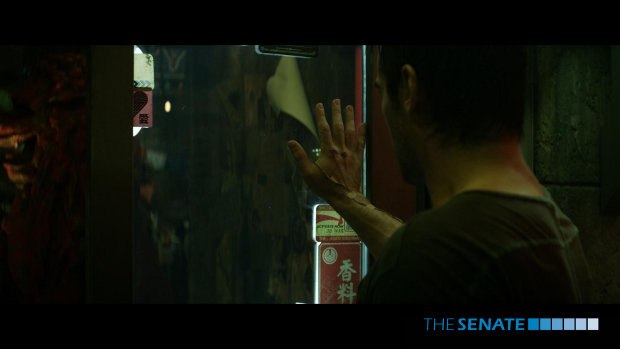
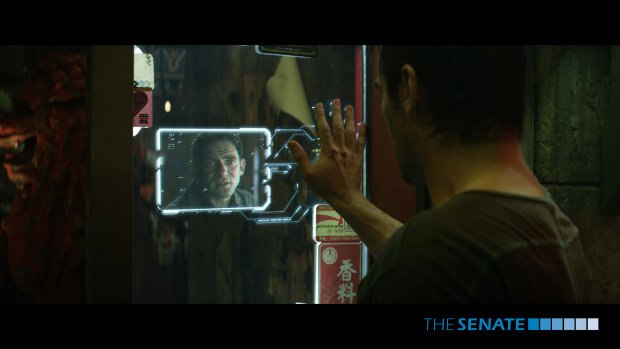

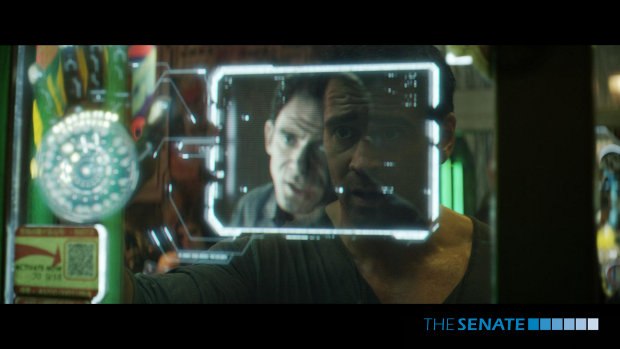
The graphics themselves had a basic animation which then had to be broken up and manipulated to match Quaid's actions. The additional work done in this sequence was to maintain the future style look of New Asia. Several green screens were replaced with digital matte paintings which were broken up and recycled to work at different angles depending which way the camera was pointing. Additional video display against glass was done for when Quaid's enemy also had dialogue with a caller -- this time against one of the future bike windshields. The look had additional breakup by using rain droplets to distort the image. Multiple holograms were added in the backgrounds to maintain consistency with other sequences.
One of the main sequences was in Reed's apartment. Quaid inadvertently activates an interactive hologram display. It is a prerecorded three-dimensional hologram of his head, able to respond to certain questions. The Senate was provided green screen plates of Farrell's upper body, shot in a 180-degree array of 18 x Canon 5D HD cameras as well as the Red Epic camera. They then went about developing a look by using a 3D model of Farrell's head.
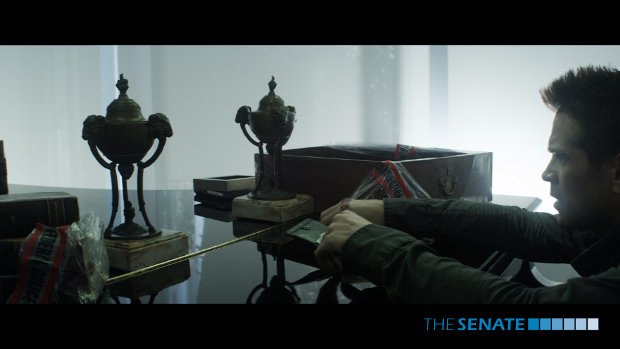
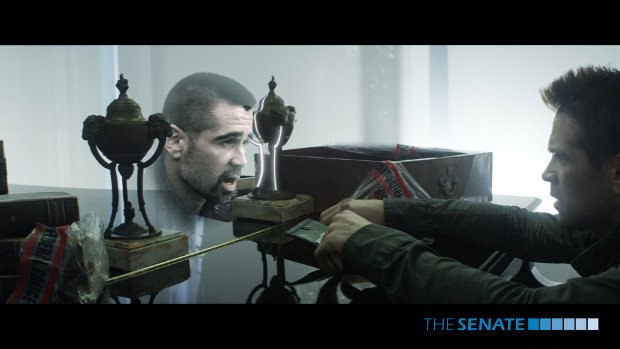
"The main function was to be able to translate the locked off green screen plates to the live action, allowing for freedom of camera movement as well as angle," Higham continues. "The green screen heads were individually tracked using PF Tracks Object Tracking function and then exported and applied to the 3D geometry. In some cases, that green screen was then re-projected back onto this animating geometry and rendered through the live action moving camera. The process represented many technical challenges as any slight inaccuracy in the object track would be very noticeable and destroy the illusion. To ensure the mesh moved exactly as Farrell did, areas of deformation were painted to the geometry so that the tracking software could allow the amount of muscle movement, especially around the mouth during dialogue. The same CG head then had additional video style scan lines projected onto the head which would follow the contours, adding to the sense of dimension. Where the 3D technique was not required, the green screen head was projected onto 2D cards within Nuke, but still with the added 3D renders of scanlines and interference.
"Wiseman wanted a slightly more unique look for when the hologram activates and then deactivates," Higham suggests. "This was achieved by projecting a geometric pattern of sections which animated up the mesh. Through these sections, parts of the holographic head are revealed and a progressive animation from lower part of the head to the top takes place. Additional distortion effects were applied to the background through sections of the head that had not completed their reveal."
--
Bill Desowitz is former senior editor of AWN and VFXWorld. He's the owner of the Immersed in Movies blog (www.billdesowitz.com), a regular contributor to Thompson on Hollywood at Indiewire and author of James Bond Unmasked (www.jamesbondunmasked.com), which chronicles the 50-year evolution of 007 on screen and features interviews with all six actors.

Bill Desowitz, former editor of VFXWorld, is currently the Crafts Editor of IndieWire.