Chris Robinson finds complex themes in the simple story of Andreas Hykades The Runt for this months Animators Unearthed.
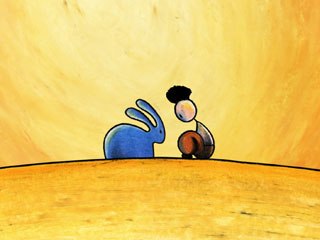
Andreas Hykades The Runt appears to be a deceptively simple film, but rumbling beneath are a variety of deep and emotional themes ranging from loss of innocence, ritual, responsibility and death. © Hydake/Film Bilder.
Like an old blues/folk song, Andreas Hykades latest film, The Runt is deceptively simple. A boy lives on a farm with his uncle and father. They breed and kill rabbits. A rabbit gives birth. The boy wants to keep the runt. The uncle agrees, but says that after a year he must kill it. The boy agrees. Time passes. The two runts bond, but the day finally arrives when they must go the way of their fates. And so it goes. Of course, nuttin aint that simple. Rumbling beneath the verses are a variety of themes ranging from loss of: innocence, ritual and responsibility, and that familiar ol refrain we will all one day sing: death.
The Runt is the final part of Hykades country trilogy that includes We Lived in Grass (1995) and Ring of Fire (2000). The trilogy deals with Hykades childhood in the Bavarian countryside. I remember the country as a dark and vital place, says Hykade. It shaped me and inspired me. As my work is about personal experience it was just natural to do these films.

The Runt began with a 2001 drawing from Hykades sketchbook, which showed him watching his uncle kill rabbits.
Initially, Hykade had no plans to do a trilogy, but after We Lived in Grass, he felt there still some issues left unsaid about his protagonists sexual desires and violent tendencies. I did Ring of Fire to try and dig deeper into the sexual aspects. When I saw the two films together I got the impression that something was still missing. So I did The Runt about killing.
The Runt began with an image from Hykades sketchbook. In 2001, remembers Hykade, I did a drawing of myself watching my uncle killing rabbits an image I remembered from my childhood. A few years later I went through my sketchbooks, discovered the image again and it really hit my deep inside. I had the feeling that this drawing is quite modern. We all need the killer, I thought. We dont want to do the shitwork. Thats why were left weak and always depend upon the killer.
At the same time, Hykade continues, the subject connected to the past. The idea of killing rabbits to eat them seemed to be centuries old. I also felt that the subject connected a personal story to a collective myth.
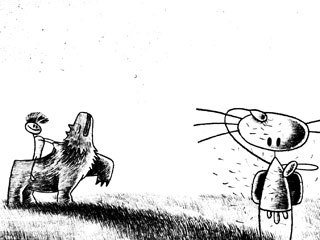
The Runt is the final part of Hykades country" trilogy. The first part, We Lived in Grass (1995), deals with his childhood in the Bavarian countryside. © Gambit, Filmakademie Baden-Wurttemberg and Film Bilder.
The Runt is almost entirely based on Hykades own experiences. My father and my uncle used to have these rabbits. Each time the mother rabbit got some newborns, my father and uncle would talk about how many theyd like to keep. The rest of them were put into a basket and my uncle would throw them against the wall to kill them. But I fell in love with this cute little rabbit the runt and wanted to keep it. Alright, said my uncle. I give you the runt, but you take care of it and you kill it in one year. Yes, I said. Ill take care of him and Ill kill him in one year.
Like his protagonist, Hykade never did kill that rabbit. Thirty odd years later, while making the film, he finally decided to confront his fear. When I did the showdown scene at first it just awful. The whole scene just felt fake. So, Hykade rang up his uncle and asked him if he could come by and help with the rabbit killing. I turned up and there were six rabbits to kill. I said: I will assist you on the first three and I will kill the second three. So I did.
It was very specific. I had to accept that I am a killer and overcome sentimentality. The rabbits wont be dead until all the blood has run out and even then their flesh shivers for a while. And the stomach will still move a few minutes after you cut it out. When I went home I changed the showdown in a night and now I think its specific without violent pathos. I will eat one of the rabbits I killed at the premiere of The Runt. [For the record, The Runt is making its world premiere at this years Ottawa International Animation Festival].
There are two magnificent shots in The Runt that elevate the films spiritual meaning and provide that link between the personal and collective. Throughout the film, the sun appears as a symbol of life. In one shot, Hykade begins with a shot of the sun, but pulls back the camera to reveal that we are actually inside the rabbit. In this simple, beautiful shot, Hykade visualizes the soul and gives life to the rabbit. The second shot comes just before the rabbit is killed. The screen is entirely white until Hykades camera again pulls back to reveal that we are actually looking deep inside the rabbits eye. Without using a single word, this image screams the runts final aching plea for life.
As inspiring and beautiful as Hykades images are, music is all a vital part of the equation. The voices of Bob Dylan, Johnny Cash (whom Hykade initially approached to narrate Ring of Fire Cash refused because he apparently felt that Hykades film was immoral. Strangely, Cash had no qualms about making a controversial music video Delia about murdering a woman) and other angels of song seep through the pour of every Hykade image. The music is always there from the very beginning. All the work is based on imaginary beats that are connected. The imaginary beat is the invisible structure of all the animated work. And as the invisible part of the film, it is the most important part, where everything that moves in time is based on the music and rhythm.

The second part of the trilogy, Ring of Fire (2000), dug deeper into the sexual aspects of Hykades childhood. © Gambit Films.
With his country trilogy complete, will Hykade finally get down to the business of making his Jesus feature? I tried to do this Jesus film a few years ago, but I was not ready for it. I wasnt able to transport an intense emotion into a story. I will think about it again. I will think about it for my whole life and if I will receive the gift of song I will do the film.
Meantime, Hykade (who has made a number of inspired commissioned films) has to butter his bread and that means more work on his excellent childrens series, Tom. I will do a second interactive game about Tom & The Slice of Bread with Strawberryjam & Honey. The children liked the first interactive game and they want more. So I want to give them what they want. I have to do some things for children funny things. You know, I dont want to travel just one road and these children films are always a good way to get away from all this violence and killing.
Chris Robinson has been with the Ottawa International Animation Festival since 1991. A noted animation critic, curator and historian, he has become a leading expert on Canadian and international independent animation. His acclaimed OIAF programming has been regarded as both thoughtful and provocative. In May 2004, Robinson was the recipient of the Presidents Award given by the New York chapter of animators for contributions to the promotion of independent animation.
His books include Between Genius and Utter Illiteracy: A Story of Estonian Animation, Ottawa Senators: Great Stories from the NHLs First Dynasty, Unsung Heroes of Animation, Great Left Wingers and Stole This From a Hockey Card: A Philosophy of Hockey, Doug Harvey, Identity & Booze.
An anthology of Robinsons Animation Pimp columns will be published in 2006. He is working on Fathers of Night, a novel about angels, devils and everything in-between. Robinson lives in Ottawa with his wife, Kelly and sons Jarvis and Harrison.

A well-known figure in the world of independent animation, writer, author & curator Chris Robinson is the Artistic Director of the Ottawa International Animation Festival.