
Animation World Network and VFXWorlds staff report back about the various secrets revealed at the Visual Effects Societys Festival of Visual Effects 2005.
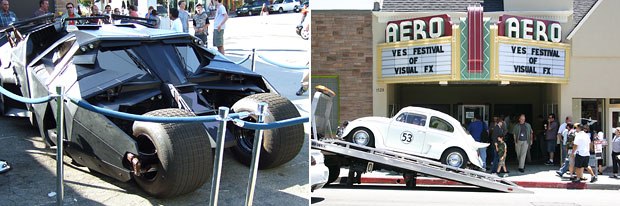
VES Festival goers got a chance to check out up close the Batmobile from Batman Begins and Herbie from Herbie: Fully Loaded. Photos courtesy of Sarah Baisley.
From June 24-26, 2005, the Visual Effects Society hosted the 7th annual VES Festival, held this year at the Aero Theater in Santa Monica, California. The event highlighted the work being done in visual effects, special effects, animation and gaming. Distinguished panelists treated attendees to the tricks to bring some of the most recent blockbusters to the screen.
Fridays Madagascar panel, which included art director Shannon Jeffries, character animation head Rex Grignon and vfx head Scott Singer, went into great detail about the technical and creative challenges of making this a fully realized 3D-animated feature at PDI/DreamWorks.
Jeffries stressed a common theme making use of the wow factor in every component of production. Environments, which were inspired by 50s and 60s photos of the New York locales along with the works of Henry Rousseau for the Madagascar jungle, combined realism with stylization, emphasizing oversized proportions. Although the jungle looks very lush and dense, for instance, (the first reveal contains an astonishing 14,000 plants), it nonetheless required a lot of theatricality and staging, making use of silhouettes, veins and textures.
Meanwhile, the lead characters (lion, zebra, giraffe and hippo) are so angular that it made it tough to adapt to 3D. Therefore, to achieve the desired squash-and-stretch, the technical staff created isolation rigs with lots of deformation. This was new to DreamWorks and they especially isolated the spine and shoulder. Grignon said the effect was elastic pajamas that went way beyond what they were able to achieve in the Shrek movies. They wanted very cartoony performances, inspired by Bob Clampett, and made use of his signature smear poses to great effect, along with plenty of oversized poses.
Singer said the vfx underwent an overhaul too in the animation department. They decided to explore the meaning of CG effects. What is gravity, what is mass? It was evidently an eye opening experience: a balance between what looked good and what adhered to 3D rules. Not surprisingly, the jungle was the biggest effect, comprising 75% of the movie.
According to Singer, the biggest challenge was database manipulation. Can a database be sexy? They learned how to swap out components from layout to lighting, and made use of deflection vectors. They also created a hierarchy of plant rigs and utilized oscillation techniques to move the plants and trees.
Water, an integral part of the movie, became a lead character of sorts, and, in one of the funniest moments, Singer showed a clip of the animators performing spit research for the various comedy routines.
The Friday Anatomy of CSI panel provided a very instructive analysis of the different vfx approaches to the popular franchise, which is built around the signature snap zoom that sweeps viewers into the micro level of the various crime scenes. The panel included Larry Detwiler, vfx supervisor of CSI: Miami, who began on CSI: Crime Scene Investigation with Stargate Digital; Andrew Orloff, vfx supervisor on CSI and CSI: Miami with Zoic Studios; and Max Ivins, vfx supervisor on CSI: New York.
Judging from the wide array of clips (which included a bullet traveling through a car window; a car collapsing from a bridge; a tsunami disaster and its impact on a bank; and lots of creative blood splatter), it surely is a complex production process melding motion control, 3D animation and compositing.
CSI still concentrates on lurid crimes and traveling inside bodies with lots of motion control (first introduced by Detwiler). CSI: Miami, by contrast, distinguishes itself with its location work and disasters. The tsunami naturally involved heavy use of 3D water, and Detwiler admitted that the effect might not have resembled a real tsunami but it sure looked great. In discussing the collapsing car, he said he had to contend with the car going straight down when they were hoping for a different approach.
Citing budget limitations, Ivins said they dont use much motion control on CSI: New York, but are able to save money using Maya, LightWave, After Effects and Flame. It also helps utilizing a grainy, high contrast look with shallow depth of field, since L.A.s Studio City must double for New York City. Invisible vfx, therefore, is vital to this spinoff.

The visual effects artists from The Orphanage and CaféFX shared some of their secrets from working on Sin City. Property of Dimension Films.
On Saturday, the event kicked off with The Orphanage and CaféFX, giving the audience a look at their work on Robert Rodriguez and Frank Millers Sin City. For the film, each vfx house was given one of the three chapters in the film the third studio was Hybride.
Working on the That Yellow Bastard segment, The Orphanages vfx supervisor Ryan Tudhope began by explaining the studios approval process with Rodriguez. The artists would devise thumbnail shots of key frames to highlight their take on the films stark black-and-white graphic novel look. Once the directors signed off on the thumbnails, the artists at The Orphanage were set to go.
Matte painter Kristi Valk of The Orphanage said the matte process began with creating the environment with detail and then applying the high-contrast black-and-white look at the end. This approach added a more believable feel to the environments, especially when light moved across a scene illuminating farther off corners of the room unseen in the comics. For exterior shots, the artists at The Orphanage collected industrial references photos throughout San Francisco where the company is based.
Vfx supervisor Dav Rauch said the film was a rare opportunity for them to see the script and work on a congruent chunk, unlike other films where they are just assigned random shots throughout the film, which often dont have story context to them.
Because the film was filmed entirely on greenscreen stages, it was up the effects houses to fashion a believable environment around the digital footage shot of the actors. The Orphanage relied on using common on-set filming techniques to create a look and feel that a movie going audience is accustomed to. For instance, in a forest scene at night, the scene was lit as a live-action shoot at night would have been. As the character runs through the woods, pools of light highlight the trees behind him. The light sources were set at ranges that wouldnt be higher than if they were actually on lightstands. To create the bold light highlights on cars, The Orphanage uses reflecting cards in their CG program to simulated the on-set filming style of a car commercial.
The Orphanage found the hardest part of their work was often things they never thought would be difficult. For instance, the snow created great problems. The CG artists had to tackle issues ranging from the correct reflection of light on snow from various angles to what happens when the snow hits the ground. For many of the matte paintings, practical models using baking powder were used. As for additional use of practical models used for effects, eggnog was used to simulate the Yellow Bastards blood.
Surprisingly, The Orphanage discovered that color correction and manipulation played a key part in this black-and-white film. By adjusting the red, blue and green of a shot before switching to black-and-white helped smooth out facial features or harden a characters look where it was needed.
For CaféFXs work on the Big Fat Kill segment, vfx supervisor Everett Burrell said the artists went back to classic film noirs to use as guides in forming the look. Like The Orphanage, CaféFX used extensive photo references from pictures taken by the staff or ones found on the Internet. As well, CaféFX used practical effects to simulate blood. They used orange temper paint instead of eggnog. In addition, the artists researched the physics of car crashes from real life footage for their dramatic all CG wreck.
CaféFX had the unique challenge of creating a digital human version of the Dwight character for an explosion shot. Animation supervisor Domenic DiGiorgio said the CG model was created using only pictures from the set. Because the quickness of the shot and the stylized look, artists had leeway in the detail that had to be applied to the model. Of instance, the model had no legs underneath its pants. However, at certain angles one could see that the characters shoes were not attached to anything. So the artists devised a cheat, attaching the pant leg to the shoes, which hide the missing legs.

ILM CG supervisor John Helms and animation supervisor Jamy Wheless outside the Aero Theater.
Next, ILM CG supervisor John Helms and animation supervisor Jamy Wheless chronicled their work on Stars Wars: Episode III Revenge of the Sith. Wheless gave a detailed look at how the animators approached bringing Yoda to life. To begin, they set a style reference of five key emotions (mad, sad, happy, fear and disdain) to work from. To really capture the emotion of the various scenes, the animators often filmed themselves acting out the parts. Often great timing and character details were brought out in these videotape sessions. An example of this would be the great casual shoving aside of the guards when Yoda goes to face the Emperor.
Helms also gave a detailed look at the effects work that went into many of the fight scenes featuring the older characters like the Emperor and Count Dooku. For a battle between the Emperor and several Jedi, a stuntman with hair that matched the character acted out the choreographed sequence. The digital artists then replaced the stuntmans face with a photoreal model of actor Ian McDiarmid.
For Count Dookus big entrance, George Lucas wanted a dramatic leap over the railing of the balcony to the floor below. Actor Christopher Lee filmed his entrance to the room and his walk after landing, but the digital artists had to fill in the rest. After Lucas approved the back flip over the rail, the artists discovered that having the digital double walk forward instead of switch back to the footage of Lee worked better. The attention to detail even extended to simulating Lees walk.
The stats for the film are impressive 1,883 animation shots, 2,151 visual effects shots, 6.5 million hours of render time and 140 terabites of data.
Next up was a discussion between Lord of the Rings visual effects supervisor Jim Rygiel and vfx veteran Richard Edlund, chronicling Edlunds career. Edlund talked about his beginnings as a photojournalist as a teen and in the military. After returning from combat, he worked on special effects for TV and commercial. The character of Thing on The Addams Family was Edlunds hand.
He moved from TV after his long hair and hippie lifestyle conflicted with the older veterans. Returning to photography, he moved to San Francisco and shot many classic rock album covers. In that time, he gains distinction (but little money) from developing the famed portable pig-nosed guitar amp.
Edlunds disdain for cocaine led him to leave the music scene and head back to special effects work in Los Angeles. He built an impressive résumé of work with visual effects pioneer Bob Abel. Having worked extensively in commercials, Edlund jumped at the chance to work on a feature called Star Wars.
The veteran then explained in detail the painstaking challenges of photo-chemical effects work. The most difficult aspect of the early special effects work was hiding the dark matte lines around objects.
Later in the day, Stormfront Studios president/ceo Don Daglow, creator/co-founder Oddworld Lorne Lanning, Blur Studios creative director Tim Miller and Habib Zargoupour, senior art director on such films as Twister and The Perfect Storm, discussed the future of gaming and its convergence with visual effects work.
Daglow designed and programmed the first-ever baseball game in 1971 and went on to create such games of Quantum Space, Earl Weaver baseball, Neverwinter Nights, Demon Stone and The Lord of the Rings: Two Towers.
Closing out Saturday was visual effects supervisor Paul Franklin chronicling the work Double Negative out of the U.K. did on Batman Begins. He was happy to finally be able to talk about the project having previously been under tight restraints before the movie opened.
The biggest challenge was convincing director Christopher Nolan that the CG work could be done seamlessly. Franklin said, Nolan didnt want vfx artists adding a gaudy fantasy layer to what he shot.
The first stage of convincing Nolan came with creating digital versions of real buildings and then displaying them side by side to see if the director could tell the difference. As the production proceeded and Nolan became more comfortable the CG, Double Negative was able to convince Nolan to use digital doubles of Batman and the Batmobile. In the end, Double Negative created three digital Batmobile shots and 15 with a digital stand-in for the Caped Crusader.
However, the core work Double Negative did was in creating more than 500 digital buildings to turn Chicago into Gotham City. Franklin and his team went to Chicago and painstakingly photographed the city. Using special set-ups to capture every possible angle and detail, Double Negative took more than 1.5 million photographs.
To bring true realism to the production, Double Negative had to revamp its color pipeline and develop its own stitching program for combining photographs in panorama shots. Small teams were assigned to all aspects of one shot to ensure continuity. So much detail was required that Double Negative devised a way to stitch flat images of a room together to simulate a 3D environment, so that the millions of windows in the buildings would not have empty voids behind them.
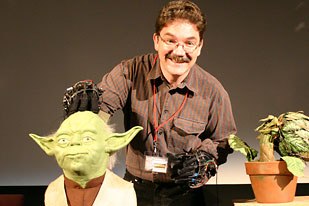
Dave Barclay, who cut his puppeteering teeth working for Stuart Freeborn on The Empire Strikes Back, brought one of the original Yoda heads mounted on a board as well as one of the plant puppets from Little Shop of Horrors.
Sunday started out with a colorful physical and digital live demonstration of puppetry, which served to wake up and engage the early morning audience at 9:00 am. Animatronics pioneer Lyle Conway was supposed to join the panel, but when called away on a family matter, he sent a performance actor with a pliable monkey mask while puppeteer/actor Bruce Lanoil provided his voice live during the presentation. Dave Barclay, who cut his puppeteering teeth working for Stuart Freeborn on The Empire Strikes Back, brought one of the original Yoda heads mounted on a board as well as one of the people-eating plant puppets from Little Shop of Horrors. Barclay said Yoda ended up being modeled after Freeborn and you could see the striking resemblance.
Barclay and Lanoil demoed the future of CGI puppeteering, using performance FX gloves to work a 3D character projected on the screen behind the panel. Lanoil provided the voice, interacting with panelists and the audience, as well as performed some of the characters motions while Barclay worked the rest of the movements using his set of gloves. It was an impressive display of realtime, CGI character performance.
Lanoil said the combination of puppetry with CGI amounts to a reinvention of the art form. He and Barclay have formed PERFORMX, a character creation and performance company. The next phase beyond the FX gloves will be body suits, utilizing a magnetic system for realtime performance. They dream of placing a puppet character interacting in realtime with a cast on a show like Saturday Night Live.
The final panelist offered how to track and integrate a performance in todays digital environment. Steve Rosenbluth, who recently founded Concept Overdrive, explained his companys new central overdrive system. This has become particularly important he said with the advent and increasing use of digital sets. Most things have been tracked singularly, as they move on a set, whether it be a puppet or a camera crane. Now you can put one system in the center and manage motion, with nodes for motion input of people and 3D objects in space, puppets, camera cranes and 3D software inputs from programs such as maya or 3ds Max.
When you have special effects networked, any elements of CGI can talk to any other elements, he said. Rosenbluth has added algorithms to do collusion avoidance. Puppets can react with virtual sets and respond to virtual falling refrigerators.
The session ended with a karaoke sing-along, allowing two volunteers from the audience to work the fx gloves to have the 3D character on the screen interact live with the audience during the song.

Lost and Alias creator/exec producer J.J. Abrams (left) talked about the importance and role of vfx in his TV series. Lost vfx supervisor Kevin Blank (center) met the challenge, utilizing the talents of freelancers like Eric Chau
Next up was the main vfx wizards from Herbie: Fully Loaded, the picture everyone swore would have little use of CGI but ended up having 663 shots. The car was also parked outside of theater during the festival, up through the presentation. Lynda Thompson, vfx producer, led her panel of John Van Viliet, supervisor; Matt Sweeney, vfx supervisor and Robert Short, technical supervisor.
Often they had to deal with removing overcast, rainy conditions, which dominated Southern California when the picture was shot, as well as having to create the NASCAR crowd for most of the race scenes. What was particularly challenging with the final victory scene, in which they had to make the lower half of the racers body as she stood through the sunroof of the car and the camera rotated around her 180 degrees, add the crowd and adjust the sky conditions.
Lost and Alias creator/exec producer J.J. Abrams was on hand with the next panel to look at the demands and delights of producing these vfx-laden shows on a TV budget and timeframe. The mantra was usually not, can we do this, but we need to do this. Lost vfx supervisor Kevin Blank met the challenge, using many studios and boutiques and even brook up one shot across three different companies (something he swears hell never do again).
He met his schedule and budget, mostly by using freelancers such as Eric Chauvin, an independent compositor, matte painter and 3D artist who joined them on the panel.
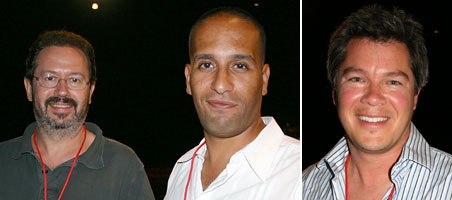
Method Studios Alex Frish, 2D vfx supervisor (left) and Hatem Benabdallah (center), 3D vfx artist shared some of their tricks of the commercial spot trade, Digital Domain exec producer Edward Ulbrich (right).
The primary concern facing the panel, 30-Second Story Telling: VFX in Commercials, was the future of commercials, given the broadening use of TiVO and other services, enabling viewers to bypass spots.
Sharing tricks of their trade were Method Studios Alex Frish, 2D vfx supervisor and Hatem Benabdallah, 3D vfx artist. They did the beautiful age transitioning spot for Direct TV, which premiered during the Super Bowl this year.
Explaining the difficulties of shooting in L.A. arial scenes without the use of helicopters in the Heineken Beer Run spot starring Brad Pitt were Brad Parkers, vfx supervisor from Digital Domain; Brad Hayes, sr. digital artist from DD and DDs exec producer, Edward Ulbrich.

Gray Matter FX creative director Gray Marshall concluded the festival with a panel to discuss the vfx on Lords of Dogtown and Kingdom of Heaven.
Ulbrich was upbeat, and said other forms of commercials will materialize with time, and pointed out the increasing use of big production commercials for theatrical run in many countries and the increasing use of branded content.
The day and VES Fest culminated with insider looks at Lords of Dogtown from Gray Marshall, vfx supervisor, and Tom Lynnes, CG supervisor, while Wes Sewell, vfx supervisor on Kingdom of Heaven, recounted his first supervising job on a major epic.
Congrats to VES Society exec director Eric Roth and his crew for pulling off another informative, eye-opening series of panels in a most appropriate venue, where one could munch on popcorn and movie house candy during screenings and check out the nearby eateries and stores during breaks.
Rick DeMott is managing editor of AWN; Bill Desowitz is editor of VFXWorld and Sarah Baisley is editor in chief of AWN.