
Renowned drawing instructor Glenn Vilppu continues with his twelfth and final "sketching on location" teaching installment. This month we learn how to use photographs as a reference tool that will make your trip last for years.
This is the twelfth and last chapter in a series of bi-monthly articles about sketching on location. The articles are based on my Sketching on Location Manual. The manual was developed as a series of lessons that I use on my guided sketching tours of Europe and as material in my regular drawing classes. As such the lessons can be part of a regular course or used by individual students as a practical learning guide. If you have not seen the previous lessons starting in the June 2000 issue of Animation World Magazine, it is recommended that you do. The lessons are progressive and expand on basic ideas. It is suggested that you start from the beginning for a better understanding of my approach. If you really want to start at the beginning open with the lessons based on the Vilppu Drawing Manual.
In the last lesson we discussed "Atmosphere." The main purpose was the use of atmosphere to create the illusion of 3D form, this was one of the corner stones of the Renaissance and a useful tool in expression and as a strong picture making tool.

All drawings in this article are by and © Glenn Vilppu.
The Camera As A Tool
Many times while traveling the camera becomes the main tool for gathering information. We all have stacks of pictures taken with the intention of one day turning them into drawings or paintings. The professional artist has organized scrap files of not only his or hers photographs, but also photos clipped from magazines and newspapers that could one day be of use in a project. Since its development, many artists, including Degas, Paul Gauguin, Alphonse Mucha and Maxfield Parrish, have used the camera as an integral part of their creative process. Many photographers have started out as painters. Keep in mind that the camera is a tool and, like any tool, there are practical as well as impractical uses for it. My objective in this manual is not to discuss the photograph as an art object in itself, but as a tool and resource for the artist who sketches on location.
The camera does a great job of gathering information if you know how to use it. First, the camera cannot be surpassed for speed and convenience in "capturing a location" for future use, but, with the speed and convenience, come certain pitfalls.
The biggest difficulty in using a photograph is the natural tendency to copy it as it is. This copying generally ends up giving everything in the photograph equal importance and emphasis. Of course, while looking at a scene and sketching on location, we do not give everything equal weight of importance. Another difficulty is the speed itself. In general, when we draw a subject we spend muych more time looking, allowing interesting details or unusual views to be discovered. Being aware of the difficulties goes a long way to help us to overcome them.
This chapter hopes to minimize these difficulties in using the camera while taking advantage of its usefulness as a tool. The key to the usefulness of the photographic reference is to treat the situation as if you were actually at the location in the photograph. It is important to remember that the drawing or painting is the point of your effort, not the photograph.

Don't Copy -- Use the Photograph
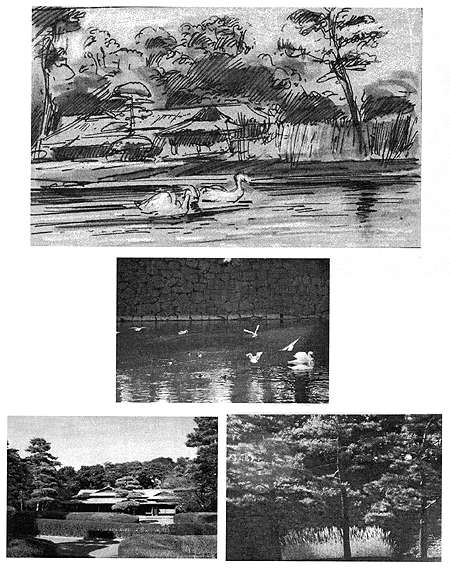
The first step should be to do simple thumbnail sketches from the photograph. In doing these thumbnails, compose the elements developing your visual ideas; another words, don't copy -- use the photograph. In the following pages you will see examples of this approach using many of the elements discussed in previous chapters along with the photographic references.
In the following, I have combined elements from different photographs. The places as drawn exist only in my imagination. Working in this manner will give you endless possibilities for creating drawings and paintings. Remember that you are using photographs and should have no qualms about changing their elements. The camera allows you to continue your sketching tour for years as you go through your photographs, remembering the enjoyment of your trip and giving you a chance to do those drawings you just didn't have time for.

Glenn Vilppu first wrote for Animation World Magazine in the June 1997 issue, "Never Underestimate the Power of Life Drawing." His drawing manuals and video tapes may be purchased in the Animation World Store.
Glenn Vilppu teaches figure drawing at the American Animation Institute, the Masters program of the UCLA Animation Dept., Walt Disney Feature Animation and Warner Bros. Feature Animation, and has been sent to teach artists at Disney TV studios in Japan, Canada and the Philippines. Vilppu has also worked in the animation industry for 18 years as a layout, storyboard and presentation artist. His drawing manual and video tapes are being used worldwide as course materials for animation students.