
Continuing our excerpts from the Inspired 3D series, Tom Capizzi delves into modeling resources in the first of two parts.

New technologies are constantly being introduced that enable faster and easier ways to use real-world objects and images when creating 3D computer models. These technologies include scanning 3D objects in new ways, using 2D photographs to create 3D environments and objects and using haptic interfaces to sculpt 3D objects. Some of these technologies have been around for many years, and some are still being perfected.
In the grand scheme of computer modeling, however, not much has changed in the last 10 years. The process of constructing geometry from reference data is still pretty much the same as it was in 1990. Each new technology, while making a profound difference in its particular niche, has not replaced the process of intelligently placing the correct geometry in the correct place on the computer model. Each computer modeling application has its own standard for what is optimum for geometry construction. Hard surface models are built with different construction criteria than environment models. Animated character models are built differently than models of character statues. This knowledge of the appropriate method of constructing a model for a particular purpose is difficult to automate. Although the general rules for constructing each type of model is fairly standardized, each studio will have production criteria that will change these rules somewhat on a case-by-case basis.
If anyone were to perfect the automation of correct model construction from acquired 3D data, the criteria for construction would probably change due to the changing needs of the production environment. The companies that are trying to capture this market are chasing a moving target. However, some great new products are making a real difference in acquiring and creating useful 3D geometry. Some of these new technologies are useful for creating models, and some are useful for creating reference models.
Accurate and high-quality reference data is critical to the production of high-quality models for film, video and video games. Without adequate reference, models created by highly skilled artists may be inaccurate enough to look wrong. If the model that is being created is an original concept and based on a real object, a sufficient number of drawings and plans must be used to create the object that is being modeled in 3D without too much guesswork.


Sometimes models need to be derived from or directly created from 3D scan data. 3D scanners enable likenesses of actual people and things to be created very quickly. The quality of 3D data ranges from easy-to-use 3D NURBS surfaces with accurate texture maps to blobby globs of polygons that do not look like anything. Figures 1 and 2 illustrate the difference between good and bad scan data. This sculpture of a swamp creature was scanned using two techniques, one which provided clean, accurate data (Figure 1), whereas the other is not even recognizable (Figure 2).
New technologies provide the ability to sculpt inside the computer. SensAble Technologies created a sculpting interface called FreeForm, which enables the modeler to mimic the process of creating physical sculptures inside the computer. Examples of providing reference material include creating a 3D perspective sketch to begin modeling from, using 3D scan that needs to be edited or tweaked to be animated and rendered and sculpting a 3D sculpture that will be surfaced for animation are all examples of providing reference material.
2D Reference Material
A 2D image can be a sketch or a photograph that is scanned into the computer and used inside the modeling program as a background for the modeling window, called an image plane. Gathering reference material, especially 2D images, is a requirement for most modeling projects. In cases where a 3D reference is available, 2D images can be used as image planes in addition to the 3D reference data.
Perspective 2D Reference
When creating an original concept on the computer, a modeler usually begins with a 3D sketch, or a perspective sketch (Figure 3). This perspective image can also be a photograph in cases where the model will not be an original design. Some modelers will choose to model from a perspective image in the perspective window, but the more accepted practice is to use the orthographic windows. This way the modeler can ensure that details seen from one view line up with details seen in another view.
Whereas a perspective sketch or photograph may be adequate at the earlier stages of design development, the 2D orthographic projection — a plan and two elevations — is the conventional way of communicating the form and geometry of the product from design to production. In order to understand ortho-graphic images, you must first understand the concept of orthographic projection.
Orthographic Drawings
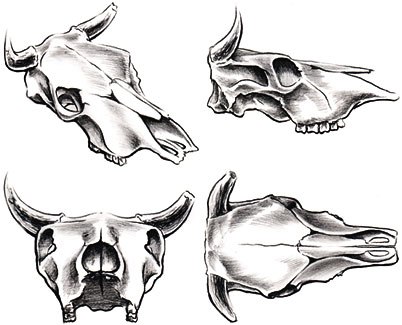
Orthographic projection is a way of viewing objects that puts the object in a theoretical box. The surfaces of this box represent the top, bottom, back, front, left and right sides of the object. If the person viewing the object were to stand so the view was perfectly perpendicular to one of the surfaces of this theoretical box, this would be an orthographic view. The modeling views in most modeling windows enable the modeler to work in this orthographic mode, generally from the top, front and right sides. In cases where the modeler is not creating an original design, photographs taken of the object in orthographic views are suitable images for constructing a 3D model. Orthographic views (Figures 4 through 6) also enable the modeler to work in views that are not distorted by the perspective camera, allowing for the accurate interpretation of the drawings onto the actual model.
The method of orthographic projection is to “float” the designed object inside this imaginary box (Figure 7). Imagine the box as a window that you look through — the silhouette or projection of the designed object onto the top horizontal window is called the plan; the projection of the same object onto the front vertical window is the front elevation; and onto an adjacent side vertical window is an end or side elevation. Now imagine the box to be hinged. The horizontal plan is swung up through 90 degrees and the end elevation is also swung around through 90 degrees so that all three projections now lie on the same plane.
![[Figure 7] The sides of the box represent the views used in orthographic projection.](http://www.awn.com/sites/default/files/styles/inline/public/image/attached/2175-i3d07fig5-07.jpg?itok=xc_kLbCO "[Figure 7] The sides of the box represent the views used in orthographic projection.")
Image Planes
When starting with an image plane in a modeling program, consider the following process for setting up the plane. The images should be in a usable digital format and at a usable resolution. For most modeling packages, TIFF format is universal, and for modeling purposes, an image that is about 300 x 400 pixels will suffice. Sometimes an image this large will bog down older systems, and sometimes this resolution will not be nearly enough to get the detail required for the model you are trying to build. These decisions have to be made on a case-by-case basis. The best results for using image planes come from getting two or three images of the object that is to be modeled shown from different orthographic views and having these images scanned at identical resolutions and dimensions to each other. One trick I use when scanning image planes is to have the images I am scanning lined up on a single piece of paper in the exact orthographic layout that I want them to appear on the screen (Figure 8). I scan the entire sheet at once. When I crop the images to load them into individual windows on the screen, I use guides or rulers in my paint program to crop the images to ensure that they will have the same edges that create the sides for each image. For example, if you are creating three views, with the top view directly over the front view and the side view directly to the right of the front view, the left and right margins of the top and front views should be identical, and the top and bottom margins of the front and side views should be identical. For this to be truly exact, the height of the top view should exactly match the width of the side view. Paying attention to small details like this early in the process will save you a lot of work down the road.
![[Figure 8] Drawings laid out in orthographic mode.](http://www.awn.com/sites/default/files/styles/inline/public/image/attached/2175-i3d08fig5-08.jpg?itok=m_agNaUe "[Figure 8] Drawings laid out in orthographic mode.")
When loading the image planes, the modeler should begin with a new file and a new set of viewing windows set to default viewing size for all windows. The reason for this is that when you load an image into your file, most modeling packages will scale the image to the existing window size. If the file has already had the windows resized to another viewing angle or dimension, the planes will load in at a different size, and all your work to get the images scanned at accurate sizes will have been wasted.
When you load the appropriate images into the appropriate windows, and the edges line up along the appropriate sides, you are almost ready to begin modeling. First, however, you should make some decisions about what types of surfaces will be constructed and where these surfaces will be placed.
3D Reference Material
3D reference material refers to processes that sample data from actual objects and make the data accessible in 3D applications on the computer. These processes generally fall into the categories of 3D digitizing and 3D scanning. 3D digitizing and 3D scanning result in the creation of a digital version of an object that exists in the real world.
A scanner cannot replace a modeler for several reasons. One reason is that scanners will scan only objects that already exist as real physical objects. In modeling for entertainment, a lot of models are objects that do not exist in the physical world. Another reason is that the modeler spends a lot of time optimizing the geometry in the 3D model to suit the particular purpose of the 3D model. Because computer systems and video game platforms are becoming more and more powerful, the modeler will usually add more things in the scene. It doesn't matter how powerful the rendering software is or how powerful the video game CPU is — efficient modeling practices will always be used. As platforms become more powerful, directors and producers will simply ask for more and more stuff to be put in the scene. The opportunity to blindly add more geometry onto each model simply to save time by using the 3D digitizing and scanning applications listed earlier never seems to materialize.
However, the companies creating these products are taking enormous strides. As these companies become more and more accustomed to the needs of the film and video game industry, the applications and equipment these companies make are becoming more and more usable. It won't be long before there will be a solution for acquiring 3D data that can be used directly by the film and video game industries.
![[Figure 9] A 3D digitizer traces the exterior of an objectÕs surface.](http://www.awn.com/sites/default/files/styles/inline/public/image/attached/2175-i3d09fig5-09.jpg?itok=wAIoQ6Gw "[Figure 9] A 3D digitizer traces the exterior of an objectÕs surface.")
3D Digitized Data
3D digitizing is a manual process. When the 3D property is digitized, the data acquired from this process is limited to vertices, polylines and polygonal faces. Depending on the interface used during the 3D scanning process, other entity types can be acquired as well. If the 3D digitizing tool is interfaced with a fully functional 3D modeling program, the digitizer can access any tool in the 3D modeling program toolbox. The process of hand digitizing a 3D object can be time-consuming and tedious (Figure 9). Most production houses that use 3D digitizers simply use the digitizer to sample points and lines off the surface of the sculpture and complete the modeling process in the 3D modeling program on the computer. In some cases, however, the entire mesh will be modeled entirely with the digitizer. This is common when the modeler is using an oversized digitizer and the model is something very large, like an automobile.
When a 3D digitizer is used on a 3D property, map out each vertex that will be sampled by the digitizer by simply drawing lines on the object in an organized grid pattern along the surface. In cases where you cannot permanently mark the surface of the object, like when the object is an actual prop used on a film that must be returned, you can use thin, black pinstriping tape. The pinstriping tape creates a bold grid pattern on the surface of the object that can be cleanly removed or edited.
When sampling digitized data, gather data that will flow in line with the directions of the surfaces that you will build later. During the process of marking on the model for the purpose of planning the digitizing process, you should be planning each surface that will be built after the digitizing is completed. If you sample the data in an organized way that corresponds to how the surfaces will be laid out, you can save a lot of time. The two main types of 3D digitizers are magnetic and mechanical.
![[Figure 10] Magnetic digitizers enable great freedom of movement.](http://www.awn.com/sites/default/files/styles/inline/public/image/attached/2175-i3d10fig5-10.jpg?itok=rMBRqMhg "[Figure 10] Magnetic digitizers enable great freedom of movement.")
Magnetic Digitizers
Magnetic digitizers can be very flexible and can enable the modeler to access areas of the 3D property that would normally be hard to get to. The reason for this is that magnetic digitizers use a central data-gathering location to electronically triangulate the position of the stylus and 3D space relative to the magnetic base. As with most 3D sampling programs, digitizers and scanners, magnetic digitizers require that the X, Y and Z-axes are defined relative to the origin. Once this orientation is established, the digitizing process can begin. In Figure 10, Ian Hulbert, a modeler and an animator at Rhythm & Hues, shows how difficult-to-reach areas can be accessed using this type of device. Other digitizers could not gather data from a complex model like the one pictured here.
The benefits of using magnetic digitizing equipment are that very large and complex physical models can be digitized quickly and easily. The size of the model that can be digitized is limited by the magnetic field of the digitizer base. The complexity of the model that can be digitized is limited by the size of the detail that can be accessed by the stylus. The stylus, which is the size of a large pen, is attached to the magnetic base with a thin flexible wire, or it can be cordless and have the signal transferred to the magnetic base through wireless transmission.
The drawbacks of using magnetic digitizing equipment are related to the nature of magnetic fields themselves. The magnetic fields used in digitizing are sensitive to metal. Any metallic substance in the property being digitized or surrounding the property being digitized will distort the accuracy of the data. A small amount of metal will create a small field of distortion, and a large amount of metal creates so much noise in the data that it will be unusable. Most objects that are digitized are sculptures created for a production. If the sculptor who worked on the sculpture used any metal in the armature, that will cause distortion in the digitized data, rendering the sculpture unusable. Sculptors who are creating sculptures for digitizingare forced to invent ways for building armatures out of wooden dowels, string and glue.
![[Figure 11] Yeen-Shi Chen, a modeler at Rhythm & Hues, shows how this bulky arm can be used to capture details on a model.](http://www.awn.com/sites/default/files/styles/inline/public/image/attached/2175-i3d11fig5-11.jpg?itok=7sw7tgWL "[Figure 11] Yeen-Shi Chen, a modeler at Rhythm & Hues, shows how this bulky arm can be used to capture details on a model.")
Mechanical Digitizers
Mechanical digitizers are inexpensive compared to magnetic digitizers. The stylus on mechanical digitizers is located at the end of a jointed assembly that resembles the arm of a robot. When the stylus moves along the surface of the 3D property, it gathers 3D information by triangulating the angular movements of the joints within the arm of the mechanical digitizer. Each time the stylus moves, the joints within the arm of the digitizer rotate and record different information based on the rotations of those joints (Figure 11).
The benefits of using mechanical digitizers instead of magnetic digitizers are mechanical reliability and lower cost. Even though the mechanical digitizers have moving parts, the mechanics involved with these parts are simple and reliable. These digitizers last for many years. It is much more common for these digitizers to become obsolete because of the software than it is for the digitizers to break and become unusable. These digitizers can sample 3D information off the surface of just about any material. The limitations of what these types of digitizers can sample are based on the integrity and stability of the surfaces being digitized. For example, a mechanical digitizer can sample data from a metal object, whereas a magnetic digitizer cannot. But neither type of digitizer can accurately sample data from a surface that is unstable, such as a kitchen sponge or a stuffed animal toy. This is a factor relating not to the mechanics of the digitizer but more to the ability of the modeler to manually sample a flexible surface.
The disadvantage of using mechanical digitizers over magnetic digitizers is that the arm itself can be heavy and cumbersome. Mechanical digitizers are sturdy pieces of industrial equipment that can be fairly large. Some mechanical digitizers are large enough to digitize a car. When the mechanical arm is large enough to digitize a large object, the arm itself can get pretty heavy.
The weight of the arm is just one problem when dealing with a mechanical digitizer. Because the jointed arm is constructed so that it will measure rotations around a limited number of joints, the range of motion of the digitizer's stylus is limited and constrained by these joints. This can make it very difficult to digitize the surface of an object that has even a moderate amount of 3D detail.
To learn more about character modeling and other topics of interest to animators, check out Inspired 3D Modeling and Texture Mapping by Tom Capizzi; series edited by Kyle Clark and Michael Ford: Premier Press, 2002. 266 pages with illustrations. ISBN 1-931841-49-7 ($59.99). Read more about all four titles in the Inspired series and check back to VFXWorld frequently to read new excerpts.


Tom Capizzi is a technical director at Rhythm & Hues Studios. He has teaching experience at such respected schools as Center for Creative Studies in Detroit, Academy of Art in San Francisco and Art Center College of Design in Pasadena. He has been in film production in L.A. as a modeling and lighting technical director on many feature productions, including Dr. Doolittle 2, The Flintstones: Viva Rock Vegas, Stuart Little, Mystery Men, Babe 2: Pig in the City and Mouse Hunt.
Series editor Kyle Clark is a lead animator at Microsoft's Digital Anvil Studios and co-founder of Animation Foundation. He majored in film, video and computer animation at USC and has since worked on a number of feature, commercial and game projects. He has also taught at various schools, including San Francisco Academy of Art College, San Francisco State University, UCLA School of Design and Texas A&M University.
Michael Ford, series editor, is a senior technical animator at Sony Pictures Imageworks and co-founder of Animation Foundation. A graduate of UCLA's School of Design, he has since worked on numerous feature and commercial projects at ILM, Centropolis FX and Digital Magic. He has lectured at the UCLA School of Design, USC, DeAnza College and San Francisco Academy of Art College.