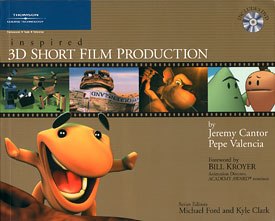
Continuing our Inspired excerpt series from the new book, 3D Short Film Production, authors Jeremy Cantor and Pepe Valencia enter the beginning of the production process by discussing character development and design.
"What is your name?
What is your quest?What is your favorite color?"Monty Python and the Holy Grail
Many scholars agree that a story's ability to attract and hold an audience is more a result of strong character development than strong plot progression. It can easily be argued that all memorable films contain memorable characters. Where would The Godfather be without Don Corleone? Or The Wizard of Oz without the Scarecrow? A memorable character is believable, relatable, and interesting. And a well-developed character will successfully channel the emotional impact of the events of your story to your audience.
It has been said that there are only a few basic storylines. However, an infinite number of variations exist through the introduction of new characters with unique points of views into this otherwise finite group of plots and scenarios.
Some short films of the fine arts or especially abstract variety, such as Hitoshi Akayamo's Garden of the Metal, don't require any actual characters in order to provide an audience with engaging entertainment value. However, if your intention is to create an animated short that tells a story, you'll likely need at least one living, breathing, thinking protagonist. Audiences expect to identify with or at least be interested in the main characters of the films they enjoy. One or both of these character-audience connections is crucial to an engaging character-based narrative. If the viewer sees recognizable features of your main character and can relate to his attitude and behavior, this connection will be well established. However, relatable character traits are not always absolutely necessary. Your protagonist might look and behave in ways that are entirely misunderstood or completely alien to your viewers, but if he or she is sufficiently interesting, your audience will still feel compelled to watch the story unfold. Concern, curiosity or preferably both is what you ultimately want from your viewers.
Furthermore, it is not necessarily important, or even desirable, for your audience members to actually like all of your characters. When creating a villain, of course, you often want your audience to fear, dislike or distrust him. Such characters that we love to hate include Darth Vader, The Grinch, Vic Vinyl from Phil McNally's Pump Action and Raf Anzovin's puppet master (see Figure 1). Remember that in order to connect your audience to your characters, sympathy is optional but empathy and interest are essential.
![[Figure 1] A villain should inspire an appropriate negative reaction from your audience.](http://www.awn.com/sites/default/files/styles/original/public/image/attached/2241-shorts03-01.jpg?itok=ZTrIT2H9 "[Figure 1] A villain should inspire an appropriate negative reaction from your audience.")
![[Figure 2] Even anthropomorphic, abstract, cartoony or fantastical characters need to have a few familiar human attributes, needs, desires, and behaviors.](http://www.awn.com/sites/default/files/styles/inline/public/image/featured/2241-inspired-3d-short-film-production-character-development-and-design-part-1.jpg?itok=eCqZ8oTC "[Figure 2] Even anthropomorphic, abstract, cartoony or fantastical characters need to have a few familiar human attributes, needs, desires, and behaviors.")
Live-action films have a decided advantage over animated films when it comes to creating audience-character connections. Assuming that the main characters are human, audiences will automatically identify with the cast members of a live action film because they can safely presume certain shared attributes and motivations. When creating animated film characters, however, this connection cannot merely be assumed; it must be effectively constructed through design, behavior and/or dialogue. No matter how realistic your attempt, all animated characters stray from absolute realism by some degree. And most, in fact, are significantly different from their live human or non-human counterparts. Regardless of the species and abstraction level of your main characters, you must establish a connection between them and your audience. To do this effectively, you must give your characters some familiar or identifiably human attributes and goals (see Figure 2). Buzz Lightyear is a toy, Stuart Little is a mouse and Shrek is a monster. However, all of these non-human characters have familiar and relatable traits and desires. Buzz wants identity and respect, Stuart wants to belong to a nice family and Shrek just wants to be left alone.
![[Figure 3] Semi-real, cartoony and abstract humans](http://www.awn.com/sites/default/files/styles/original/public/image/attached/2241-shorts03-03.jpg?itok=mCB0WAx9 "[Figure 3] Semi-real, cartoony and abstract humans")
Character Styles
The characters in your short film can be humans, animals, anthropomorphized toys or vehicles, vegetables, minerals, spiritual entities or aliens or they can defy any standard classification whatsoever. You might choose to make them highly realistic, stylized, idealized, exaggerated, caricatured, abstract or symbolic (see Figures 3 through 7).
![[Figure 4] Realistic, cartoony and abstract animals](http://www.awn.com/sites/default/files/styles/original/public/image/attached/2241-shorts03-04.jpg?itok=dXY6MRSB "[Figure 4] Realistic, cartoony and abstract animals")
![[Figures 5 & 6] Realistic, cartoony and abstract monsters (left) and realistic and cartoony robots (right).](http://www.awn.com/sites/default/files/styles/original/public/image/attached/2241-shorts03-0506.jpg?itok=rTtPgkU2 "[Figures 5 & 6] Realistic, cartoony and abstract monsters (left) and realistic and cartoony robots (right).")
Table 1 shows a handy matrix used to classify 3D story characters by genre and style.
Most narrative characters can find an appropriate spot in Table 1. Some characters, of course, are hybrids, combining elements from two or more genres. Jimmy Neutron's best friend, Goddard, is a robot dog, and Stuart Little can be considered a hybrid because he looks like a mouse but walks, talks and dresses like a human (see Figure 8). Although mixing genres in a single character can be quite interesting, mixing styles rarely leads to appealing results. Introducing abstract or cartoony elements into an otherwise realistic character design generally looks more odd than creative (see Figure 9). An exception might be when the opposing elements are particularly stylized, as in the mixing of cartoony heads and more realistic bodies in many Japanese anime films. Furthermore, the line that separates semi-real from abstract is sometimes a bit blurry. The original video game version of Lara Croft is certainly idealized, but should she be considered semi-real, or are her proportions so exaggerated that she should fall under the category of a cartoon?


Table 1: Genre/Style Chart
Genre/Style
Real or Semi-Real
Abstract or Cartoony Human Aki from Final Fantasy The baby from Tin Toy The old man from Geri's Game The Girl from Respire Woody from Toy Story Major Damage The blue boy from Keith Lango's Lunch The couple from Polygon Family Animal The protagonist from PDI's Bunny Falcon from Stuart Little The prehistoric beasts from Dinosaur Scrat from Ice Age Our feathered friends from for the Birds Cubicle from Squaring Off The Antz The tadpoles from Early Bloomer Aliens, monsters, and mythologicla creatures The bugs from Starship Troopers Draco from Dragonheart Gollum from The Lord of the Rings Shrek Sulley and Mike Wazowski from Monsters, Inc. The ChubbChubbs The dragon from Top Gum Machines and robots Luxo Jr. The Iron Giant The robot from Dronez B.E.N. from Treasure Planet Clank from the game Ratchet & Clank Food, minerals and other inanimate objects Horses on Mars The leaf from Alma The carpet from Disney's Aladdin Bunkee & Booboo The hero from Coffee Love The California Raisins Killer Bean Archibald asparagus from Veggie Tales Hew and Chew from Das Rad Too abstract to classify Rolie Polie Olie The 7-up "Dot" Poor Bogo
Consider the advantages and disadvantages of different character styles, as discussed in Table 2.
Be sure that the style of your character works with the genre of your film (see Figure 10). Imagine the loss of effectiveness if the characters in dark, poignant morality pieces, such as f8 or Balance, were cute, goofy bunnies with enormous eyeballs and yellow polka-dotted bowties. Similarly, if you plan to drop anvils on life-like human characters without causing any real or permanent damage, you run the risk of confusing your audience with inconsistent internal logic. Cartoon physics generally works best on cartoon characters. Sometimes it is indeed appropriate and quite fun to apply cartoon logic to human characters; however, such rule breaking is usually only acceptable if your piece is a particularly wacky comedy in the style of The Three Stooges or Hiroshi Chida's Polygon Family.
Character Types
Every character in your story will ultimately fall under one of the following classifications, listed in order of story importance:
Protagonist
Partners, sidekicks, antagonists and objects of desire
Supporting roles
Minor characters
Extras
The most important (or perhaps the only) character in your story is called the protagonist. However, assuming your story has multiple characters, the protagonist doesn't necessarily have to be the first one you invent or introduce. It might be desirable to start with your antagonist. After all, he is the one who will very likely create your story's central conflict. Sometimes it is easier to create a hero when his source of antagonism has already been established. Similarly, you might invent an interesting or amusing character who turns out to be more appropriate as a sidekick or a vice president. His particular attributes might even help determine those of his boss.
Table 2: Pros and Cons of Character Styles
Style
Pros
Cons Realistic characters, especially humans Immediate relatability. Easy to find and study reference material. Your audience will expect subtle, realistic movement, which is the most difficult form of animation. Slightly caricatured characters Close connection with reality, therefore relatively direct relatability. A bit more creative license allowed when it comes to exaggerating behavior and stylizing animation. Sometimes difficult to find just the right balance between realism and imagination when developing nearly lifelike characters. If the behavior of such a character is too realistic, perhaps there was no good reason to exaggerate him in the first place. If you exaggerate him too much, his behavior and movement will run the risk of being inconsistent with his design. Cartoon characters The greatest opportunities for creativity and exaggeration. You can and should feel encouraged to invent your own rules of proportions, symmetry, physics, gravity and timing; your audience won't expect perfect realism and subtlety from your animations. Creating unique and appealing cartoon characters is not as simple as it looks. Too much exaggeration can lose all connection with reality. Not enough might just look freakish. It is also sometimes difficult to maintain audience connection with such characters because their designs will stray significantly from real life. Therefore, you must make their behavior sufficiently identifiable and expressive. Abstract characters Anything goes. Feel free to break every rule of realism in the book. Such characters will have the most difficult time establishing an immediate connection with your viewers. Believable movement and behavior will be crucial.
replace_caption_shorts03-11.jpg
Character Type 1: The Protagonist
The main character in a story is the protagonist (or hero). Although the word "hero" generally implies an individual who is willing to sacrifice for the good of others, we are using the term a bit more loosely to simply refer to any character who strives to overcome a dilemma or a conflict. The protagonist is the person who most directly interacts with the story's central conflict, journey or punch line, and he is the character the audience is expected to follow, identify with or care about the most. With very few exceptions, every story has a single main character. Even in buddy films, one partner is always a bit more dominant than the other. In Monsters, Inc. and the short Das Rad, Sulley and the smaller rock, Kew, respectively, are slightly more dominant if only because their character arcs are more significant (see Figure 11). While ensemble films like Crimes and Misdemeanors, Magnolia and Supinfocom's Tom the Cat have multiple and seemingly equal protagonists, these movies are collections of individual stories, and each one indeed has a single main character.
Protagonists are rarely perfect or all-powerful. Most have a flaw or two an Achilles heel, a significant fear or an obsession of some sort. This is generally necessary to establish believability because, after all, nobody's perfect. Furthermore, protagonists are not always heroes. If a protagonist's flaws dominate his personality, he becomes an antihero. The audience still sympathizes or empathizes with him; however, society would label him as an outlaw or at least a social misfit. Wile E. Coyote is one of the all-time great animated antiheroes. We empathize with his hunger and sympathize with his stupidity, but he is, after all, the villain. Other examples include Léon from The Professional, Robin Hood and Shrek. Thieves often make for interesting antiheroes because they have needs and desires just like the rest of us and they come in a variety of types, including pickpockets, cat burglars, complex heist leaders, crooked politicians or corporate swindlers. Also, protagonist film thieves usually don't intentionally cause physical harm to their victims, so they are easier to like. The best way to turn a criminal into a sympathetic protagonist is by making his enemies even bigger scoundrels (Payback, Ocean's 11 and Supinfocom's AP2000).
[Figure 12] There are many types of heroes. Alberto Giacometti is portrayed as a tragic hero in Sam Chens award-winning Eternal Gaze. Another common hero type is the underdog, exemplified by the little girl in Supinfocoms
There are many other types of heroes as well unwilling heroes, who are compelled or forced into action despite their fears, laziness or better judgment (Dorothy or Luke Skywalker); unsung heroes, who remain somewhat anonymous while others gain from their deeds (Aaron Altman from Broadcast News); tragic heroes, who suffer significantly for their triumphs (Maximus from Gladiator and Alberto Giacometti from Eternal Gaze); catalyst heroes, who don't necessarily change or grow themselves, but instead improve the lives of those around them (Monty Brogan from 25th Hour); superheroes, who have powers or skills beyond those of mere mortals (Spider-Man or Major Damage); and underdogs, who beat the odds (Rocky or Supinfocom's Sarah) (see Figure 12).
[Figure 13] The second most significant character in a film is often the sidekick, like Fishmans trusty partner, shown here.
Character Type 2: Nearly Equal Partners, Antagonists and Objects of Desire
Many short films require only a single character. Such simplicity has obvious time, budget, and technical advantages to the individual filmmaker or the small team. However, a second character of nearly equal importance to the protagonist is very often necessary.
This category represents the second most significant character in a story assuming, of course, that more than one exists. Such number twos generally fall into one of the following three classifications:Partner, buddy or teammate Antagonist Object of desireThe Partner, Buddy or Teammate
This character, often only slightly less significant than the protagonist himself, directly contributes to the resolution of the story's central conflict. Laurel had Hardy; Riggs had Murtaugh (Lethal Weapon); and Dan Bransfield's Fishman has his patient sidekick (see Figure 13). Rarely are a protagonist and his partner of exactly equal significance. The protagonist virtually always has either a bit more screen time or a more significant character arc. And it is almost an absolute rule that the buddy must have a remarkably distinct personality from that of the protagonist. Lennie and George (Of Mice and Men), Cates and Hammond (48 Hours), and Lilo and Stitch are almost complete opposites; however, they generally share a common goal. One is often the straight man to the other, more comedic role (Martin and Lewis, Shrek and Donkey). If you create two main characters who have basically the same traits and personalities, consider the possibility of simplifying your story by combining them into a single character. A protagonist might also have a group of teammates, each with nearly equivalent significance, such as the Marx Brothers or the members of Ocean's 11. Furthermore, the teammates are not always there by choice, nor do they necessarily agree with the protagonist (Saving Private Ryan). Regardless of the number or willingness of the partners, they are always at least slightly less dominant than the protagonist.
[Figure 14] The force of antagonism must be sufficiently threatening.
The Antagonist
More often than not, the second most important character in a story is the antagonist an opposing force that might be human, animal, monster, or machine. A story's antagonist can also be a non-character element like time or Mother Nature. Antagonists might be full-blown villains who create the central conflict by stealing the gem, kidnapping the princess, or threatening the planet, or they might be mere opponents who compete against the protagonist for a trophy, a dog biscuit, a love interest or a courtroom judgment. The element that generally distinguishes a villain from a mere opponent is that a villain usually hopes to harm or destroy the protagonist, while an opponent simply wants to win the prize or reach the finish line sooner.
Remember that just as heroes are usually not flawless, villains are usually not all bad. Often they are quite generous and loving to their families, partners, henchmen, or pets. It is often desirable to give your villains some sympathetic qualities so your audience will accept their motivations, and it is not a bad idea to create a villain whom your audience will partially envy, even if they'd rather not admit it. Despite our associated fear or disgust, most of us would probably love to be as brilliant as Hannibal Lecter or as powerful as Saruman.
Opposing forces must be powerful or evil enough to represent a significant and interesting challenge for the protagonist (see Figure 14). If a tennis ace plays against an extremely inferior opponent, the game won't be very exciting. Similarly, if your villain is easily defeated, your story won't be especially climactic or memorable. The more powerful the antagonist, the greater the triumph.
Many villains are obvious bad guys and can easily be identified as such because they display fangs, exposed weaponry, angry dispositions or especially nasty behavior. However, many of the most sinister villains are demons hiding behind seemingly benevolent or even philanthropic guises. Examples of such wolves in sheep's clothing are Norman Osborn (aka the Green Goblin) and The T1000 from Terminator 2: Judgment Day.
It is usually undesirable to have multiple villains in the same story unless they are partners in crime, teams of outlaws or one is a non-human element, such as a sinking ship mixed with a villainous fiancé (Titanic). And unless they are simply psychotic like Norman Bates or sadistic like Vic Vinyl from Phil McNally's Pump Action, villains must have logical motivations for their evil deeds. In a short film, however, it is not always necessary to provide this information to your audience. In fact, often you simply won't have time to do so. However, it is usually a good idea for you to know where your bad guys are coming from, even if you don't let your audience in on the secret.
Common human villainous motivations are greed (Big Al from Toy Story), power (Dr. Evil in the Austin Powers movies), revenge (Cape Fear), jealousy (Fatal Attraction) and prejudice (Mississippi Burning). Common animal and monster motivations are hunger (Jaws), territoriality (For the Birds) and species preservation (Alien).
Remember that most villains see themselves as heroes. Even the most sinister antagonists often believe they are in the right. Badness and goodness are relative they depend on your point of view and the comparative maliciousness of each opposing force.
[Figure 15] The elusive love interest
The Object of Desire
The third category for character number two is the person waiting on the other side of the conflict the kidnapped princess, the injured father trapped in a mineshaft, or the elusive love interest (see Figure 15). The protagonist must reach, obtain, entice or rescue this character in order for them to live happily ever after.
Keep in mind that protagonists and secondary characters do not necessarily remain static in their classifications. Villains can become partners (my dog, Butch). Partners can turn out to be villains (Denzel Washington in Training Day). Mentors might become partners (The Wedding Planner). Heroes can fall (Anakin Skywalker), and villains sometimes heroically save the day (Darth Vader).
Character Type 3: Supporting Roles
Very often, stories will contain secondary characters who assist or impede the conflict resolution, but not at the same level of significance as the partner or the villain. The archetypal mentor is one such character, as are the seven dwarves, the trusted canine companion, the wacky neighbor or the enemy's henchman. If your main character is a villain, his victims can probably be appropriately classified as supporting roles. If one of them happens to escape or perhaps defeat your villainous main character, the former victim might indeed graduate to the role of a full-fledged antagonist, even though he will probably be seen as the good guy.
Character Type 4: Minor Characters
Sometimes a few additional characters crop up to sell weaponry, offer brief advice, guard the castle gates, or serve cocktails. These minor roles usually have limited screen time and only marginally assist or temporarily impede the plot's progression or the protagonist's quest. Often they appear to simply give the hero an opportunity to demonstrate a character trait as a result of their interaction.
Character Type 5: Extras
Characters who merely exist as background noise or perhaps as minor obstacles are often included for realism and detail. Extras typically do not speak or directly interact with the main characters.
To get a copy of the book, check out Inspired 3D Short Film Production by Jeremy Cantor and Pepe Valencia; series edited by Kyle Clark and Michael Ford: Premier Press, 2004. 470 pages with illustrations. ISBN 1-59200-117-3 ($59.99). Read more about the Inspired series and check back to VFXWorld frequently to read new excerpts.
Authors Jeremy Cantor and Pepe Valencia.
Jeremy Cantor, animation supervisor at Sony Pictures Imageworks, has been working far too many hours a week as a character/creature animator and supervisor in the feature film industry for the past decade or so at both Imageworks and Tippett Studio in Berkeley, California. His film credits include Harry Potter, Evolution, Hollow Man, My Favorite Martian and Starship Troopers. For more information, go to www.zayatz.com.
Pepe Valencia has been at Sony Pictures Imageworks since 1996. In addition to working as an animation supervisor on the feature film Peter Pan, his credits include Early Bloomer, Charlie's Angels: Full Throttle, Stuart Little 2, Harry Potter and the Sorcerer's Stone, Stuart Little, Hollow Man, Godzilla and Starship Troopers. For more information, go to his Webpage at www.pepe3d.com.