
Dr. Toon looks back at the impact of deregulation on TV animation.

In the world of animated children's programming, free enterprise and Federal regulations were not always the best of friends. The Federal Communications Commission (FCC) was often called upon to enforce regulations concerning the amount and nature of advertising that could be aired during programs aimed specifically at children. The FCC sometimes partnered with the National Assn. of Broadcasters (NAB) in order to ensure that commercials did not overwhelm television broadcasting.
From 1946, with the publication of its Blue Book(a document limiting commercial airtime) until 1983, the FCC did a fairly good job at it, despite broadcasters who occasionally figured out ways to flaunt the code. In 1963, the FCC lost a key battle against the broadcasters, and with it the ability to make or enforce any rules related to number or length of commercials. It was finally decided in 1974 that the FCC could enforce regulations that kept advertising on any sort of TV program to a maximum of sixteen minutes per hour.
Still, loopholes remained, and the FCC was sometimes called to task by public watchdog groups who pointed out the abuses in the system. Perhaps the most vigilant group was Actions for Children's Television (ACT) founded in 1968 by Evelyn Sarson and Peggy Charen. Boston-based ACT would eventually have 20,000 members and a half-million dollar operating budget, but it was still a grass-roots organization when it took on Romper Room as its first target. This popular preschool program advertised its own branded line of toys, pitched by the show's host. ACT threatened to turn the matter over to the FCC unless local TV station WHDH made the program conform to current regulations. WHDH backed down, and ACT had its first victory.
During the 1970s ACT tried to get advertising banned from children's broadcasting altogether, but reached a compromise with the NAB in 1973 that limited advertising to twelve minutes per hour. ACT then began a campaign to have advertising banned from all programming aimed at preschoolers. The activist group challenged the broadcasters on many other fronts regarding programming content. In short, ACT was a force to be reckoned with whenever the group felt that the FCC was not enforcing regulatory standards. Unfortunately, Sarson and Charren were about to run up against a force far greater than a recalcitrant TV station -- the 40th President of the United States.

Ronald W. Reagan did not much care for any regulations that unduly hindered business, and the selling of products to an entire nation of children was a big business indeed. When Reagan appointed Mark S. Fowler as commissioner of the FCC on May 18, 1981, children's television would change dramatically. Fowler championed market forces as the determinant of broadcasting content, and thus oversaw the abolition of every advertising regulation that had served as a guide for broadcasters. In Fowler's estimation, the question of whether children had the ability to discriminate between the ads and the entertainment was a moot point; the free market, and not organizations such as ACT would decide the matter.
Twelve years before Fowler took office, the ABC network featured a Saturday morning cartoon show called Hot Wheels. The show was ostensibly about a car racing club, but it was noted that Mattel toys sold a line of miniature racing cars known as "Hot Wheels." The FCC, past lessons in mind, considered the show to be an extended commercial for the toy cars and threatened to pull the series from the air. ABC argued that the toys were never actually advertised, but the show, under continual scrutiny for two years, was cancelled. Hot Wheels was to be the last controversy the FCC would face; under Fowler's new hands-off policy, the issue never would have been contested.
The changes wrought by deregulation did not happen immediately. The televisions cartoons of 1981-82 were seemingly bound by the old regulations, but it was not long before the barriers came crashing down. The first barbarian at the gate was a cheerful yellow sphere named Pac-Man who made his debut on Sept. 25th 1983 - a landmark date in the history of children's television. Pac-Man was not created by a studio or a writer, nor was he entirely original. He was, in fact, a video game character licensed by Nintendo. Hanna-Barbera studios, creators of so many original animated programs since 1959, partnered with the Japanese company to produce a cartoon originally known as The Pac-Man Show. Toy and game-based products were now primed to flood the airwaves, unhindered by any form of regulation.
Toy companies adopted several strategies in order to ensure success and estimable profits. In most cases the toy was developed first and the animated program was then used to promote the line of toys. One example of this was the DIC/Kenner-Parker show M.A.S.K. (1985). Most of the shows were syndicated, meaning that they could be aired during blocks of time outside of Saturday morning, the traditional hours of children's programming. Shows were ordered by the bloc rather than by the season via a strategy known as strip syndication. A 65-episode series was quite common, with new installments aired daily; after all, this was advertising, not entertainment.
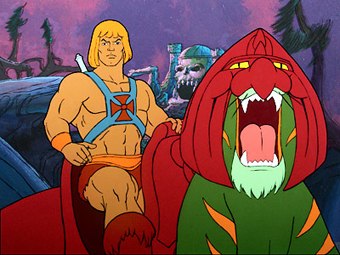
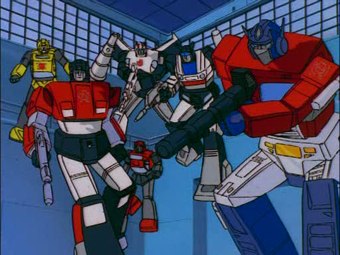
The impact of deregulation on children's programming was astounding. Cultural historian Tom Englehardt noted that between 1984 and 1985 cartoons featuring licensed characters increased by some 300%. By the end of 1985 there were more than 40 animated series running concurrently with licensed products and active marketing campaigns. Some shows, such as the Filmation/Mattel collaboration He-Man and the Masters of the Universe (1983) were among the most-watched animated shows in television history. Other properties, such as the Transformers (Marvel/Hasbro, 1984), are still selling products at a steady pace 27 years later. Millions of action figures found their way into the hands of young boys, but the lucrative market for little girls was not ignored.
Licensed characters like My Little Pony (1986, developed in conjunction with Hasbro) charmed prepubescent female audiences. The American Greeting Card Company, through its "Those Characters from Cleveland" division, managed to develop an entire series based on their licensed characters: Kideo TV (1986) marketed The Get-Along Gang, The Popples, and Rainbow Brite to young girls. That same greeting card company had long since cornered that market for grade school girls with its saccharine production of The Care Bears series in 1985. For those in their tween years, Hasbro helped to develop a show called Jem in which pre-teens could watch a female rock-star fantasy and then go out and purchase the products accordingly.
These new, deregulated shows were partnerships between toy companies and select animation studios, and inevitably corporate guidelines dictated much of the show's content. Writing in issue three of Cereal Geek, a British magazine devoted to 1980s animation, Robert Lamb noted that:"Shows based on toy lines like He-Man, She-Ra, G.I. Joe, My Little Pony, etc., also had the added joy of input and supervision from their respective toy companies. Different deals were struck that determined how much freedom the studios had to create and how much oversight the toy companies would wield…Hasbro maintained complete script control (over G.I. Joe) in order to showcase the toy line over the needs of the story…Hasbro mandated that all the cast be on the screen as much as possible. This played havoc with staging and drove up production costs."
Another casualty of placing product over story, according to Lamb, was that continuity suffered, at least partly because writers had limited power over their stories.
In short, many of the toy-based series birthed by deregulation tended to be cookie-cutter affairs, with clearly defined good-vs.-evil storylines, recurrent plots, and few attempts to establish backstory or give much depth to characters. Another limiting factor was the fact that one successful formula or toy spawned imitators, and originality was the prime casualty in such cartoons. For example, Hasbro's Transformers (Marvel/Sunbow) and Tonka/ Hanna Barbera's Challenge of the Gobots both aired in 1984 and seemed to share the same storyline: Battling cadres of robots end up taking their centuries-long battles to Earth and find human allies. It is probably no surprise that as late as 1987 the Lightyear/KK&D/Coca Cola production Dinosaucers recycled those exact same elements using alien dinosaurs in the place of robots.
The demands of a 65-episode "season" meant that the animation was farmed out to many sources, and at times it is amazing that some of them look as good as they do. Others, such as Thundercats (Rankin-Bass/LJN, 1985) were marred by stiff and inconsistent animation even when it featured interesting plots. That did not keep Thundercats from becoming America's most popular syndicated cartoon show within a year of its debut, but few would claim that animation reached new heights in shows like Bravestarr, The Adventures of Teddy Ruxpin, Silverhawks or Dragon Flyz.
Perhaps the most lasting legacy of the Golden Age of Deregulation (roughly 1983-1989) was that it dominated the memories of a generation. Many college-age Americans spent their formative years during the Fowler era, and He-Man, She-Ra, and the Transformers are now cherished relics of their childhoods. It was they who collected nearly one billion plastic figures, strained their thumbs on Atari games, wore out batteries by the truckload, and spent dreamy afternoons by the TV watching Voltron and Legend of Zelda.
Deregulation, in the final analysis, did not make American animation any better, did little to further the art, and negated creativity and originality as benchmarks for animated TV fare. It can be argued that the decade prior to deregulation produced few outstanding programs, but at least they engaged some level of the imagination. In the age of Ronald Reagan and Optimus Prime, this claim was harder to prove. Cartoon shows of the deregulation era were too often nothing more than soulless vehicles for product promotion, brightly colored symbols of corporate capitalism's ascendancy over children's entertainment.
This column completes my 11th year as a freelance commentator for AWN. I cannot thank the site enough for giving me the opportunity to share my views on animation, history, and popular culture with you. Everyone seems to have a blog these days, but I hope to bring you, my esteemed readership, something unique and thoughtful every month. Without your hits, comments and support, the column never would have made it this far. Thanks to all!