
J. Paul Peszko investigates Vicon's new MX line, the next generation suite of realtime optical motion capture systems.
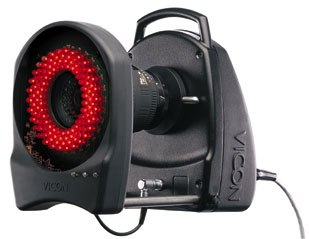
Vicon MX is a big step forward in the world of motion capture.
MoCap is part of the buzz at SIGGRAPH 2004. There's ILM's infrared capture system, which was used on Van Helsing, Sony's Imagemotion performance capture system launched for Polar Express and Vicon's new MX suite. This is the next generation of realtime optical motion capture systems that greatly improves the quality, flexibility and ease with which motion capture data can be applied to realtime and off-line applications ranging from film, television and video games to virtual prototyping, scientific visualization and biomechanical analysis.
Headlining the new Vicon MX suite is the MX40. According to Jon Damush, business development manager for Vicon, "The MX 40 is the world's highest resolution motion capture camera. It is proprietary architecture built completely in-house. Its foundation is a four-million-pixel center that runs at full resolution all the way up to166 frames per second. It can actually run all the way up to 10,000 frames per second at lower resolutions. So, it's pretty versatile."
Just how much of an improvement is the MX40 over previous models? "Dramatic," Damusch claimed. "You could literally say on the order of magnitude in terms of the data quality that's achieved. There are actually two main improvements that come with the MX40. The most visible change is obviously that it's four-mega-pixels. But what's going on under the hood is as equally impressive. And that is the cameras now can do their own gray-scale processing."

Jon Damush, Vicons business development manager.
In the past, optical motion capture systems would have to pick a target threshold. They did this by sending out light via a strobe from the front of the cameras and they would record the reflections off a plastic marker. Damush explained, "What we would basically do when we engineered the camera we would pick an intensity that we would expect the reflection to come back at. And we would say, if we get a reflection below this intensity, don't pay any attention to it. And if you get a reflection above this intensity, it's probably a reflected marker. So basically we're picking a very specific line or threshold, if you will, that we expect to get a reflection back above. So what that means is, when you had reflections right around that line, they would sometimes be visible and sometimes not be visible, and that would typically show up on the edges of the reflection." That leads to what is typically referred to as pixel noise. "And that's inherent to just about every optical motion tracking system there is," said Damush. "By using a gray-scale, we get for every pixel on that sensor 256 shades of gray. Now we no longer have to guess at a value to threshold. We get the whole image, and we can process that whole image to come up with the 3D position of the data.
In layman's terms, what does that mean? "We're no longer using a light switch that's on or off. We're now using a slider. You can see value all the way along the scale. Which means that the accuracy that the camera produces is a) about three times better just from the number of pixels that are present and b) about 10 times better due to the fact that we can now use gray scale. Our previous generation systems would have data accuracies on the order of a 10th of a millimeter to a half of a millimeter. Now we're down to the sub-hundredths of a millimeter."
If you don't think that's dramatic, just ask Brian Rausch, manager of Motion Capture and Scanning at Sony Computer Ent. of America, why they purchased the MX40. "Grayscale, grayscale, grayscale. I decided to go with the MX40 system over others for the "pixel handling" rather than a pixel being only ON or OFF it now has 256 levels of gray to help control the circle of a marker. We are looking forward to the noise reduction that this promises to bring us."

Vicon MX40 is not just a camera but a complete system.
But dramatic improvement is nothing new for Vicon. "During its 24 years at the vanguard of the motion capture industry, Vicon has introduced more than 20 ground-breaking cameras. Every increment of camera performance has been larger than the one before, and the MX family is no exception. The cameras' supreme specifications speak for themselves and are a tribute to our engineering development team. The four-million pixel MX40 is the highest-resolution, high-speed, image-processing camera in the world, in this or any other market," boasted Dr. Julian Morris, ceo of Vicon and parent company OMG plc. "But the most important message is that all this resolution and processing power makes motion capture simpler, faster and more useful than ever before."
The Vicon MX40 is more than just a camera. It's a complete system. So are there any additional innovations as far as the whole system is concerned?
"The cable lengths are greatly improved," Damush suggested "Our standard cable length now is over 150 feet, which enables use in very large studios akin to what they use in a lot of big films today." Before the cable length was about 100 feet. So all in all that's a 50% improvement. Even more dramatic is the way they have compacted the system. "We've minimized the equipment profile at the central point so that all the equipment you need can be rack-mounted along the lines of your other audio visual equipment very easily." All you need to do now is pop them into your existing studio racks and run cables all the way out to the cameras. "In our previous systems we had these components in the middle (of the camera) that would basically multiplex a cable into multi-cables and you had to strap those in. Now you don't have to that anymore."
Of course, when we talk about the software, the improvement there seems even more dramatic. The software that comes along with the MX suite is called IQ2.0. If you think the name is a little presumptuous, think again. As Damush explained, "Each camera now is essentially its own computer. It's doing that gray-scale processing on board so that it minimizes the work that the central computer has to do. Combine that with some of the biomechanics work that we have from our other markets and you have IQ, a software that takes all that knowledge of both what the camera provides and the work we've done in the biomechanics world." That knowledge of the human body allows the MX40 to do some pretty incredible things automatically. "So, when we have a performer that we're capturing, we will actually be able to tell you what their bone lengths are a) because of the accuracy of the system and then b) because of the biomechanics background that our software uses. Once we know that information we can create that person's skeleton, and then we use knowledge about their skeleton and the fact that they're humans to fill in the gaps in motion capture data. Even the hardest moves can be pretty much automatically processed. When it comes down to the studio level, especially when they start shooting hundreds of moves per day, it winds up saving them days if not weeks of man-hours."
What about support for the Vicon MX suite? Just how good is it? "Past support is one of the main reasons that I have chosen Vicon," stated Sony's Rausch. "They have always been extremely helpful and responsive to any concerns that we had, tools that we needed, or hardware replacements and upgrades on the spot." Another important point is the fact that Vicon has purchased the motion capture firm, House of Moves, which licenses Diva software. "Diva is a large, vital, ever growing portion of our pipeline," says Rausch.
The Vicon MX line, which started shipping in July, will be on display at the Los Angeles Convention Center, Aug. 10-12, in booth #1346.
J. Paul Peszko is a freelance writer and screenwriter living in Los Angeles. He writes various features and reviews as well as short fiction. He has a feature comedy in development and has just completed his second novel. When he isn't writing, he teaches communications courses.