
Laurent Alquier took in all the wonders of SIGGRAPH 2007's Electronic Theater and Computer Animation Festival, finding a wide spectrum to the reality of CG.

The CG creations on display are more than just for entertainment. All images courtesy of SIGGRAPH. © MIRALab - University of Geneva.
For the past 34 years, artists, researchers, students and industry professionals celebrate their achievements at the International Conference and Exhibition on Computer Graphics and Interactive Techniques, commonly known as SIGGRAPH. The best way to get a sense of the scope of these accomplishments is to attend the Electronic Theater, key event of the Computer Animation Festival.
The logo of SIGGRAPH 2007 in San Diego was a stylized face of an android, reminiscent of Futura, the robotic female from Metropolis. As in Fritz Lang's masterpiece, the driving force behind computer graphics is the quest to capture reality, recreate it, give it life and, eventually, transcend it.
Serving as this year's chair of the Computer Animation Festival, Paul Debevec is no stranger to SIGGRAPH or the Electronic Theater. His first film, The Campanile Movie, based on his Ph.D. work, was presented in the Electronic Theater in 1997, while his first paper appeared in SIGGRAPH proceedings the year before. He served on its jury a few times since. Under his guidance, this year marks a return to a more balanced selection of animations, with a larger place given to research work.
Capturing Reality
Capturing reality is a recurring theme in Debevec's work. From HDRI techniques to Light Stage, an aspect capture system used in several movies from The Matrix to Spider-Man 3, the techniques he developed to facilitate the realistic integration of real and computer generated imagery have influenced computer graphics for more than a decade.
From the complex behavior of skin deformation (Capturing and Animating Skin Deformation) to recreating the look and feel of haute couture garments too fragile to observe in motion (High Fashion in Equations), representation of reality is still at the core of research in Computer Graphics.
The SIGGRAPH 2007 Papers Preview, narrated by CG pioneer Jim Blinn, showed a brief summary of the record 108 papers accepted this year. These papers are representative of the core areas of research in modeling, animation, and rendering. The focus of many papers this year is on particles, flames, liquids and cloth simulations. Submissions also span into the related areas of imaging and visualization, addressing image processing into multiple formats, such as content aware image resizing for use on cellphones or challenges created by gigapixel photographs. Other prominent topics are related to non-photorealistic work with interactive scientific cut outs or watercolored videos. Some would say they are just an excuse to abuse a digital bunny and a mutant armadillo.
It is easy to look at current state of computer graphics and assume that we have already discovered all there is to know. This selection of papers shows that this assumption couldn't be more wrong. There is still plenty to discover.
Beyond research work, Debevec's dedication and technical knowledge of Computer Graphics are clearly visible in the instructions he gave to this year's jury: comb through 905 submissions (from 726 last year) to select a state of the art and innovation across all aspects of computer graphics --storytelling, science, broadcast, games, visual effects, art. The result is a selection of 39 pieces for the Electronic Theater and 93 in the additional Animation Theater.

Games like Gears of War show off the technology advances that have happened over the past years. © Microsoft 2006.
Realtime Advances
Among many firsts this year, such as the submission of movies in high- definition video, there was a major representation of realtime technologies, starting with the pre-show event.
The startling contrast of moving from a game of Plasma Pong with realtime fluid dynamics simulations to a game nostalgia piece with classic arcade games such as Asteroids, Tempest and Star Wars, projected in vector graphics as a laser show was an experience only possible here. The best part of the pre-show was the presence of celebrity players at the controllers of these games -- CG pioneers Blinn and Ken Perlin, Glenn Entis (VP, chief visual and technical officer, Electronic Arts, and featured speaker this year) and John Knoll (co-author of Photoshop and visual effects supervisor at ILM).
Later on, NVIDIA Real-Time Graphics Research: The GeForce 8 Demo Suite and Game Technology 2007 showed how far we have come in 30 years of advances in realtime rendering. Using GPUs for realtime effects and physics simulations, these two pieces of the show demonstrated the jaw-dropping realism of next-generation games. Realistic rendering of human skin, waterfalls, complex character rig and deformation, interactive, destructible environments and physics simulation are now becoming well established features of modern realtime entertainment.
Looking at the lush environments of Crysis or the grittier Gears of War, it is difficult to believe that, only a few years ago, these effects required several hours of calculations. This breakthrough is welcome news for impatient gamers. Once photorealism becomes the norm, creativity in gameplay and storytelling will finally become important again as demonstrated by Valve's Portal and its mind-bending use of physics puzzles, teleportation and anti gravity devices.

Children of Men displays photoreal CG and its integration with film powerfully. Courtesy of Framestore-CFC. © Universal Pictures.
Reality Movies
While realtime effects are the new frontier of Computer Graphics, visual effects in movies are becoming more mature. This year's selections from major studios show how these visual effects can serve storytelling in multiple breathtaking moments.
The birth sequence in Children of Men is a stunning example of perfect integration between CG and film, rendering a powerful moment in the story with an incredible level of details. If watching that sequence the first time in the movie was an intense surprise, it was nothing compared to witnessing how Framestore CFC actually tracked a plastic prop and replaced it with a credible, wet, cold and screaming newborn.
Visual effects were also a key storytelling tool in Pan's Labyrinth. Without them, blending the cold reality of Spain's civil war and the fantasy of a little girl would have been impossible. CafeFX provided the foundation that allowed Guillermo del Toro to take us seamlessly in and out of Ofelia's dreamworld, so effortlessly that we are left wondering if it wasn't real after all.
At the other end of the spectrum, a preview of the upcoming performance capture movie, Beowulf, showed how computer graphics can shape the whole reality of a story, raising the bar beyond Robert Zemeckis previous attempt of The Polar Express. While some scenes from the preview looked spectacular (Angelina Jolie as a shape shifting demon, in particular), I couldn't help thinking that the main character still looked a little stiff. The preview left me with the impression that completely virtual photorealistic actors still have a way to go. It will be interesting to see how far we are from leaving the uncanny valley when the movie is released on Nov. 16.
Maybe the difference between the two performances was that the water creature had some fantastic element to it while Beowulf tried hard to look natural. After all, Spider-Man 3 is filled with a gallery of virtual actors, which, because of their fast paced action (Spidey, Sandman, Venom, New Goblin), come out perfectly credible. The fact they were masked most of the time didn't hurt either. The other two characters from Spider-Man 3 illustrate another recurrent theme in this year's edition of the Electronic Theater, and in SIGGRAPH in general -- as techniques mature and computational power increases, it is becoming possible to represent complex natural or supernatural effects such as the sentient goo of Venom or the living dust of the Sandman.
Smoke on the Water
It is easy to run out of superlatives with this year's selection of movies, in particular when it comes to vfx involving fluid simulations and volumetric smoke. In U2 and Green Day's video The Saints Are Coming, the interaction between virtual objects and water in news footage was recreated to show what might have happened in an alternate reality. Layers of dust, smoke and debris were used by Double Negative in World Trade Center to visualize what actually happened with startling realism. This was an even greater challenge, as these images have been extensively documented by live news footage and left no room for mistakes.
Pirates of the Caribbean: At Worlds End was represented by two reels. The first was ILM's 2007 creative trailer in the form of a vfx factory, in which digital pirates shared an assembly line with robots from Transformers, before plunging into a giant vortex of simulated water. The second reel showcased Digital Domain's voxel based STORM system -- from waterfalls and mist at the edge of the world in At Worlds End to smoke and dirt at Iwo Jima in Flags of our Fathers and Letters From Iwo Jima. Still in the liquid element, Surf's Up: A Practical Guide to Making Waves showed waves simulations with both a stylish and realistic feel, worthy of the best surf documentaries. Finally, Scanline VFX followed up with the Flow movie from last year with their fantastic work on 300's Liquid Battlefield. Their high-definition fluid simulation helped invoke one of the highlights of 300, a lyric scene that communicated the fury of an ocean storm with the breathtaking details of an animated painting.
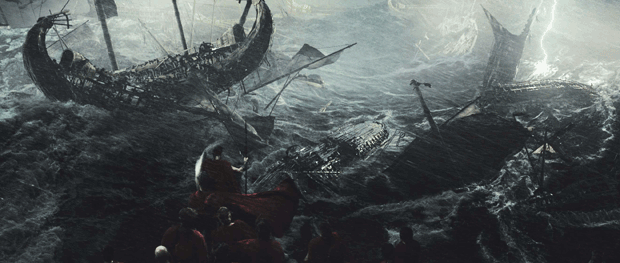
300's Liquid Battlefield is a perfect example of the growing extreme of visual effects. moving from photoreal to stylized looks. © Warner Bros.
Extreme Realities
There were no effects of water or smoke in this year's smaller selection of ads, but there were plenty of complexity and extreme visuals. Two movies in particular pushed twisted realities to an absurd conclusion - equilibrio's unbalanced bodybuilder and Raymond's unfortunate guinea pig were fun examples of experiments that had run amok.
As in 300, Vigorsol: The Legend gave a stylish, painterly feel to its environment while its fire-fighting squirrel went to extreme measures to save his beloved forest. Sears Tools Arboretum was a hypnotic, seamless blend of organic materials and tools with a uniquely ambiguous effect. But the most impressive piece of extreme reality this year was the live action tumbling effect from Weta Digital's Travelers: Snowball ad, with a result previously seen only in the cult PlayStation game Katamari Damashii.

CG work has long been part of commercials, but HP Hands Paulo Coelho highlights the experimentation that takes place in advertising. Courtesy of Motion Theory.
The remaining ads were more artistic and poetic. Happiness Factory answered the questions: How to visualize joy? And what happens inside a soda vending machine? The wonderful series of ads for HP was represented by HP Hands Paulo Coelho, with an exciting blend of symbolism and magic, taking the viewer on a visual journey through the imaginary world of the author of The Alchemist.
Finally, one of the rare artistic experiments in this year's selection, Swirl, used Fluid Motion Simulation to create an animated sculpture that certainly left a few people in the audience scratching their heads.
Back to The Basics
Great visual effects are only means to an end -- telling a great story. This year's studio productions and student work had two major traits in common -- over-the-top comedy and a stylish, cartoony feel.
Blue Sky Studios' No Time For Nuts sent their mascot, Scrat, through a hilarious, fast paced run after his beloved nut through Time. Pixar's latest short from Gary Rydstrom, Lifted, put a sleeping farmer through the abuse of an alien abductor in training. Blur Studio went for a surrealistic duel straight out of Jules Verne's worst nightmares with A Gentlemen's Duel. While all three were impeccably directed and extremely funny, they had the feel of polished productions one could expect from large studios.

Blue Sky Studios' No Time For Nuts showcases the software advances has allowed CG artists to bring more and more classic cartoon elements to CG than ever before.
As in previous years, works from students and smaller studios distinguished themselves with unique features. In Burning Safari from Gobelins, a group of robots from outer space make first contact with primitive apes, with a result as painful as it is abrupt. The short is produced with a successful blend of traditional animation with computer graphics that gives it a very distinct 2D feel. The Itch's surreal story was well served by its very old fashioned, simple 3D style, while The Recent Future Robot: HELPER Z drew rounds of applause with its brutal, slapstick humor.
This year's award winning movies went far beyond storytelling and visual effects. Each one explored the humanity and emotions of a character who has lost something precious: hope, love or usage of his legs -- and eventually finds redemption in unique ways. All three movies were rewarded for their very high production value, their artistic vision and the emotions they communicate.
Winner of the Best of Show award, Ark, was the only movie in this selection with a darker, more sinister theme. With a mix of realism and caricatures, blending CG characters in extraordinarily detailed photographed miniatures, this short takes you on an individual journey into memory and nightmares, as all hope for humanity is lost to an unforgiving virus.
The Jury Honors was awarded to Dreammaker, a graduation project from the prestigious Filmakademie Baden-Württemberg in Germany. Shot for more than four years, Dreammaker tells the story of an old misanthrope alchemist obsessed with the quest for the dream of his lost love. Actually, this movie was so long, a special trailer had to be made to fit in the Electronic Theater selection. Fortunately, the complete version was part of the selection of the Animation Theater.

Best of Show winner Ark mixes reality and fantasy into one breathtaking experience. © Grzegorz Jonkajtys, Marcin Kobylecki.
My personal favorite, En Tus Brazos, from Supinfocom Valenciennes, a prolific French school, received the Award of Excellence for its dynamic, perfect capture of the spirit of tango stolen from a careful study of real dances. Taking inspiration from film noir movies and artists, this short invoked a rare emotion by portraying the greatest tango dancer in the world recovering usage of his legs during an imaginary dance in the arms of his wife. As a genre, Computer Graphics needs a lot more movies of this caliber.
Computer graphics are so pervasive; it is easy to take them for granted. Watching the Electronic Theater is a perfect antidote. It is a fantastic way to restore that magical sense of awe that comes seeing things again for the first time.
Laurent Alquier received his PhD in Computer Vision from the University of Montpellier II (France) in 1998. A year later, he joined Johnson & Johnson in New Jersey , where he works as a software engineer in Pharmaceutical Research.
In 2000, his interest for computer graphics turned into something more serious than a hobby when he discovered online communities such as Renderosity. As part of this community, he created several contest winning images. In 2004, he joined the Renderosity team as a columnist and a moderator dedicated to e-on software's Vue Suite
Alquier is a fervent advocate of the democratization of computer graphics tools. His figurative imagery is at the crossroad between virtual photography and painting, taking inspiration from fantasy illustrators, sci-fi movies, horror writers and photo reporters.