
This isnt an episode of CSI. Bruce Shutan investigates the real life uses of 3D in forensics and medical science.
The skys the limit for vfx artists and animators specializing in the hotly emerging area of forensics and medical science, but dont be fooled by fictional portrayals on television.
A lot of people think if they get into forensic animation that its going to be like CSI, observes James Murphy, whose Virtual Partners Training Center (VPTC) in Green Bay, Wis., is the first animation training center to offer forensics education. Not going to happen. Most forensic animators will probably be in a courtroom once or twice every three years. Its not very dramatic and can be boring. Theres a lot of interaction with attorneys and expert witnesses, and youre there to simply help visualize what the experts witnesses are attesting to.
Even without the Hollywood sizzle, there are plenty of pluses along this seemingly unorthodox career path. Its a market where you can really learn things about what you are animating, according to Michael Astrachan, studio director for XVIVO LLC, a 3D animation facility in Rocky Hill, Conn., for which hes also one of three partners.

His firm specializes in translating complex medical information into scientifically accurate and visually compelling presentations for scores of blue-chip clients, including Merck, Pfizer, GlaxoSmithKline, Yale University, Alcon Surgical, IBM, Canon, Lego and Hasbro. The companys award-winning mechanism-of-action animation offers extraordinary insight into how drugs work at the molecular level and parts of a fully implantable artificial heart mimic the real thing.
Too Much Information
One slippery slope for vfx artists and animators is augmenting reality to sway juries. Too much detail can get cases tossed out of court, with Murphy citing as the most infamous example a forensic animation short used in the O.J. Simpson murder trial depicting a black man as the perpetrator. Indeed, he says topographic data neednt be spelled out to the nth degree for most forensics.
We spend our careers making things look more fantastic, so in that regard it can be a detriment if you have a background in visual effects and try and go into forensics for court cases, says Perry Harovas, director of visual effects for XVIVO and a partner in the firm. If anyone knows this, its Harovas. Prior to joining XVIVO, he worked in vfx for about a dozen years on projects that included several features with legendary director-producer Roger Corman.
He believes another draw to the field is that for a lot of the stuff were depicting nobody knows what it looks like, especially at the molecular level, because these objects are smaller than the wavelength of light and, therefore, have no color. The colors are all inferred. Its either a combination of what the client wants for a color palette or what has been shown in their field to be the specific colors for parts of cell structure.
The implication: endless opportunities for vfx artists and animators to write custom-dynamic simulation for some of these processes because theyre incredibly complicated -- far more than a T-Rex stomping on a jeep, he enthuses. The challenges for visual effects people are varied and great.
Boning Up on Body Parts
The latest and greatest techniques and breakthroughs in 3D animation design visualization applied to forensics and medical science with the help of 3ds max, Maya and LightWave arent taught in college. Which is why Murphy founded VPTC (only recently has he seen other training centers finally add this area to their curriculum).
The school holds classes three days a week for eight to 10 hours at a time, covering a plethora of material, video samples from actual cases, some field work measurements and accident scene photography, recommended reading and resource lists to help round out the classroom learning. Classes ideally involve six to eight students from numerous backgrounds, many of which are skilled animators. Topics include legal vocabulary, rules of evidence, working with lawyers and experts, practical tips and hints.
Most of the work is used to win personal-injury cases in civil court, the lions share involving vehicular accidents vs. medical malpractice, shootings, environmental or intellectual property law. Companies specializing in this technology application tend to lump together the forensic and medical science areas because they can involve significant damage to the human body.

That means its critical to have a working knowledge of body parts. Explains Murphy: You ought to be able to identify specifics in depth kind of on demand: bullet entered left of the zyphoid and lodged over the right iliac arch. First time you hear that youre gonna go, Huh? flipping through the anatomy books figuring out the trajectory. It helps to be able to communicate with experts in the field and lawyers for depositions and cross-examination (such interaction is practiced through role playing exercises).
Dave Wright, a VPTC instructor and president of a forensic animation company called Wyeknot inc., suggests that those who want to break into the field have an ability to do basic geometry and algebra, simple programming skills to create or modify scripts or expressions, and familiarity with principals of Newtonian physics for accidents (especially the vehicular kind).
Still, there are limits to what new recruits need to know. As a forensic animator, he quips in an e-mail posted on the VPTC Web site, you shouldnt be called upon to compute stopping distances from skid marks.
Wright says vfx artists and animators should be proficient in the use of tools that provide accuracy, cost control and reduce therbligs, which is a unit of measurement engineers use for time-motion studies. Theres an increase in demand for higher realism, he notes, adding that industry practitioners need to work within a 3-7 reality quotient range and avoid the sensational.
Surviving Urban Warfare
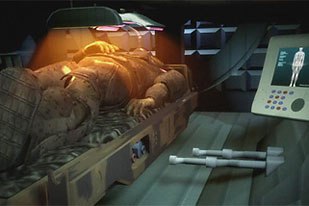
On the other end of the spectrum, XVIVO has provided a fascinating glimpse into potentially revolutionary applications for medical science. The Defense Advanced Research Projects Agency, which serves as the Pentagons R&D arm, recently commissioned the company to conceptualize injury stabilization protocol for soldiers of the future in a 60-second animation short.
The aim is to enhance the role of medical practice in combat and remote-access situations and, thus, increase the survival rate for urban warfare casualties. This requires realistically projecting advances in robotics and machine intelligence as well as portraying unmanned robotic casualty retrieval systems that travel with combat squads.
The thinking is that a soldiers healthy 3D CAT scan data, imbedded in his dog tags, would be retrieved and compared to a scan autonomously performed in the so-called SurgiPod vehicle so that when an injury occurs in battle the patient could be sedated and stabilized with sophisticated surgery, then evacuated to a manned care facility.

When developing the animation, Harovas sought to add dynamic elements to the scene, one of which was an explosion. Rather than rely on stock footage from an off-the-shelf CD library, the Mastering Maya co-author used Mayas Fluids for a 2D blast whose simulation, he says, is especially effective when correctly placed in the shot.
Adds Astrachan: We stepped on the footage quite a bit in the beginning section so it seemed like a gritty heads up display that the medics would be wearing, and we used after effects with several different layers of static and some text animation sequences.
A cylinder with text on it was placed around the camera, whose physical rotation was recorded and kept 100% in sync when action slowed down or sped up. In effect, the creation of a heading tape would enable soldiers (as is the case with helicopter pilots) to know which direction they were facing on a real battlefield.
We also used a couple of layers of Mayas deformers to give the impression that there were newspapers blowing around the street -- one of the things we always want to put in to help liven up the environment but usually dont have the time, Harovas reports.


Importance of Standards
Leaders in the field are working hard to raise the bar on a commitment to excellence. Wrights pet project is to ensure that forensic animation meets both legal and scientific standards in the eyes of judges who determine whether the material presented in each case is fair and accurate. If and when it is admitted, he explains, an animation carries different evidentiary weight than witness testimony, physical or hard evidence, or an experts opinion.
His larger point is that forensic animation professionals need to be proactive to insure their work meets the highest possible standards. For example, FBI bullet analysis has proven to be of questionable forensic value when a metallurgist testifies that two bullets are analytically indistinguishable.
According to the FBIs own estimate, comparative analysis of bullet lead evidence has played a role in at least 2,500 cases and 500 trials during the past three decades. Wright says each of these cases must be reviewed and judges, prosecutors and defense attorneys must be notified not just for exoneration of the innocent but apprehension of the guilty.
At the end of the day, standards help animators make sound judgments in difficult situations. One of the dilemmas of the adversarial legal system is overt and subtle pressure to put spin on an animation to favor one side, he explains. Counter balancing spin is opposing counsels right and obligation to examine and question all aspects of the creation of the animation.
Bruce Shutan, a Los Angeles-based freelance writer, has written for several entertainment publications and Websites, including Daily Variety, Weekly Variety, emmy, the 55th Annual Emmy Awards program, Below the Line News, Film Score Monthly, DRUM! and OnlineRock.com. Shutan also specializes in writing for the human resources and employee benefits trade press.