The director of the latest Dr. Seuss adaptation discusses the challenges of bringing Ted Geisel's darkest and most personal work to the big screen.
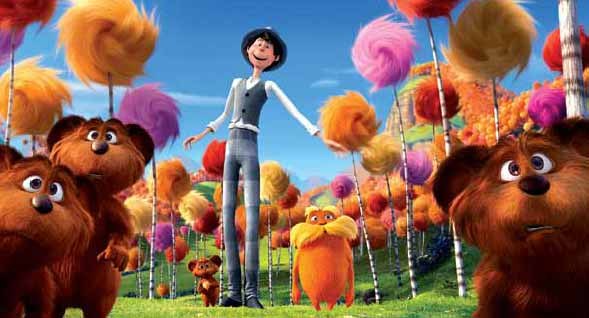
The Lorax (opening today) proved even more daunting than the last Dr. Seuss adaptation, Horton Hears a Who! "The Lorax has its challenges because as a film we're asking audiences to grapple with issues that have real weight to them and to find the expression of a movie that can both do justice to his intent as well as realize the storytelling that is highly entertaining and engaging," suggests producer Chris Meledandri, who's managed to achieve the best of both worlds as an indie with his Illumination Entertainment and association with the Muc Guff animation studio in France, as well as being partnered with Universal. I discussed some of the challenges and opportunities with Lorax director Chris Renaud.
Bill Desowitz: What was it like tackling The Lorax?
Chris Renaud: A very challenging story to make a movie out of, which was the great part as well. As depicted by Dr. Seuss, it's a very serious message [about saving the trees] and the book in many ways has a very somber tone, 'cause it's a cautionary tale. So our challenge was to make a very entertaining, family-friendly movie that lets you in while maintaining that message.
BD: And what about the animation challenge of making it more dynamic but true to the original design?
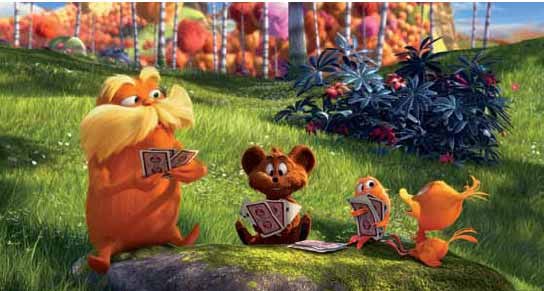
CR: One of the funny things that we discovered was that because they don't look like trees or animals that we understand or relate to directly, you have to create, based on Seuss' illustrations, something that's believable. Because the Truffula trees are beautiful -- they look like cotton candy. But, by the same token, you have to create something that the audience feels something for. So it can't just feel like Candy Land; you have to buy it as a real forest. So we looked at Birch trees and then figured out how to make those wonderful illustrations work in a 3-D movie. It's a real fantasy forest that you could relate to when it's being chopped down.
BD: And you had a small visual clue in the book that enabled you to create Thneedville as a combination of Disneyland and Vegas?
CR: Yes, what happened was we went round and round. We had a design that was very city-like and very dense, which wasn't quite working. But we went back and looked at a little drawing in the upper corner of the page when the little boy is first coming to look at the Lorax. And we sort of used that as our basis: it's got these big, curvy roads and a couple of building shapes. In some ways, the easier choice would've been to create a Blade Runner-like dystopian future with smog. But of course we wanted to create something that was fun and entertaining, but in some way relates a little more about where we are today, with inflatable bushes and plastic flowers and fake nature that still has a sense of fun, much like Disneyland or Las Vegas or Dubai. So, in the movie that felt like a great way to go but also suggesting that you have to be careful to maintain balance with nature so it can be sustained.
BD: What were the technical challenges in creating a world filled with hair and fur and the crowds? What did you do at Mac Guff?
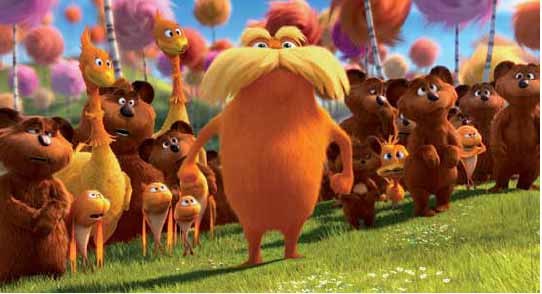
CR: We did quite a few things that were new to us. With Despicable Me, we made very clear decisions with an existing pipeline, but we also knew it was our first film and there were a lot of things that had to be worked out with the cloth effects. But we didn't want to bite off more than we could chew. With this one, we decided to throw all caution to the wind and had a plethora of furred characters and environments. Every Truffula tree is a fur shader essentially; grass -- characters walking on grass; and large crowds of both animals and humans in the town of Thneedville; and of course in the forests. And we're continuing to master crowds for subsequent films like Despicable Me 2. The Minions are simpler characters but there's a nice hand-animated feel to the crowds, which we tried to maintain in Thneedville. Certainly some things are replicated, but we didn't use any software like Massive -- but certain spots call out characters in little background animations, which makes it fun. It gives that world life. I think at the end of the day, the crowds ended up being the most work intensive from the rendering point of view.


BD: How did you solve that?
CR: We had a lot of crowd animators. We did it in separate passes. We'd do the principal animation and then we had a special team that was the crowd animators and would have separate approval and ran in through. We developed a library of moves that we would replicate for some dancing.
BD: And most of it is done in Maya?
CR: Pretty much. We do use a proprietary renderer at Illumination Mac Guff, but essentially they're tools and plug-ins using Maya as a base. We use a very comp intensive process [with Nuke], compared, I think, to a lot of people. We get to a certain point in our lighting model and then finish it with comp. Actually, for the upcoming projects, we're looking at global illumination and displacement maps, which we haven't been using. But that's where everyone is. But we tend to do it with grading and comp, which, I have to say, I like very much. At the end of the day, even with global illumination, what I tend to find is, while it's great to have reality, what you end up needing is a heightened reality, so you end up tweaking it a lot anyway.
But one thing we did, which was different on The Lorax, was we didn't have lighting and comp very separate as far as approvals. We had the lighting and comp team work really hand in hand. And so when I was looking at shots to approve, they were at a finished point. So it was good, even with the cloth effects, the fluidity wasn't so much about the specifics of the tools but it was how we integrated them and where I checked into the process. The cloth effects were far and away improved over Despicable Me, where Pierre [Coffin] and I had to really watch for mistakes. This time our meetings were about creative decisions instead of being policemen.
--
Bill Desowitz is former senior editor of AWN and editor of VFXWorld. His blog is Immersed in Movies (www.billdesowitz.com), he's a regular contributor to Thompson on Hollywood at Indiewire and he's the author of the upcoming James Bond Unmasked (Spies), which chronicles the 50-year evolution of the iconic superspy from Connery to Craig.

Bill Desowitz, former editor of VFXWorld, is currently the Crafts Editor of IndieWire.