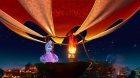
Catherine Feeny visits with Digital Domain to find out how they created a magical world for Ron Howard's latest blockbuster 'The Grinch.'
In the opening shot of "How the Grinch Stole Christmas," the camera takes a ride through the crystalline contours of a snowflake, transporting the viewer to tiny, whimsical Whoville. The journey sets the stage for a brief stay in a world where houses seem to spring from mountainsides, sunrises scream with color and one grumpy Grinch discovers love in the Christmas season. Faithful to the illustrations of beloved children's author Dr. Seuss (Theodor Geisel), whose book was published in 1957, Digital Domain (DD) helped director Ron Howard create a world that is at once magical and painstakingly real.

"Ron described himself as the keeper of story. He'd listen to ideas from anybody, but was very selective about what he would use," VFX supervisor Kevin Mack said. Sitting in the rustic, high-ceilinged Venice, Calif., offices of DD, Mack, CG supervisor Matthew Butler and compositing supervisor Bryan Grill agreed that working with Howard on "Grinch" was a uniquely collaborative process. Howard understood that the quality of the film depended on striking a balance between his own ideas and the ideas of his crew. "If the person who was doing the work had an idea that serviced the story as well as Ron's idea, he went with their idea because they would passionately execute it," Mack said. Ultimately, though, the team always had to answer the question, "Does this effect further the story?" Executive producer Nancy Burnstein and visual effects producer Julian Levy also were part of the team at DD, while Kurt Williams was the VFX producer for Imagine Entertainment.
The question became especially crucial because the crew was working with a story that is loved by so many. Mack excitedly said he'd discovered that each person on the crew had a personal relationship with the stories of Dr. Seuss. "I was raised on it, my kids have been raised on it and I found out that virtually everyone involved had the same exact experience," he said. Howard and DD worked to meld all of these ideas into a cohesive vision, while keeping in mind the familiarity of the viewing audience with this tale about the true meaning of Christmas. Production designer Michael Corenblith and director of photography Don Peterman echoed this sentiment in their interviews with CinematographyWorld.
Working with an imaginary world was both a challenge and a blessing for Mack and his team at DD. The ambitious nature of Howard's concept of "The Grinch" meant much of the atmosphere surrounding Whoville had to be created digitally. As the work progressed, Mack found that the more they created digitally, the simpler shots became. "We had this world, we could stage it, get exactly what we wanted, try different things -- once it's computer-generated, it's all one world and we have more control," he said. Sequences that initially were intended to contain physical backgrounds and elements became CG, as the difficulty of tracking in elements became more burdensome than animating them.
For instance, the sleigh ride the Grinch takes down Mt. Crumpit and into Whoville was shot with Jim Carrey (the Grinch) and Taylor Momsen (Cindy Lou Who) on bluescreen. The second unit shot background plates of a snowy hill in Utah, and the actors and the sleigh were to be composited into the shot. But the weather in the background plates of Utah wasn't the same as the weather in Whoville. Neither did the flora of Utah quite match the fantastical trees in Seuss' story. And DD had already created a photo-realistic sleigh for the shot in which all of Whoville's Christmas gifts teeter above a panorama of snowy cliffs. So artists generated the sleigh and the backgrounds, using a complex procedural system to create details such as swaying bags of gifts, and snow kicked up by the sleigh's runners. Even the Grinch's dog, Max, is 3D animation at times.
Howard initially planned to cut shots of the Grinch skiing down the hill with tight shots of Cindy Lou in the sleigh. However, Mack suggested adding a dramatic overhead shot of the sleigh going down the hill. After seeing an animatic of the idea, Howard agreed. Since much of the rest of the scene also was animated, the transition between the shots was smooth.
DD created tens of thousands of trees seen in the sleigh sequence and throughout the film. For the Christmas tree that burns in the center of Whoville, Mack had Butler and the team use L-Systems, a formal grammar developed by botanist-mathematician Aristotle Lindenmayer that can be used to define the branching structures of plants. Mack used the formula in "What Dreams May Come," "Fight Club" and again in "Grinch," though in a limited context. L-Systems produces realistic, organic-looking trees, but the huge output makes the technique cumbersome.

The trees that populate the hills surrounding Whoville required a different approach. "The audience sees the trees from many different angles, so the simplest method, which is to matte images onto cards that are facing the camera, falls down quickly," Butler said. Instead he and the DD team took a hybrid approach, minimizing the geometry of the trees and relying on the use of texture maps and shader tricks for realistic-looking branches. The challenge was to create trees that had volume and areas of transparency, so they stood up from a variety of perspectives.
The artists started with 10 proxy trees that could be tweaked to provide a wide variety of shapes and sizes. They created simple cone shapes in Houdini and "crumpled" the cones for variation. The team then rendered the trees in Renderman, adding complex surface geometry in the shader. The same device was used to create the faceted surfaces within the snowflake in the opening sequence of the film.

The weather became an integral part of the work that DD did for the film. Animators added 3D snow to more than 200 shots. "We created matte objects to hold out the snow so that it goes behind people and buildings. It also lands on surfaces, it sticks and melts," Mack said. Created in Houdini, the snow fell intelligently so that it stuck on certain surfaces -- like the crags in a mountain -- and not on others.
Grill supervised the compositing of up to 50 layers on complex shots, such as the scene in which the Grinch lifts the sleigh overhead. Disgusted by the Whos' Christmas revelry, the Grinch steals all of the town's Christmas presents and decorations in the middle of the night. As he stands outside his Mt. Crumpit lair on Christmas morning, he hears the Whos singing in celebration, even without their presents, and he begins to understand the spirit of the holiday. With young Cindy Lou imperiled on top of the sleigh full of gifts that he stole, the Grinch understands for the first time what it means to care.
In this shot, only the Grinch and a piece of the mountain ledge were actually on-set. The expressive skies were multilayered matte paintings created by Mack's wife, Martha Snow Mack. Then 3D transformations were applied to the 2D clouds, which moved in accordance with their proximity to the horizon line. The artists relied on Amazon Paint, Elastic Reality and custom tools to give the clouds form and motion.

Little wind or snow could be used on-set because the contact lenses Carrey wore made his eyes sensitive to irritation. Compositors added practical smoke and steam elements to the shots to add a sense of atmosphere and movement. They also used Elastic Reality, inferno* and flame* to give motion to the Grinch's fur, in reaction to the CG wind. "The practical elements really helped sell the wind. If you can't see the air, then you can only see its effect on the fur. Since there wasn't much of that, we had to actually try to make the audience see the wind," Grill said. In this scene and in many others, Grill also created snow eddies to add to the dynamism of the environment.
DD employed color correction in this sequence to add to the mood of the film. The scene takes place in pre-dawn light, so in the final print, the shadows are heavy and gloomy. However, the sequence was shot in bright light. DD toned down the highlights and the overall brightness of the film, so much so that in some cases they had to brighten the Grinchs face so the audience could see it. "We showed some of the test shots to Ron and to Don Peterman, the DP, and they loved the idea, so we effected every shot in that sequence," Mack said. "They shot the entire thing indoors under stage lights and the whole movie takes place outdoors under a sky -- it's quite a shocker when you realize that."
DD had significant creative freedom in designing Mt. Crumpit and the other mountains that surround Whoville. "We made a Mt. Crumpit and showed that to Ron and Michael and they would tell us, for instance, to make the peak a little more bent over. But for the most part, their attitude was, "That's great, keep going,' " Mack said. The team also created huge set extensions for Whoville itself.
Vernon Wilbert, the lead set extension artist on the show, based the designs for the Whoville extensions on the work of production designer Corenblith. In addition to studying all of Seuss' books, Corenblith researched mountain towns and architecture, especially the work of Spanish architect Antoni Gaudi, to arrive at the life-size structure of downtown Whoville seen in the film. The set was built on Stage 12 at Universal Studios, the largest stage on the lot. "It's the whole first row of buildings in the town square and one other little side street -- about 11 buildings. That's about 25% of the whole Whoville area," Mack said.

While Corenblith built the physical set, Mack took an evolutionary approach to creating the rest of the town. Wilbert and the team made many simple shapes for buildings and then would develop the ones that were promising and eliminate those that didnt fit in. "The Seussian style is seemingly very clear, but it's actually quite difficult to quantify, so we struggled a bit finding buildings that matched the style," Mack said.
DD took a similar approach to creating digital Whos. Mack received photos and a cast of the Grinch's head from makeup designer Rick Baker, upon which the team based a "Who construction kit." Essentially, they built a genome for the Whos. "We started with a generic Who and then had genes or 'sliders' for all of the various parameters -- how big their noses and ears were, how much their faces protruded," Mack said. For scenes like the Whobilation, Baker put up to 50 extras in Who makeup, and DD filled in the rest. In some shots, that meant more than 200 individually animated characters.

Crowds of Whos were created in Maya using no motion capture and no crowd replication. "We could reuse animation in different bodies and offset it in time. The animators got really into it," Mack said. To simplify the animation process, DD had libraries of clothing so that animators could concentrate on fabric simulation. "We had an approach defined for all of the different challenges. There's no way we ever could have animated hundreds of Whos for dozens of shots in the amount of time we had unless we built this construction kit. We had a very efficient pipeline," Mack said.
DD also filled in various brief CG sequences throughout the film -- CG termites in the Grinch's teeth here, moths loosed on the Whos' Christmas stockings there -- while Rhythm & Hues and Centropolis also contributed work to the film, DD did most of the content creation. Mack and his team not only realized the above-ground world of Whoville, they created a CG version of the underground tunnel that Cindy Lou takes from Whoville to the garbage dump near the Grinch's home. Special effects supervisor Allen Hall put Carrey and Momsen on rigs to simulate the motion of sliding down a tunnel, but they also had to get the Grinch's dog in the tunnel. "We couldn't get him on the rig or anything, we just laid him on a blue table and got him to roll around on his back. People were laughing as we shot and the camera guys were moving around trying to make it exciting -- it's just the dog lying down," Mack explained. They tracked the dog into the 3D tunnel along with the Grinch and Cindy Lou, and voila, the shot was a success. DD also did some shots of a 3D dog that whips right by the camera.
DD used traditional gags for other shots as well. The scene in which the Grinch sucks Christmas gifts into a big hose actually was shot in reverse. The special effects team built a device that would shoot the presents out, then filmed it and ran the film backwards. Similarly, when Cindy Lou's neighbor, Martha May Whovier (Christine Baranski), uses an industrial-strength machine to shoot Christmas lights onto her house, the machine really is pulling the lights off of the house.
But the heart of the film was CG. Howard had a firm plan that the film would contain 260 VFX shots all together. In the end, however, there were more than 300 major effects shots, not including rig removal and minor fixes. Digital Domain did 356 shots -- they count 40 minutes of VFX in the film, including 35 shots that are completely CG. Including the work done by Rhythm & Hues and Centropolis, "The Grinch" contained about 600 effects shots.
While at times the sheer volume of work was daunting, excitement and positive energy permeated the project and drove Mack, Butler, Grill and the rest of the DD team to create at a high level. "We proceeded with blind arrogance. The three of us wanted to work together and we were very confident about pushing some of the more-advanced ideas about virtual worlds," Grill said.
"It was amazing," Mack said. "Everybody involved -- from the costume people to the prop makers to the set designers, as well as everyone on our team -- was so enthusiastic, so passionate about making this film work, that everyone collaborated. It wasn't enough that their part of it be right. People made sure that everybody else was doing a good job, too." Somehow, it seems, the spirit of Seuss suffused the scheme serendipitously.
This article is copyright Creative Planet 2000.Courtesy VFX PRO.