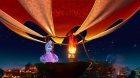
Ellen Wolff takes a look at new advances in Shrek 2.

If you happened to be cruising the parking lot at PDI/Dreamworks Northern California studio during production of Shrek 2, you might have seen something that looked like a stunt for the David Letterman show containers of water being dropped from ladders, with several people scrutinizing the splashes when the containers hit the ground.
We always shoot live-action references for ourselves, says Shrek 2 visual effects supervisor Ken Bielenberg about PDIs approach. On Halloween, we had cauldrons in the cafeteria with dry ice that gave off a smoky effect, and our effects guys came by and said Oh thats perfect! They shot footage and used that as reference, too. So audiences at Shrek 2 can expect to see more realistic-looking effects than theyve seen before in the computer-animated ogres stylized world.
Its a high standard to exceed, since the original Shrek won the animated feature film Oscar for 2001, the first winner in that category. Bielenberg, who earned a BAFTA nomination for the visual effects in Shrek, garnered wide attention for breakthrough work in several areas, including an innovative approach for animating fire. For this sequel, Bielenberg says, Weve raised the bar again. The overall level of complexity is two or three times the complexity of the first Shrek. For instance, in the forest scene where Donkey and Shrek first met there was a certain simplicity to the environment. There was moss-like grass and not much ground cover. This time, in a similar forest scene, the amount of detail that we have in the environment is much richer. There are vines and flowers and grass, and the leaves on the trees flutter in the wind. Its not photoreal, but the richness has increased.
For this new film, Shrek co-director Andrew Adamson paired with co-directors Kelly Asbury and Conrad Vernon, and the voice actors from the original are back in force. Newlyweds Shrek and Fiona (Mike Myers and Cameron Diaz) are once again accompanied by sidekick Donkey (Eddie Murphy). Theyre also joined by some major new characters the tabby cat Puss-in-Boots (voiced by Antonio Banderas) and a quartet of humans, including King Harold (John Cleese) and Queen Lillian (Julie Andrews) as Fionas royal parents.

replace_caption_shrek202_Bielenberg.jpg
Up Close and Personal
When it came to the look of the characters, reports Bielenberg, There were a lot of refinements done under the hood. Weve added more muscles, especially in the necks of the characters for example, the male characters have Adams apples now. Using the sci-tech Academy Award-winning facial animation system developed by longtime PDI animator Dick Walsh, the studio was also able to achieve what Bielenberg calls amazing close-ups where the acting shows through. Youre no longer looking at an animated character youre really looking at an actor.
Overall, asserts Bielenberg, We did very little to change Shreks and Fionas appearance, so theyre very consistent with the first film. Weve done a little bit of upgrading, adding a little bit more subsurface scattering on their skin, but not a lot, actually. We did use subsurface scattering to soften the area around Shreks nose, and also with his ears so that when theyre backlit the light shows through. And weve redone Fionas hair a little bit, but I dont think it will be an apparent change.
The bulk of visual development time was spent working on the new human characters and developing new technology for modeling and moving hair, says Bielenberg. Modeling hair is a real challenge because youre not dealing with something thats hard and easily definable. You have tens of thousands of hairs that youre trying to move around. We came up with new programs and techniques for modeling hair. Compared to PDIs previous method of modeling a clump volumes of hair, the new approach enables PDI to interpolate the movement of neighboring hairs on a much finer level. As a result, the characters hair parted in more convincing ways and the haircuts showed off some better-looking bangs.

There were many challenges with animating Puss-in-Boots: his fur, plume, belt and cape.
Faux Fur
Among the biggest challenges of Shrek 2 was creating the furry feline Puss-in-Boots. While the original inspiration for the character was co-director Andrew Adamsons gray cat, Bielenberg admits, Along the way I objected to that because having a gray cat next to the gray donkey wasnt working. So I brought in pictures of my orange tabby cat I was able to push that new look on the director!
We had to develop various things for this character, recalls Bielenberg. He has your standard orange tabby tail, and we spent a lot of time retooling our fur shader and tweaking his fur. Adding to the degree of difficulty presented by Puss-in-Boots was the fact that the cat wears a hat with a big feather plume, which he sweeps with a flourish. I tried to talk them into a stiff feather, but it just didnt have the same effect, so we went with a full plume. There were two levels of simulation the first level simulating the spine of the feather and what the overall feather would do. Then each barb on the feather had simulation so there was a nice fluttering.
Dressed for Success
The appearance of Puss-in-Boots was further complicated by the fact that the character wears a belt, and also a cape that ties around the front. So we had fur interaction challenges, explains Bielenberg. The biggest was the belt which was hand-animated that rides around on his body. We developed a simulation system for automatically getting the cats fur out of the way.
Bielenberg identifies clothing as an area of major R&D focus for PDI, noting that in the past, We made a lot of creative choices that were based on what would be efficient something thats tight-fitting versus something thats loose. On Shrek we always had belt lines. Thats something that we worked on for Shrek 2. We have a number of characters where weve figured out the blending from a procedurally-driven, tight-fitting top to a simulated skirt.
To achieve this, PDI used both its proprietary software and Alias Maya. As Bielenberg notes, The queen has a one-piece dress in which the top is procedurally-generated. That blends seamlessly into a Maya-simulated dress on the bottom, without a belt line. Weve worked on several things like that for the clothing in Shrek 2.When youre dealing with the Middle Ages there are some pretty fantastic outfits that you can use for inspiration. We developed a new fabric shader for this film that deals with threads running in different directions, which gives surfaces different properties. By tweaking the parameters, we could go from cotton to satin to silk.

Shrek and Fiona get ready to interact with fluids in this homage to From Here to Eternity.
The Cast of Thousands
While great care was lavished on the leading characters, PDI also focused on upgrading the secondary characters and the crowds that frequently populate Shreks world. There are shots where you see a half dozen people and shots where you see thousands, notes Bielenberg.
We thought we could improve the level of detail of the secondary characters, so we went back to the drawing board and remodeled the generic characters from the first Shrek. Secondary characters now have more high-resolution assets and more anatomically correct physiques. We had full skin shaders with subsurface scattering and wrinkles. The textures of their clothing also got a lot richer and the hairstyles were all redone. The background characters in Shrek 2 are convincing enough, believes Bielenberg, to get their SAG cards.
Dynamic Fluids
The irreverent humor that made Shrek so appealing often came from the films clever parodies of classic movies, and that tradition continues with Shrek 2. In a takeoff on the famous lovers on the beach scene in From Here to Eternity, Shrek and Fiona embrace as waves crash over them not a trivial task in CGI. Bielenberg admits, Its certainly difficult when were art directing fluids, especially when the fluids are interacting with characters.

Puss-in-Boots Breakdown Shots: (1) Red-green-blue icons represent animation joins in a wireframe view; (2) lo-res stand-in models allow for realtime feedback; (3) hi-res model is smoothly deformed into the final pose; (4) Finished scene.
To achieve this, PDI built upon the fluid dynamic systems that were first developed for the studios 1998 debut feature Antz, (a film for which Bielenberg was also visual effects supervisor.) The system, which won PDI scientist Nick Foster a technical Academy Award, enabled the studio to animate dozens of layers of water elements. The process entailed animating particles for the waves as well as various splash layers on top of them. PDI leveraged a lot of the water effects work that the company did last year for Universal Studios special venue stereoscopic film Shrek 4-D. Bielenberg notes that, The difficulty with a stereoscopic film is that you cant cheat as much. On Shrek 2, whenever we could cheat we did cheat! Were not purists in any sense of the word. Well do whatever it takes.
In the original Shrek, one of the most difficult tasks was creating a glass of milk, but thats changed this time around. We have some big vats of milk getting dumped out, says Bielenberg. We also have a boiling cauldron with a potion thats supposed to have a magical yet believable look glowing and with some translucency. This time, instead of a glass of milk, theres volumes of potions spilling across the screen volumes on the order of The Sorcerers Apprentice.
The Crowning Achievement
Of all the advances on this film, I think that our use of global illumination was the biggest technology breakthrough, asserts Bielenberg. Ray tracing/global illumination/radiosity techniques have been out there for a number of years, but it has been price-prohibitive to utilize them significantly. For Shrek 2 we used global illumination for 80% of the shots.

PDI spent a lot of hours getting the hair to look and move realistically.
Its our own renderer, and its been re-written since the first Shrek. We developed a bounce light technique that given a key light automatically computes the correct bounce light off of the other objects in the scene. If the light bounces off of a yellow wall, it will bounce back yellow in character. When our lighters started using the tool, they would try to work the way they normally do, but once they got used to it, they had to re-think the way they lit things. Instead of thinking that the bounce light was just the icing on the cake, they would start off with a key light and then turn on the bounce light and see what they would get from that. Then they would add additional fill light and tweak it from there. The bounce lighting became a primary lighting tool.
Bielenberg notes, however, Were not just using it as effects lighting were using it to soften the overall feel of the shots. It gives a really rich, soft feeling. A lot of times with Shrek we had trouble with creases under the chins of our characters it was hard to get light up under there. This way we can get a nice soft bounce light thats built in to the problem areas. It has a dramatic effect on the visual complexity.
The Road Ahead
After two-and-a-half decades in business, PDI has seen the CGI industry come of age, and the studios successes with Antz and Shrek positions it to stay on the leading edge of technical development. When Bielenberg looks forward, he offers the opinion that The curve is starting to level off as far as all the Holy Grails of hair and water and fire. For example, since Shrek weve come up with new techniques for better looking, more realistically animated individual flames and a more interactive approach to lighting them. So I think a lot of challenges have reached a certain level of being tackled, if not solved. I think its more about refining everything so that we remove further creative roadblocks. The point of technical development is to remove any constraints on the creative process.
From his perspective as a supervisor with a more global role on PDI/Dreamworks films, Bielenberg expresses some amazement at how weve come to take sophisticated techniques for granted. I havent been hands-on in so long, that if I had to actually sit down and do them, Id have no idea how!
Ellen Wolff is a Southern California-based writer whose articles have appeared in publications such as Daily Variety, Millimeter, Animation Magazine, Video Systems and the Web site CreativePlanet.com. Her areas of special interest are computer animation and digital visual effects.