
Dr. Toon investigates revolutions that help change the art of animation, which are addressed in Allan Neuwirths new book, Makin Toons.

Makin Toons by Allan Neuwirth traces the popular rise of animation in features.
Animation, owing to its nature as an art form, is fated to transmute into an ever-changing array of presentations. It is the method by which this is accomplished that draws the attention of critics, analysts and historians; each exploring different facets of change and how they alter previous expressions in the state of the art. No one, for example, could argue that animated cartoons went from Paul Terrys Farmer Al Falfa to Genndy Tartakovskys Samurai Jack overnight.
Even if we allow for the span of almost 80 years that separates their respective debuts, it is evident that something happened, besides the passage of time, that accounts for the disparate appearances and content of the two creations. The identification of that something is not always simple, even after the actual revisions have occurred and we are held in thrall by the shock of the new. This months column is a humble attempt at defining the methods by which animation has evolved over the years. The biggest surprise may be that animation has never really evolved at all: Revolution, and not evolution seems to have been the true agent of progression.
As I began writing this month's column, Allan Neuwirths new book Makin Toons hit the stands. This perceptive and entertaining work correctly identifies several events which marked the beginning of the Toon Boom that began in 1988 and continues (despite more than a few bumps in the road) to the present. Neuwirth is accurate in his assertion that the 1988 film Who Framed Roger Rabbit got the Boom bouncing in the first place. Equally astute are his observations that several key developments followed the release of that film in short order: The Broadway stylings of The Little Mermaid; the advent of The Simpsons; the premiere of John Kricfalusis The Ren and Stimpy Show. These four events profoundly shaped the appearance and narrative structure of animated films and television productions. It should also be noted that all four events took place within three short years.
In 1995, the appearance of the Disney/Pixar collaboration Toy Story established a stunning precedent for future CGI presentations; the rest of the Toon Boom notables listed by Neuwirth (The Nightmare Before Christmas, Dexters Laboratory, The Powerpuff Girls, The Lion King, South Park, Shrek, King of the Hill and Ice Age) were all influenced by the five unique productions first mentioned. Since1988-1995 is a span of only seven years; given that the history of American animation spans roughly 110 years, this spasm of creation truly represents a revolutionary period.

Neuwirth asserts that Who Framed Roger Rabbit started the current animation revolution. © Buena Vista Home Entertainment, Inc. All rights reserved.
That these events happened is indisputable, and Neuwirth does an excellent job in detailing them. However, how these events happened (and why at this particular point in time) is a separate story, one that deals with the nature of how animation has progressed since silent ink-and rice-paper toons held sway. The most fertile periods in animation history have been marked by sudden, rapid change rather than slow, painstaking evolution. To discover the reasons for this, it is necessary to examine the process of revolution itself. Revolutions in animation are rarely political but they do tend to follow four other paths: economic, ideological, stylistic and technological. Each path is capable of producing a radical change in a short period of time. Let us explore these concepts, and how they have directly wielded their influences on the art and business of animation.
Economic revolutions in animation are global in their manifestation, and are thus easy to observe. There have been several of these cataclysmic events during the history of American animation, and the following are just a few examples. During the 1950s the rising cost of theatrical animation coincided with diminishing returns from theatrical outlets. This led the major studios to dismantle long-standing animation departments and discontinue the production of theatrical shorts. While it is true that economic pressure had been building towards the death of the theatrical short, the studio closings took place in a very brief amount of time. Between 1957 and 1964 virtually all of them journeyed to extinction, seven years that reversed the previous 30. This threw hundreds of animation professionals out of work and marked the curtain call for the beloved cartoon that once opened for the main attraction.

A key touchstone in animation was The Little Mermaid due to its Broadway roots. © The Walt Disney Company
Another economic revolution affecting animation took place as a result of the one mentioned above. Television became the major consumer of animated product. Overwhelming production schedules combined with minuscule budgets, necessitated the use of limited animation. The Hanna-Barbera studio is the one most associated with this practice, and its story illustrates the speed at which revolution can occur. Bill Hanna and Joe Barbera established a studio geared for producing limited animation TV series within five months of being let go by MGM. Every production company had to adapt to the standard merely to survive, and, thus, the look of animation permanently changed due to financial pressures
Sometimes economic revolutions are a result of factors seemingly unrelated to animation such as federal deregulation.When Mark Fowler, a champion of deregulation, took over the Federal Communication Commission in 1981, cartoons were allowed to become half-hour advertisements for toys, action figures, the nascent videogame market and whatever else merchandisers wished to palm off on children under the guise of entertainment. So, within a surprisingly short time a revolution took place. By the mid-1980s much of televised animation consisted of series directly created to move playthings off the shelves of stores and into the hands of kids.
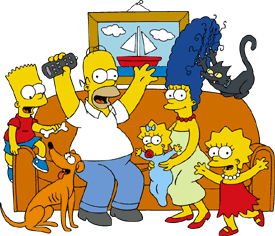
The Simpsons blend of animation and adult humor made it an important milestone says Neuwirth. © & TM 1997 20th Century Fox Film Corp. All rights reserved.
Ideological revolutions are most evident in the content, rather than the artistry of animation. A couple of examples will suffice here, the first being the proscription against cartoon violence. Cartoons were scrutinized to the point where any conceivable action suggesting hostility or unsafe behavior in a cartoon led to terrified self-censorship by networks. This was neccesary lest the watchdogs of the FCC, outside groups such as Action for Childrens Television, and other concerned parents and educators raised their voices in protest. Animation historian Hal Erickson dates the emasculation of the classic Warner Bros. shorts for television as beginning in the mid-1970s, but more interesting is his assessment that the heyday of network Standards and Practices lasted from 1975-1983. From there it was a short hop to having cartoons contain educational and safety tips welded into their structure; the Childrens Television Act of 1990 sealed this deal.
Another ideological revolution took place in the early 1990s with the premiere of The Simpsons. Neuwirths analysis of this series is quite sharp and serves to underscore the nature of swift, radical change -- in this case, because the concept behind The Simpsons succeeded: an adult demographic could be entertained by a cartoon aired during primetime hours. Every animated series that comprised the Primetime Toon Boom in the late 1990s owed a debt to The Simpsons. The fact that virtually all of them failed miserably does not erase the fact that a revolution happened.

Ren and Stimpy had a profound impact on future animation projects. © Viacom International, Inc. All rights reserved.
Some revolutions are stylistic, and these can be startling to observe. Again, a few examples. When Walt Disney came to the decision that his animators should create the illusion of life in full, Disney hired the noted art instructor Don Graham in 1932. By 1934, the staff was attempting its first realistic animation of the human figure in The Goddess of Spring . By 1937 -- only three years later -- the studio produced Snow White and the Seven Dwarfs. In the space of just one year (1933-34), the Disney studio also released two films that established the concept of fusing a characters personalities and inner thoughts with expressive animation: Three Little Pigs, animated by Fred Moore, and Playful Pluto, ably drawn by Norm Ferguson.
The graphic revolution pioneered by United Productions of America (UPA) radically changed the look of animation. John Hubley, Zach Schwartz, Bob Cannon, Bill Hurtz and Dave Hilberman broke away from the naturalistic style typified by Disney. UPAs cartoons were signified by flat, stylized design and novel uses of color; the influence of that style was soon felt worldwide. How soon? Six years after UPAs foundation with the premiere of Gerald McBoing Boing in 1951.

Revolution CGI style: The Nightmare Before Christmas and South Park. Left to right: © Touchstone Pictures. All rights reserved; © Comedy Central and courtesy of Fox.
Stylistic revolutions can be retrogressive as well, and the effects can be just as rapid. With just six episodes of The Ren and Stimpy Show in 1991, John Kricfalusi influenced the look of cartoons over the next decade. He did so by channeling animation styles of the late 1950s and merged them with startling emotional and anatomical distortions. Anime has also been the impetus for stylistic changes in American animation. Offerings such as Batman: The Animated Series, Batman Beyond, The Powerpuff Girls, Teen Titans and Samurai Jack owe their distinctive look to Japanese influences. Timeframe: roughly 1990-1993, with the revolution continuing in full force at this time.

Batman Beyond is an example of work influenced by anime. ©Warner Bros. All rights reserved.
Finally, but by no means least, are technological revolutions. These may well be the most rapid of all. The story of animation has, to a large degree, been concurrent with advances in film technology. Applications tend to be immediate and produce a considerable impact both on studios, artisans and audiences. Historian Donald Crafton, in his book Before Mickey, notes that: In a very short timespan, from 1913 through 1915, an entire technology developed, flourished and became standard. Crafton astutely recognizes that the nature of change in animation tends to be rapid and revolutionary. The technologies referred to include the adoption of acetate cels and the scientific management of animations production process in concordance with the assembly-line vision of Frederick W. Taylor.
Other revolutionary advances? Actual cartoon/sound synchronization, developed in 1928: standard in cartoons by 1933. True Technicolor was first used in 1932 in Disneys Flowers and Trees. When Disneys exclusive three-year contract for Technicolor ended, every animation studio in Hollywood was making brilliantly colored films, including relative lightweights like the Van Buren studio.
The multiplane camera, which could simulate 3D effects, made its debut in Disneys The Old Mill (1937). That same year, the Disney techs were comfortably using it in Snow White. By the time the studios second feature, Pinnocchio, arrived in 1940 the multiplane was used in that film for some of the most amazing animation shots ever done. It is impossible to forget that once PCs and digital software caught up with animators dreams, there was a veritable explosion of feature-length films animated wholly by the arrangement of pixels in a software program, a cathode-ray cavalcade beginning with Toy Story in -- was it only 1995?

Toy Story represents the zenith in technological revolution in animation. © Disney. All Rights Reserved.
With the mention of Toy Story we come full circle to Neuwirths list of achievements: That film was the result of a technological revolution. Ren and Stimpy represented a stylistic revolution, as did The Little Mermaid. The Simpsons was the child of an ideological revolution in its subversive blending of animation and adult sitcom sensibility. And the father of the Toon Boom, Who Framed Roger Rabbit, actually blended elements found in technical, stylistic and ideological upheavals. Taking the above into consideration, there are at least two things we can expect of animation in the future. One, it will continue to change along the four lines discussed above. Two, these changes will be fast, spread rapidly and reflect more of a revolutionary than evolutionary bent.
While I do not deny that some changes within animation are slower and do suggest a process of evolution -- such as the refinement of a given characters appearance over time as animators grow increasingly comfortable working with it -- a global analysis of the art does suggest that when things happen, they are likely to happen fast. As animation is now more diverse, plentiful and popular than ever perhaps we can agree with Thomas Jefferson, who once said: God forbid we should ever be 20 years without such a rebellion! !Viva La Revolucion!
Makin Toons: Inside the Most Popular Animated TV Shows and Movies by Allan Neuwirth. New York, NY: Allworth Press, 272 pages. ISBN: 1-58115-269-8 (US$21.95)
Martin "Dr. Toon" Goodman is a longtime student and fan of animation. He lives in Anderson, Indiana.