
Nicole Hewitt proves that animation does not need to be done in the solitary confinement of a studio. With her film In Between, she took to the streets of Zagreb to animate the cast off possessions of hundreds. Includes QuickTime clips!
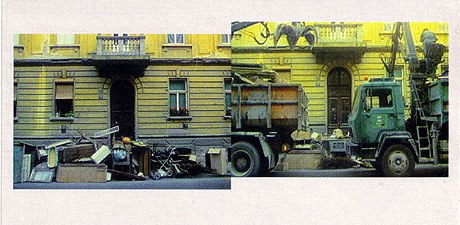
Masses of debris mobilize in Hewitt's study of discarded possessions. View a clip now. © Zagreb Films.
Editor's Note: If you have the QuickTime plugin you can view clips from In Between.
At Zagreb 2002, the 15th World Festival of Animated Films, I had the opportunity to view In Between, a new short film from Zagreb Film by filmmaker Nicole Hewitt. We often think of animation as being a very controlled medium, but here, Hewitt takes to the streets in a form of "guerrilla animation," animating mounds of trash that has been left on the streets of Zagreb. From heavy washing machines and refrigerators to wicker baskets, couches and beyond, the film focuses on our displaced possessions.
Heather Kenyon: First off, why was all this trash out on the sidewalks and whatever gave you the idea to animate it?
Nicole Hewitt: The city of Zagreb organizes an annual clearance of large household refuse. This takes place every year starting in April on the outskirts of the city, making its way into the center by the summer and then moving out again toward September. Each borough or neighborhood is allocated a specific day to chuck their stuff out, so during that period piles and piles of rubbish appear all around town. This has been going on for years and has always been a source of fascination to me. There's a kind of continuos choreography going on with the rubbish as people empty their garages, attics or whatever and other people look through the piles; some just perusing, others collecting toys or looking for antiques, the Romany gypsies [Editor's note: Romany gypsies are an ethnic group of wanderers that have been in Europe since before the 14th century. Originally from northwest India, they began their migration before the 9th century. Once in Europe, they suffered discrimination, and even torture and slavery. Prejudice continues to this day.] collecting metal, wood and plastic. It's like a whole archaeology of the city on public display.
HK: What point are you making with your film? Is it more a study of the trash items, their form and nature, or are you making an environmental point?
NH: Rubbish is to me a fascinating subject and I was initially interested in the identity status of these objects. The anthropologist Mary Douglas calls rubbish 'matter out of place' -- discarded objects still retain traces of their previous identities, they have not yet disintegrated into an amorphous and unidentifiable mass, they are still recognizable objects, but in the wrong place and with traces of ownership still lingering. They are, to my mind in an In Between state of things, on their way to becoming nothing, non-objects. In the Zagreb case, the matter is even more fascinating as other factors come into play -- private vs. public space, bourgeois taboos of cleanliness are confronted with 'scavenging.' There is a whole alternative economy going on in the streets, with the Romany people sorting and reclassifying the rubbish according to material. There are also cases of people throwing their own junk on the pile and taking something their neighbor threw out...
HK: How did you come to make a film for Zagreb Film? Don't you usually live and work in the U.K.?

Nicole Hewitt. Image courtesy of Zagreb Films.
NH: This is the second film I made for Zagreb Film, and before the war I made two for Luna Film, a small company that folded. I have spent half of my life in Zagreb and half in London, and I can't see that changing in the near future. I am pursuing some university research in London at the moment but will be starting work on another film in Zagreb some time next year.
HK: The sound track contains a number of voices but since most people don't speak Croatian...what is being said?
NH: I was toying with the idea of translating the sound track but in the end decided that it was so locally specific, that I would simply accept it having very different readings in Croatia than elsewhere. Most of the questions directed at the crew are people just wondering what the hell we are doing. There are also some exchanges between the Romany gypsies and the white citizens of Zagreb. I thought it was interesting to include a completely authentic location soundtrack to accompany the animation. As you said, an important feature of this film is that it does not have any of the common animation control devices. A lot of the work involved a certain amount of improvisation and collaboration. We could not predict what and how many objects would appear on a pile, or what kind of interactions between people might occur. In the end we started going on location with a number of mini disc recorders and just recording everything that went on.
HK: Fascinating. So, it turned into an animated documentary of this neighborhood event. How did the people on the street react to you making an animated film on their sidewalk? Do they know about Zagreb's prestigious history of animation filmmaking?
NH: People were incredibly interested in what we were doing, sometimes too interested and either wanted to instruct me in the form of correct filmmaking or wanted to join in. Most people do know about Zagreb's past fame but are not sure that there is any animation still being made.
HK: What difficulties did you encounter in making your film? How much time did you have per shot and how long was your overall production schedule?

Another sequence from In Between. © Zagreb Films.
NH: One of the main difficulties was (apart form the shear physical effort involved in moving around bits of washing machines, bathtubs and wardrobes) public relations -- I was not aware of the power of the camera until this film. A soon as you're out on the streets with a camera, people think you're a TV crew and they give you such a hard time because it seems they think the minute the media get hold of a problem story the story will get solved. As we would take about 12 hours on average on a single location, we were a good target for all local grievances and feelings of despair. This I think comes over more in the soundtrack; a certain aggression that was directed toward us just for having a camera and daring to shoot something as innocuous as piles of rubbish. Interestingly enough we had the best of relationships with the Romanies. To them the trash is a source of income and deserves the respect we showed it, so that gave us a common ground of understanding and mutual support. Initially I thought I might have to give them some money to compensate for taking up a pile of rubbish, but we worked out a system where we would hold on to the pieces they had selected until the end of the shoot and they would then come and collect it after we had finished.
Heather Kenyon is editor in chief of Animation World Network. After graduating magna cum laude with a BFA from the University of Southern California's School of Cinema-Television, Heather began her career in animation at Hanna-Barbera Cartoons, where she became manager of the Production Communications department. She has contributed a chapter to the book, Animation in Asia, published by John Libbey & Company, Ltd. Heather is also vice president of Women In Animation International and on the Board of Trustees of Trees for Life.