Three years ago, the first Night at the Museum turned to Rhythm & Hues to create its fantastical CG characters. From a playful T. Rex skeleton to talking Easter Island heads, the crew was charged with the responsibility of bringing the exhibits of New York's American Museum of Natural History to life after hours. Now, with the sequel, Battle of the Smithsonian, the plot expands to include the entire Smithsonian in Washington D.C. and Rhythm & Hues has returned to significantly up the stakes.

Three years ago, the first Night at the Museum turned to Rhythm & Hues to create its fantastical CG characters. From a playful T. Rex skeleton to talking Easter Island heads, the crew was charged with the responsibility of bringing the exhibits of New York's American Museum of Natural History to life after hours. Now, with the sequel, Battle of the Smithsonian, the plot expands to include the entire Smithsonian in Washington D.C. and Rhythm & Hues has returned to significantly up the stakes.
Leading the team is Visual Effects Supervisor Raymond Chen, whose 13 years of work for Rhythm & Hues has included (most recently) The Golden Compass and The Fast and the Furious: Tokyo Drift. For Smithsonian, Chen found that the sheer scale of the film's storyline was a call for some ambitious planning.
"The biggest difference is the scope of the work," says Chen, "…In Scooby Doo or Garfield, you might have one character with a number of props with 400 to 500 shots. On this, it felt like working on a lot of different shows because each sequence had its own challenges that aren't necessarily connected to each other."
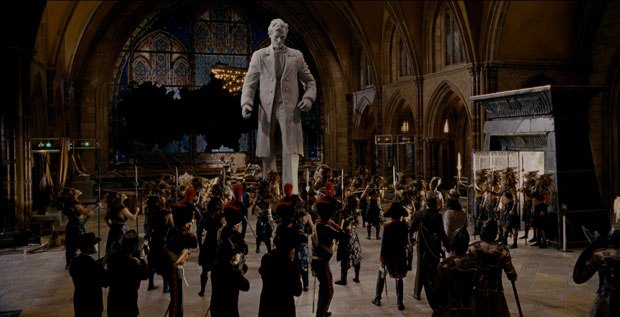
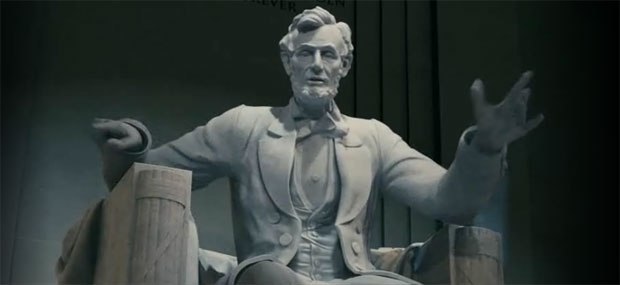
Not only are the new characters staggering in number, but each required a different specialty for Chen's team to pull off properly. Whether it's the hair on a photo-real squirrel or the light and luster of a moving, talking marble statue, Chen had to simultaneously deal with characters and events in completely different scales, from miniature cowboys to a gigantic, writhing octopus. That's in addition to compositing matte paintings and creating CG set-extensions.
Though its headquarters and primary facilities are in L.A., Rhythm & Hues also has offices in India in both Mumbai and Hyderabad, both of which operated under Chen's supervision, bringing the total number of working artists to between three and four hundred. Though others did spend some time traveling back and forth between the countries, Chen was able to stay on the continent, communicating with the other offices through video conferencing.
"We use something very similar to CineSync," explains Chen, "It's our own sort of review system. It actually sets it up so that you can run clips in two different locations. You can kind of draw in the frame or go frame by frame or zoom in. Stuff like that. In terms of review, it's very, very straightforward and extremely helpful."
Chen did get to slip out of the country, though, for the film's principal photography, which all took place in Vancouver. Operating on-set, Chen was able to assist in greenscreen placement and work ideas out during production that would become invaluable in post. The biggest concern, in his eyes, was ensuring that the live talent be able to establish realistic eye-lines with the CG characters.
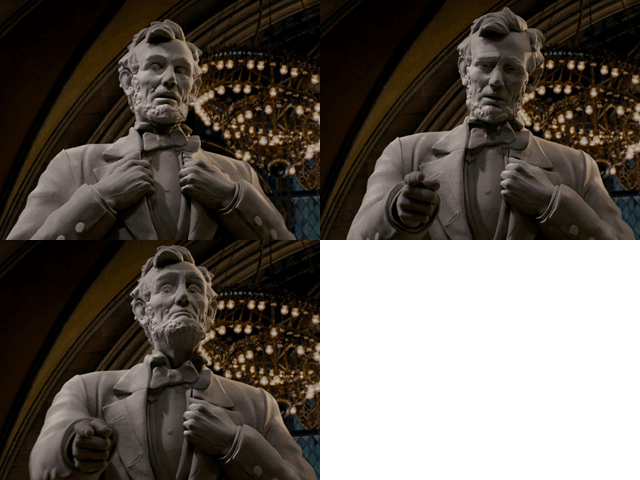
"That's one of the things that gives away CG the most. The live-action performers need to act or interact and if the eye-lines are off by a couple of inches, it makes it feel like they're not engaging one another in the same space. A lot of what we do on-set is trying to set-up accurate and relatable eye-lines or marks or anything that can give a proper indication of where characters are and what they're going to be doing when they're not actually there on the set."
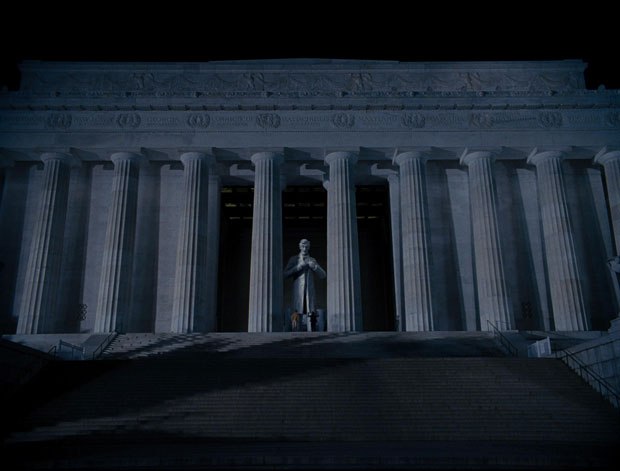
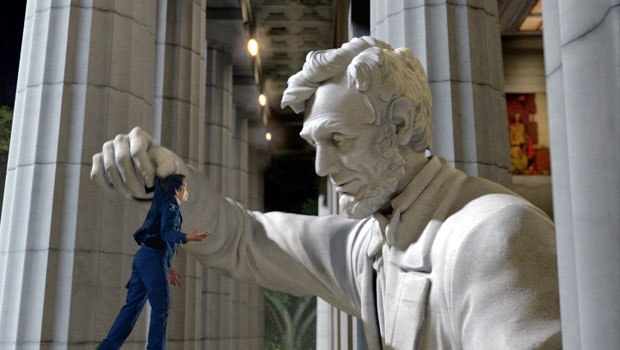
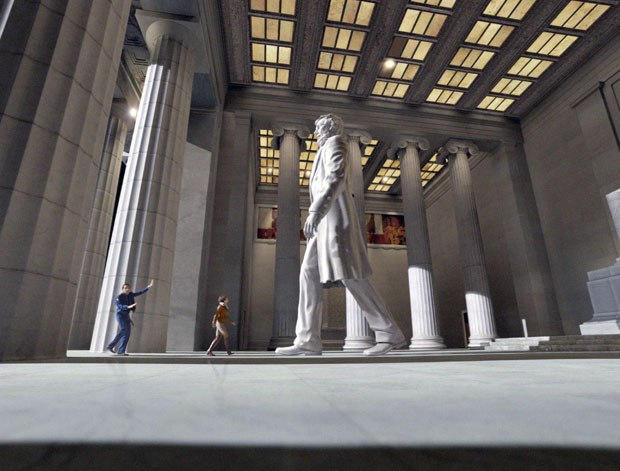
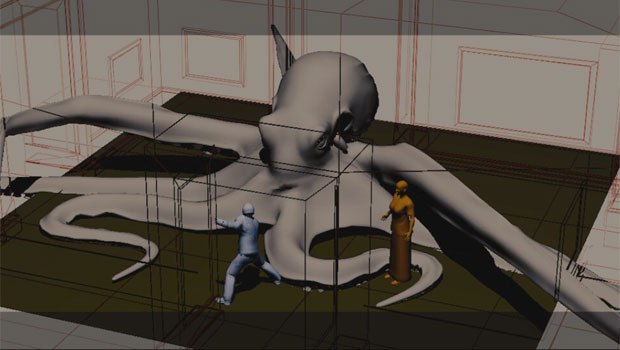
To this end, several different stand-ins were used, all depending on the size and range of movement of the respective animated character. When Ben Stiller's night watchman, Larry Daley, enters the National Gallery of Art, all of the sculptures come to life. On set, these mostly-immobile characters were represented by ping-pong balls on sticks, held by C-stands at the appropriate level. For other, more substantial characters, such as a giant octopus or the Lincoln Memorial, full-size cardboard cutouts were created with cardboard or foam-core that could then be imagined in full by the actors. Other times, it was even as simple as using a laser pointer to represent a shifting focal point.
When photography concluded last September, Chen entered into a seven-month post-production stage that called on a vast catalogue of animation software, ranging from proprietary programs to "off-the-shelf" products such as Voodoo, Lighthouse, Houdini and Maya as well as their internal rendering engine, Wren and internal compositor, ICY.
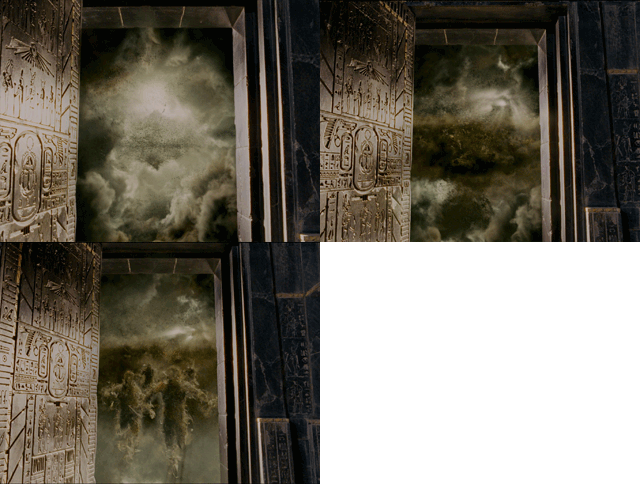
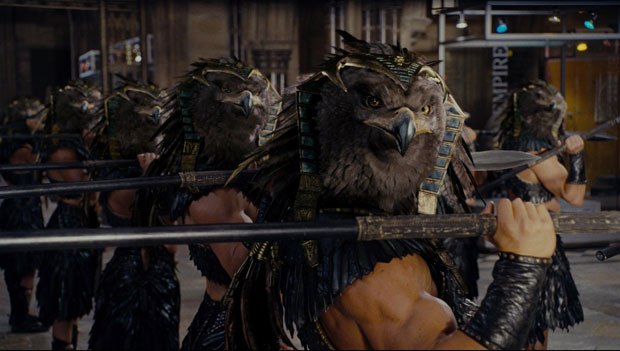
The most challenging element to bring to the screen involved the film's villain, Kahmunrah (Hank Azaria), an Egyptian Pharoah who plots to bring his 3,000-year- old army of the undead into the modern world. The army is glimpsed at in a place called the "Netherworld," a concept that Chen had to define visually.
"They wanted to show eternity," says Chen, "They also wanted to show these Horus guards or soldiers that transform from flapping birds to human soldiers with hawk-heads like the ancient Egyptian God. It was particularly difficult, because we're trying to put a face on something that is very abstract. They did a number of concept paintings that were very detailed and specific about what it should look like. Even getting from that concept art to the final shot was a long exploration."
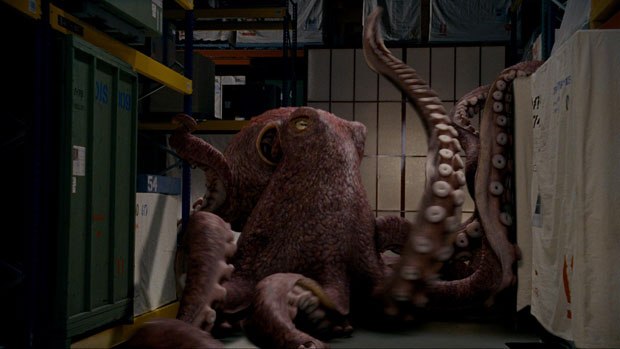
Also an enormous challenge was the film's giant octopus, something that Chen believes to be one of his proudest accomplishments.
"That's one of those characters that's a particularly hard animal because, in addition to having more limbs than most, and having eight different tentacles, there's a lot of freedom of motion in that it doesn't necessarily have a skeletal structure or bones. The rig that we had to make for it is extremely complex. There's a lot of movement in the tentacles themselves, plus there's a lot of close-ups and the character itself is quite big. You have to have controls for things like the suckers and the gill and the blowhole."
To add to the challenge, the Octopus' photoreal look prevented obvious facial expressions that the director wanted to be communicated to the audience. In the end, Chen thinks that they managed to hit just the right balance of being anthropomorphized without looking or feeling overly cartoony.
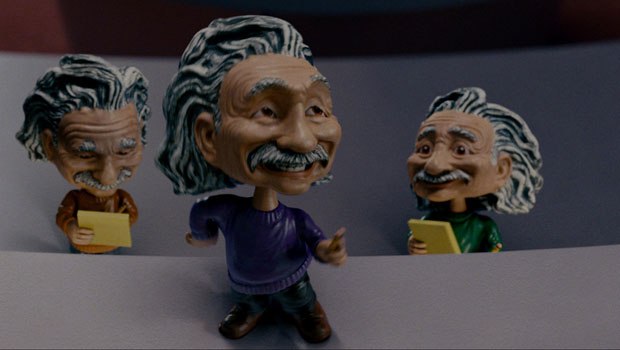
Other new characters introduced for the sequel include flying Cherubs (whose faces the team modeled after the Jonas Brothers) and a bunch of talking Albert Einstein bobbleheads that Daley comes across in the gift shop of the Air and Space Museum.
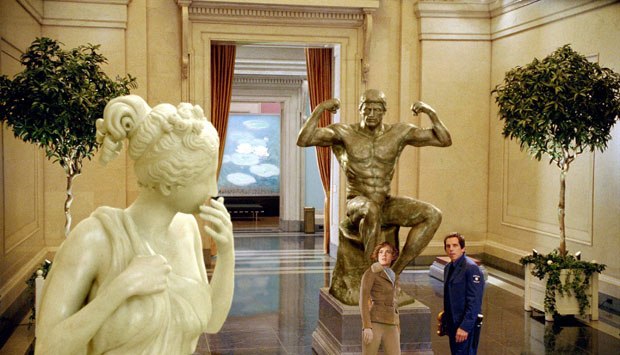
"[Even more] didn't make it into the film," adds Chen, "There's a whole sequence in the National Gallery of Art where a lot of the sculptures come alive. We have some of our main ones like the Thinker or Venus or Degas' Little Dancer, but there are some minor ones like a Noguchi globular thing. There's a spiral man. There are a lot of background sculptures that were only going to be used in a few scenes. Some of them got built and they got cut from the film or the director didn't like certain sculptures."
With about 535 effects shot having made the final cut, Chen found his team working hard right up until the delivery date, including a big shot that came about just two weeks from the final deadline.
"It was one of the Horus gods emerging from the netherworld. The studio felt that they didn't have a big sort of payoff. We never got a really close look at the heads of these guys so we put in a nice close-up of one of these hours guys walking toward camera and having a big squawk. It was kind of an extreme close-up of a CG head."





Silas Lesnick is a freelance writer and critic. Now living in L.A., he graduated from Emerson College with a degree in media arts and has spent time working with the American Film Institute in Washington, D.C.