
Emru Townsend reviews Dennis Tupicoff's new animated documentary, His Mother's Voice, an exploration of an unexpected death.
Download a Quicktime movie clip of His Mother's Voice by Dennis Tupicoff. 644Kb. © Dennis Tupicoff.
His Mother's Voice © Dennis Tupicoff.
What can a mother say when her son is violently taken away from her? Dennis Tupicoff's latest endeavor, His Mother's Voice, answers the question - twice.
Matthew Easdale was shot dead in a house in Brisbane, Australia in April 1995. His mother, Kathy Easdale, was interviewed for ABC (Australian Broadcasting Association) Radio a few weeks later. That broadcast provides the voice track for His Mother's Voice, a film in which Tupicoff explores how such an earth-shattering event can resonate with an audience.
Feeling the Loss
For all the horror and strife in the world today, it's safe to say that most mothers will not have to experience the sudden, brutal loss of a child. Fortunately, it's difficult for many of us to relate to or even imagine the feeling of losing our own flesh and blood.
Of course, the whole point of a narrative is to involve the audience, to the point where they empathize with at least one person on the screen. If Lost World can make us feel even a little bit linked to a leather-jacketed mathematician running away from cloned dinosaurs, then surely something with its roots in reality can move us. Using a curious blend of realism and stylization, Tupicoff does the job - but not in a way we expect.
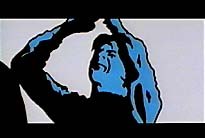
As the camera closes in on a live-action radio, the interviewer asks one question, `What happened on the night of the murder?' Mrs. Easdale begins narrating the night's events, and the scene is quickly transformed into a dark but colorful rotoscoped reminiscence, with thick lines and a flat color scheme reminiscent of Tupicoff's Darra Dogs. We watch a re-enactment of the evening unfold, as Mrs. Easdale hears the news that something has happened, drives to the house, and discovers her son was shot. The camera alternates between following her and giving us her point of view as she waits outside while the paramedics try to save Matthew. Eventually, she gets the news: her son has died. Mrs. Easdale's monologue ends with the recounting of Matthew's brother's reaction to the news.

A rotoscoped Mrs. Easdale in the second half of His Mother's Voice. © Dennis Tupicoff.
Take Two
Then it starts all over again.
Well, not exactly. The dialogue starts over and there's rotoscoped footage. Only this time, the footage is of the interview taking place at Mrs. Easdale's home, and the medium is rougher, like pencil on paper. The camera only spends a brief time in the house before wandering outside, observing the quiet suburb, and eventually returning indoors to close in on Mrs. Easdale's face as she recounts her surviving son's reaction.
His Mother's Voice raises some interesting questions about documentaries in general, and animated documentaries in particular. Students of media literacy have long recognized that documentaries are not the objective recordings of events that many people assume they are. Choosing a soundtrack, editing the film, and even the act of deciding what to record and what to ignore are all filtered through the subjective viewpoints of the director, writer, and editor. (Remember that the next time you watch Truth or Dare.)
Tupicoff acknowledges this when he says, "By presenting just two of the many possible points of view that might accompany the voice of Mrs. Kathy Easdale, I hope the film leaves the audience to imagine others, and to ponder its own response to her pain." The film itself tells the audience that what we see is not an absolute; the same events, narrated by the same person, can be observed, interpreted, and experienced in many different ways.
The Technique
The mind game is aided by the use of rotoscoping, which fuzzes the line between reality and craft. The viewer's mind jumps between viewpoints. This is a real radio broadcast, but it's animated. The animation is based on live footage, but the footage is really a dramatization of events. Is this real or is it unreal?

Ultimately, it doesn't matter. After the mild garishness of the first segment, the more subdued second half, with its drifting camera, softly hits you with the power of the experience. Hearing it for the second time, the tiny details in the audio - Mrs. Easdale's gradual loss of composure, for instance - are more apparent. Of course, we've just seen and heard the story from a first-person perspective, and now we're hearing it again... only the camera doesn't seem to care as it observes the world outside the house, lingering on a dog who is oblivious to the tragedy being related within.
Strangely enough, it's by watching the dog that the full impact of Mrs. Easdale's loss becomes clear. She's alone in her grief. The other son has lost his brother, but he won't feel the loss the same way as his mother. The rest of the world just keeps on going about its business.
Manipulation
Would reversing the order of the two segments have changed this feeling? What if, as Tupicoff suggests, there were other points of view presented? Would we feel more sorrow, or less?
Think about it. The suggestion that we might feel less sorrow as a woman recounts her most terrible loss. Whether we feel more or less pain all depends on the director's whims. Isn't that a little disturbing?
Yes, it is, and that's just the sort of disturbing feeling that makes for a powerful and thought-provoking film.
Emru Townsend is a freelance writer who won't stop talking about cinema, animation and computers. He is also the founder and former editor of FPS, a magazine about animation.
| Attachment | Size |
|---|---|
| 613-mother.mov | 622.79 KB |