
Due to a series of legal problems, Kimba, the White Lion, has had numerous enumerations. Fred Patten tracks them all down for us and discusses the latest release the truly original, much loved 1966 television series.
At the beginning of the year 2000, professionals and fans alike were joyous about the seemingly endless possibilities for animation on the Internet. Celebrity deals and big dollars were in the headlines regularly. New entertainment firms sprung up left and right trying to make waves in the new medium. However, by the end of the year, eyes shifted from IPOs to business plans that just weren't working. And like the pog, Web entertainment sites were disappearing faster than the dinosaurs. So what happened to the promised land?

There are many culprits in the plummet of Internet entertainment. The quick blame has been put on the ad market, which pulled dollars out as stock markets fell. Technology had been the "plastics" of the new millennium, but now it's a roller coaster very few people want to ride for any extended period of time. As Douglas Kay, president of Mondo Media, explains, there was huge pressure in 2000 to expand fast so your company would not be left behind. This strategy proved to be one of the key blows to many hopeful companies because they were spending money and creating content with no concrete way of making the money back. Once that became a reality and backers started getting major jitters during second and third rounds of financing, everybody wanted to take their hot Internet properties off-line where the money was. However, that plan proved as easy as selling pilot television series. Entrepreneur's Web wonders weren't the cat's meow like many creators hoped they would be in the eyes of off-line decision-makers. As a result, many companies like Anteye closed. Others like Icebox shut down and now are operating bare bones in an attempt to sell their assets. In the case of Stan Lee Media, lawsuits have sprung up regarding misallocated funds and stock manipulation. Even major players like AtomShockwave were forced to lay-off the majority of their staff in an effort to cool the capital burn rate of their parent company. Even this Web savvy writer has found himself in the unemployment line searching for a new home. So now that the holy land has turned into a holy mess, what's next? I sat down with four of the key players in the field -- Hypnotic, Brilliant Digital Entertainment, Mondo Media and AtomShockwave -- to see what direction they are going now that the high hopes are grounded and Internet businesses need to get down to just that -- business.

Hypnotized By More Than The Web
When I talked to Jeremy Bernard, president and CEO of Hypnotic, calling his company an Internet company was like calling him a foul name! All jokes aside, his company started moving out of the Internet exhibition business almost a year and a half ago. He states straight out, "There is no money to be made in Internet exhibition." Bernard describes Hypnotic as an entertainment marketing and services company. They acquire content from talented filmmakers from around the globe and license it in various mediums including the Web.
With most of their current work being done in traditional media, I asked how the company's recent merger with Nibblebox, a network of college-based Internet content sites, fits into the overall strategy. Bernard said the Web is a way of reaching and promoting emerging filmmakers. Nibblebox gave Hypnotic a chance to contact a younger audience and open doors to acquiring content from emerging artists. "Short films are a visual resume and not a passing fad," Bernard says. It's this visual resume idea that attracts licenses and larger deals. Currently, Hypnotic and one of its filmmakers are producing a live-action feature in association with Vivendi Universal, who is one of the major backers of the company.

Bernard sees the Internet going in the direction of sponsored entertainment. "As broadband develops, ads will become more compelling and more interactive." He feels that companies that can show higher penetration numbers will get support for content. Bernard also points to syndication as a very viable market. "Large portals dominate 90% of the online audience. Those companies will benefit," explains Bernard.
BDE: Technology First
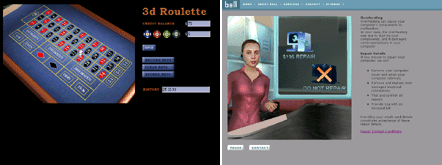
Sponsored entertainment and syndication were also on the lips of the three other firms I spoke with. However, each is approaching these directions in different ways. Brilliant Digital Entertainment has always been a tools and technology-based firm; however a year ago when its software wasn't available to the public yet, the company was focused on producing and syndicating its content to various sites. Now the company is focusing on selling its b3d software to other companies to create content on the Web. However, the firm still creates content as a means of promoting its software's capabilities and increasing player downloads.
When asked about the future, company CTO Anthony Rose started by recapping what hasn't worked. Specifically with 3D animation on the Net, immersive worlds and chat rooms failed pretty early on. "Why haven't they worked? It could be a combination of poor graphics performance, clunky characters and so on," says Rose. "Webisodic content is very popular, however there's not revenue right now to support it." He adds that one of the main issues is broadband. Three years ago people predicted that it was just around the corner. So the true potential of content on the Web lies in the answer to -- when will consumers readily use broadband? However, when your TV and Internet merge, "If you can stream video of Gone with the Wind, why would you want to watch an animated version?" At this point, immersive content will become more desirable. Brilliant Digital is working on many ways to capitalize on this very idea. Currently, they are designing ways for people to send them personal pictures to have characters created in their likeness. This approach could be very attractive as a tour guide for personal and professional Websites or putting oneself directly into games.

Plus, Brilliant Digital is maximizing its potential for growth by gearing its toolset for global practical use. The software has the capability to take animation from Maya and 3D STUDIO Max and "library" identical geometry, thus reducing file sizes and shortening downloads. In addition, the system can also plug new characters into already completed animation. For example, in a Webisode of The Multipath Adventures of Superman, Superman could be replaced by an animated version of oneself. Moreover, the b3d technology has multi-language support enabling it to adjust the lip-synch to a selected language. With over 4,000 studios using the software, the possibilities could be endless. For example, MindGel in Florida created a 3D banner ad advertising its services in banner creation, which garnered a huge response, generating a large amount of added impressions. So in turn, companies could use 3D banners as a way to make their message stick out from all the rest. Another advantage Brilliant sees for itself in the market is its relationship with its customers. For instance, Brilliant was contracted by Rock the Vote! to create 3D talking heads for its Website. Due to the amount of work involved, they outsourced some of the project to one of their customers "as a way to give business to people who bought our tools," explains Rose.

Sticking to a Plan
Where Brilliant has moved from creating its own content to helping others create theirs, Mondo Media remains the top producer/syndicator of original animation for the Web. Out of all the major players in the space, Mondo is the one that has really stayed with its original business plan and made it work. They create and acquire 2D animation for syndication on high-traffic Websites. So how was Mondo able to stay vital as the market started to dry up? Simply put, president Douglas Kay said, 'Prove it then move on.'
Kay does not remove Mondo from the list of companies that overextended themselves a little in 2000, but is proud of Mondo's ability to focus on the goal at hand, prove it can work and then move on to the next stage. In the beginning, Mondo Media wanted to prove it could create compelling content for airing on the Internet. Once that was proven, they moved onto distribution and then rich media advertising.

Kay explains the key to its business relationships is "making it profitable for everyone." It starts with good content. "It's cost effective to go to the high-traffic sites," says Kay. More eyeballs on your content creates good buzz and buzz brings more eyeballs. Once their distribution channels where established, Mondo was able to interest advertisers into adding rich media ads in front of Mondo Mini Shows. Each show has a measurably targeted viewership, which is appealing to companies.
For the future, Kay sees advertising more integrated with content. With the onset of broadband, he feels the possibilities are endless for advertisers and content producers. However, the key for Mondo is "getting from here to there and positioning itself for the future."

A Change of Focus
Finally, we come to AtomShockwave. They too haven't really changed their business plan -- much. They will continue to be a games, films and animation destination Website. The major change that has come in the past year is a slow down in original content production. AtomShockwave's general manager and executive producer, Scott Roesche, says, "In the past year, original production has proven pretty costly." AtomShockwave had to cut back to focus on profitability.
About the future, Roesche says, "The big debate, these days, is over whether free content is a viable model." He believes it is, however ad sales can't support it currently. He sees brand integration as a way free content will survive in the present market. For example, AtomShockwave has a partnership with Ford, which integrates the Ford Focus into content like the game DJ Fu. In addition, both the AtomFilms and Shockwave sites leverage their current high traffic to sell ads that pay before each short. For the animation community, Roesche says, "Bare with the industry. The opportunity for talented artists too will be there."
The Internet has proven to be a savage land for hopeful entrepreneurs and the space has slowed down to let dreams catch up with reality. Anthony Rose makes a good point about the habits of people and new technology: "Technology runs way ahead of what people actually want. We can often produce things faster than people can get use to, like in the case of e-commerce. But people just don't want to change their habits. In retrospect, their habits are pretty sensible and these pipe-dreams were really silly. Who wants to sit in an uncomfortable chair waiting for something to download for two hours?"

Rick DeMott is a freelance writer, working in Los Angeles.

Rick DeMott
Animation World Network
Creator of Rick's Flicks Picks