
Wendy Jackson Hall reviews Giannalberto Bendazzi's latest book, Alexeieff: Itinerary of a Master, that discusses the art and life of pinscreen master Alexandre Alexeieff.
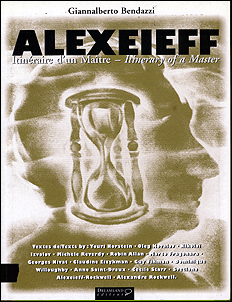
One of the most prized purchases from this year's trip to Annecy is the new book entirely about animator and artist Alexandre Alexeieff, whose work was the subject of a retrospective and exhibition at the 2001 festival. Edited by Italian animation historian Giannalberto Bendazzi, Alexeieff: Itinerary of a Master is even denser than the author's fact-packed animation history volume, Cartoons: 100 Years of Cinema Animation, because it devotes over 300 pages to the work of one animator.
Considered one of the "masters" of experimental animation, Alexeieff began making animated films at age 30, when he invented the pinscreen, a board with thousands of tiny holes in it, each one with a metal pin inside. When a light is shone on the screen at an angle, the protruding pins cast shadows of varying length onto the board, which when viewed from a distance (and photographed) create varying shades of gray. By making subtle movements of the pins in between photographing frames, he was able to create animated films resembling the etching techniques he had mastered earlier in his career.
Published in French and English by Dreamland, a European publisher specializing in comics and animation, Alexeieff: Itinerary of a Master is a compendium of 15 essays by Bendazzi's colleagues: animator Yuri Norstein, composer Michele Reverdy, filmmakers Dominique Willoughby and Claudine Eizykman, scholars Robin Allan, Guy Fihman, Marco Fragonara, Nikolai Izvolov, Oleg Kovalov, Georges Nivat, Anne Saint-Dreux and Cecile Starr, as well as Alexeieff's daughter, Svetlana Alexeieff-Rockwell and grandson, Alexandre Rockwell.
Bendazzi's introduction seems to have been written by him in English, and reads much like a conversation with a non-native speaker. I wonder if it would be more coherent if he had written the book in his native Italian and had it translated by a professional. The following essays vary greatly in style, from fawning praise to intellectual analysis, often overlapping in subject matter. It doesn't seem like Bendazzi "assigned" the topics to the writers, and as such the book lacks overall coherence. I found the most interesting reading to be those chapters that offered facts, anecdotes and quotes from the artist rather than just pure analysis.
For me, the primary value of the book lies in its 200-plus crisp illustrations in color and black-and-white; reproduced etchings, beautiful still frames from films, photographs of the artist, his studios and equipment, friends and family. Many of the images are quite large -- half-page or filling two-page spreads -- offering an incredible amount of detail.
Many of Alexeieff's book illustrations for novels by Dostoyevsky, Gogol, Poe and Pushkin are reproduced in the book. The meaning of these illustrations are explored in Nirat's essay, while Fragonara's goes into great detail about the techniques he used, such as xylography, etching and aquatinting. The toxic chemicals he used for these methods caused him severe illness early in life, as recalled by his daughter in her chapter of personal memoirs. Svetlana Alexeieff-Rockwell's essay also details the emergence of Claire Parker into her family's life, first as a protégé and later as "the other woman" who became Alexeieff's wife and creative partner.
It was around the time that "talkies" or sync sound films were becoming mainstream that he decided to illustrate music through films, rather than literature through books. Izvolov's essay explores Alexeieff's identity as a mystic and prolific inventor, noting that his idea for the pinscreen actually struck him during a crisis where he felt that his inspiration had deserted him after years of book illustration. He notes that later, Alexeieff and Parker invented a technique called "totalization," which was a way of creating "illusory solids" with long exposures of moving lights on pendulums, that looked very much like the images produced on an oscilloscope. The technique was used to great effect in commercials, which took most of the couple's creative energy following their return to France after WWII. In fact it is their commercial work that places them in the context of their animation contemporaries John and James Whitney, Mary Ellen Bute and Norman McLaren who were experimenting with similar animation concepts.
Saint-Dreux's essay looks at Alexeieff and Parker's commercial work, revealing that Alexeieff saw little difference between his artistic and commercial endeavors. He said, "The important thing in life is to create. That's the only thing that interests me. If L'Oreal wants to sell a bar of soap, I don't think about the product but the invention I could achieve."
Willoughby's chapter, "Cinematic Synthesis," compares the pinscreen technique to the pointillist painting style perfected by Seurat. It is described in Eizykman's essay as "engraving the film screen," a concept that Alexeieff shared with other filmmakers such as Berthold Bartosch, who subtitled his 1929 film, The Idea: animated engraving, and Herman Warm, the set designer for The Cabinet of Dr. Caligari, who said "the screen must become an engraving." It is revealed in other chapters that Alexeieff was also influenced by the films of Emile Cohl, Fernand Leger and Man Ray.
Robin Allan compares Alexeieff's first pinscreen film, Night on Bald Mountain (1933), with the same sequence in Disney's Fantasia, made seven years afterward. Although Allan says there is no "direct evidence" that Disney artists [or Disney himself] saw Alexeieff's animated version of the Mussorgsky musical composition, he provides a convincing argument that Disney was influenced by European artists, and that being inspired by Alexeieff is a distinct possibility.
Composer Michele Reverdy's essay contains enlightening reflections on film's relationship with music, comparing meanings of form, rhythm and counterpoint in musical, visual and temporal composition.
Russian animator Yuri Norstein, whose work has a similar aesthetic and narrative style to Alexeieff's, includes in his essay an illustration detail comparing an ox character from his film Tale of Tales to Alexeieff's Three Moods, both made in 1979. That the two share cultural mythologies is common of artists from Russia. Although he spent most of his life in France, Alexeieff's identity as a Russian native plays strongly in his work. But describing Alexeieff's identity solely as an individual is the grave oversight of many of the essays in this book.
In her essay, Cecile Starr writes, "The tendency has been...to give all credit (or blame) to one participant in the filmmaking process and neglect the contribution of the team." This has certainly happened with Alexeieff and Parker, as evidenced even in the very title of this book. For instance, Bendazzi writes in his introduction "her true country was Alexandre Alexeieff" and describes their relationship almost as one of worship. Starr, who was friends with "Claire and Alosha" provides insight into the life of "the other half," from her origins as a wealthy American art student to her role as Alexeieff's patron, wife and creative partner. The two are described as "an inseparable team" in a letter written to Starr by Norman McLaren (published in the book), who invited them to make En Passant (1944) at the National Film Board of Canada. Later, Jacques Drouin (who created the cover illustration for this book) made films with the small pinscreen they left there, and became like the son they never had, says Starr, noting the sacrifices Parker made for their art, including not having children. Alexeieff once said that without Claire, he never would have made films. He couldn't live without her either, and took his own life a year after Claire died in 1981.
Alexeieff's legacy continues in the work of his grandson, Alexandre Rockwell, an independent filmmaker who created films such as Lenz and Four Rooms. His memoir at the end of the book reveals the influence his grandfather had on him. He writes: "I can safely say there has been no greater influence in my life, and in that I know I am not alone."
Alexeieff: Itinerary of a Master by Giannalberto Bendazzi. Paris, France: Dreamland, 2001. 318 pages. ISBN: 2-910027-75-9 (350 FF/53,38€)
Wendy Jackson Hall is a U.S.-based freelance writer, animator and educator. Her bibliography and other details are online at www.jacksonhall.com.