Oscar winner Jan Pinkava and a group of animators spontaneously collaborated to make a stop-motion animated film in one day during the Ottawa International Animation Festival. Wendy Jackson reports. Includes a Quicktime movie.
Download a Quicktime movie excerpt from 67 Aluminum Plates. 1.1 MB. or download the entire movie. © National Gallery of Canada.

"ATTENTION! Feel free to give any shape you want to this sculpture. Gently move the aluminum plates. The artist would like you to share in the pleasure of handling the forms in space..."
So reads the plaque next to a large, metal, moveable sculpture in the Garden Court of the National Gallery of Canada, Ottawa. It was early October, 1998,and Oscar-winning director Jan Pinkava (Geri's Game) was in town for the Ottawa International Animation Festival, taking place just a few blocks away at the National Arts Centre. Browsing the gallery, Pinkava was struck by inspiration to take the artist's words quite literally, and animate the piece. He approached the gallery's staff, who were receptive to the idea and got to work clearing the red tape involved with filming in a public place.

67: The Magic Number
The roughly six-foot, seven-inch high sculpture, titled "Column," is made up of 67 relatively lightweight aluminum plates, connected to a column on which they rotate freely. It was created for the Canadian centennial in 1967 by Ulysse Comtois, a former film editor inspired by his craft. Comtois, now 67 years old, lives in Granby, Quebec and was thrilled to hear of the project.
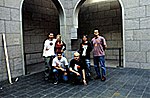
Pinkava enlisted the help of colleague Jean-Claude Kalache of Pixar Animation Studios; Rob Anderson, Jordan Craig and Karolina Craig of Ottawa-based animation studio, Dynomight Cartoons; Denis Lelong, an animator from Paris; and Carol Beecher of the Quickdraw Animation Society. Within 24 hours, they were set-up in the gallery, filming "Column" one frame at a time.

The Production
Dynomight Cartoons provided the set-up to film the animation digitally: a Sony DCR VX1000 Digital Handy Cam connected to a Macintosh PowerMac 8500/180, using Strata Video Shop and Adobe Photoshop to capture the images. After Rob did the technical set-up, Jordan and Karolina manned the computer while Jan and Jean-Claude animated the sculpture. The crew averaged roughly five seconds an hour, working from about 8 a.m. until 5 p.m. In all, about 35 seconds of animation were created, shooting on ones and twos. Toward the end of the shoot, a few additional animators helped out.
The next day, the footage was edited together in Adobe Premiere. Specific movements such as the corkscrew-like action were cycled, to create a one-minute completed piece. Ed Eagen of local sound studio 12th Root created a digital score by using samples of Pinkava saying "67 Aluminum Plates," the title of the film. Chris Mullington of Television Factory also collaborated on the final sound and video mixing.

Spontaneous Collaboration
"This is a non-profit spontaneous piece of artwork, produced by volunteers," said Pinkava, "I'm happy for all parties concerned to share the work and distribute it to whomever in a non-commercial spirit." "What excited me was that the making of this film fit so perfectly with the artist's intention of having a kinetic sculpture that should be physically manipulated by the viewer," said Carol Beecher, who assisted with the animation and acted as a production manager, taking photos and notes. "It was really interesting to watch the process of animating something this large. Once a rhythm of shooting was developed it looked like we were doing a square dance with the sculpture."
The film was finished in time for the closing night awards show, where it was screened and met with wild applause by the audience. "It must be the first time that a festival actually produced a film," said festival director Chris Robinson, "this really captures the spirit of creativity that festivals are meant to inspire."
We want to give you the opportunity to see the entire production of 67 Aluminum Plates, but it will take a long time to download. 4.4 MB. © National Gallery of Canada.
Wendy Jackson is associate editor of Animation World Magazine.