
Bryan Hoff tests the new HP Z800 to see if it offers enough of an increase in efficiency and productivity to justify the expense in this economic downturn.
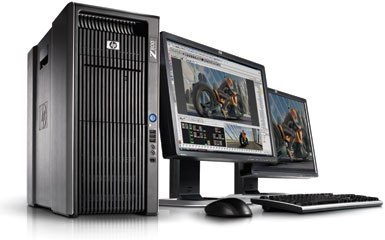
When I reviewed HP's xw8600 workstation, I mentioned that the xw series could use a case redesign. Now, with the Z series, the workstation has been redefined -- and Darth Vader would approve. Draped in sheets of aluminum and sporting integrated carrying handles, the Z series' new look represents an advance not only in industrial design, but also in computer architecture and hence productivity. HP partnered with BMW Designworks to come up with a workstation that's brand new from the ground up. The front-side bus is gone, replaced with Intel's QuickPath Technology, resulting in a 140% bandwidth increase. With its brand new power supply and improved interior design, the system is cooler and quieter than previous systems. And for all you overclockers out there, the Z600 and Z800 were also engineered with the option of liquid cooling in mind.
So What Else is New? In a word, lots. From its sleek front "bezel" with its slot loading optical drive to its aluminum side panels, the Z800 is a brand new machine. On the inside, the system leverages the Intel Xeon 5500 series (Nehalem) processor running at 3.2GHz (45nm), 1333MHz DDR3 memory and 78 lanes of PCI Express. The new processor has a few tricks up its proverbial sleeve to save power, and maximize performance when running applications that don't take advantage of multi-threading. Of course, the Z800 also has a couple of siblings: the Z600 and the Z400. While the Z400 looks like xw series on the outside, it still takes advantage of Intel's new Nehalem 3500 Xeon architecture, offered at an entry-level price.
As usual, HP offers a tiered approach with their Z series. The Z800 system starts at $1,999, while the particular system I reviewed cost $10,787 as configured. That configuration included 2 Xeon W5580 processors at 3.2GHz, 12GB DDR3 RAM, a Quadro FX 4800 video card, two 15,000RPM SAS hard drives and a 1TB SATA drive for data. The Z800 can be maxed out with 192GB of RAM -- great news for users in the oil and gas industry who will utilize every byte -- while the Z600 and Z400 can handle 24GB and 16GB, respectively. The Z600 starts at $1,679 while the Z400 starts at a mere $969.
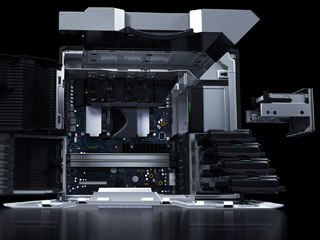
Despite the elegant new external case re-design, some of the coolest innovations are on the inside. The standout for me was the power supply, which was architected from the ground up to be completely modular and user-replaceable. By popping the power supply out of the system with a quick tug and plugging it into a power outlet, it's simple to tell whether the unit requires a replacement, based on a green status light. Meanwhile, along the front of the case where the drive cages reside, power "dongles" tuck away until you need them, say, to power a second Quadro FX card. Speaking of drive cages, those pop in and out in mere seconds, not requiring so much as a screw to hold them -- or the drives they contain -- in place. Green labeled "touch points" make it simple to see what pulls out, and where. HP has taken the tool-less design of the xw series to a whole new level, including fewer cables, and still no cut hands. I pulled out and replaced parts in the Z800 with speed and ease. The case felt solid and it was dead simple to tell whether something wasn't snapped properly back into place. If necessary, it's even possible for the end-user to replace a misbehaving motherboard with nothing more than the two most versatile tools at your disposal -- your hands.
SpecViewPerf Scores Once again, I'm using Windows Vista and SpecViewPerf 10 to do my benchmarking. This will keep the scores consistent with the results from my recent 8730w review. I'm also including the results from my xw8600 review for the sake of comparison. As mentioned earlier, the video card in the Z800 was an NVIDIA Quadro FX 4800 with 1.5GB RAM.
HP xw8600 3.20GHz (SpecViewPerf 9)
SUM_RESULTS3DSMAXSUMMARY.TXT 3dsmax-04 Weighted Geometric Mean = 38.07
SUM_RESULTSCATIASUMMARY.TXT catia-02 Weighted Geometric Mean = 49.13
SUM_RESULTSENSIGHTSUMMARY.TXT ensight-03 Weighted Geometric Mean = 48.44
SUM_RESULTSLIGHTSUMMARY.TXT light-08 Weighted Geometric Mean = 39.19
SUM_RESULTSMAYASUMMARY.TXT maya-02 Weighted Geometric Mean = 198.2
SUM_RESULTSPROESUMMARY.TXT proe-04 Weighted Geometric Mean = 45.29
SUM_RESULTSSWSUMMARY.TXT sw-01 Weighted Geometric Mean = 84.76
SUM_RESULTSTCVISSUMMARY.TXT tcvis-01 Weighted Geometric Mean = 28.84
SUM_RESULTSUGNXSUMMARY.TXT ugnx-01 Weighted Geometric Mean = 32.14
HP 8730w (SpecViewPerf 10)
SUM_RESULTS3DSMAXSUMMARY.TXT 3dsmax-04 Weighted Geometric Mean = 35.77
SUM_RESULTSCATIASUMMARY.TXT catia-02 Weighted Geometric Mean = 43.37
SUM_RESULTSENSIGHTSUMMARY.TXT ensight-03 Weighted Geometric Mean = 37.09
SUM_RESULTSLIGHTSUMMARY.TXT light-08 Weighted Geometric Mean = N/A
SUM_RESULTSMAYASUMMARY.TXT maya-02 Weighted Geometric Mean = 116.28
SUM_RESULTSPROESUMMARY.TXT proe-04 Weighted Geometric Mean = 41.25
SUM_RESULTSSWSUMMARY.TXT sw-01 Weighted Geometric Mean = 76.14
SUM_RESULTSUGNXSUMMARY.TXT ugnx-01 Weighted Geometric Mean = 26.22
SUM_RESULTSTCVISSUMMARY.TXT tcvis-01 Weighted Geometric Mean = 23.88
HP Z800 (SpecViewPerf 10)
SUM_RESULTS3DSMAXSUMMARY.TXT 3dsmax-04 Weighted Geometric Mean = 52.92
SUM_RESULTSCATIASUMMARY.TXT catia-02 Weighted Geometric Mean = 62.95
SUM_RESULTSENSIGHTSUMMARY.TXT ensight-03 Weighted Geometric Mean = 52.57
SUM_RESULTSLIGHTSUMMARY.TXT light-08 Weighted Geometric Mean = N/A
SUM_RESULTSMAYASUMMARY.TXT maya-02 Weighted Geometric Mean = 208.46
SUM_RESULTSPROESUMMARY.TXT proe-04 Weighted Geometric Mean = 61.31
SUM_RESULTSSWSUMMARY.TXT sw-01 Weighted Geometric Mean = 133.83
SUM_RESULTSUGNXSUMMARY.TXT ugnx-01 Weighted Geometric Mean = 32.39
SUM_RESULTSTCVISSUMMARY.TXT tcvis-01 Weighted Geometric Mean = 28.28
And just to ensure we're comparing apples to apples, here are the SpecViewPerf 9 scores for the Z800:
HP Z800 (SpecViewPerf 9)
SUM_RESULTS3DSMAXSUMMARY.TXT 3dsmax-04 Weighted Geometric Mean = 53.33
SUM_RESULTSCATIASUMMARY.TXT catia-02 Weighted Geometric Mean = 63.56
SUM_RESULTSENSIGHTSUMMARY.TXT ensight-03 Weighted Geometric Mean = 52.69
SUM_RESULTSLIGHTSUMMARY.TXT light-08 Weighted Geometric Mean = 46.48
SUM_RESULTSMAYASUMMARY.TXT maya-02 Weighted Geometric Mean = 204.8
SUM_RESULTSPROESUMMARY.TXT proe-04 Weighted Geometric Mean = 60.43
SUM_RESULTSSWSUMMARY.TXT sw-01 Weighted Geometric Mean = 130.7
SUM_RESULTSTCVISSUMMARY.TXT tcvis-01 Weighted Geometric Mean = 27.46
SUM_RESULTSUGNXSUMMARY.TXT ugnx-01 Weighted Geometric Mean = 31.88
As you can see, the Z800 beats its predecessor in nearly every instance. But since SpecViewPerf results sometimes depend on the video card that's installed, let's see how the Z800 fared in my 3ds Max 8 render tests.
The 3ds Max Tests As evident from the test results below, the more processor-intensive the scene, the better the results, with the Displacement & DOF test completing nearly a full minute faster than it did on the xw8600 system. While the increased RAM may have helped, it's clear that the new architecture is also a benefit to the Z800. 3ds Max was more responsive in general, and took more effort on my part to bog it down. Chalk that up to the increased RAM and improved memory handling as well, but the bottom line is that this is one fast machine.
Displacement & DOF.max
HP xw8600 5:25 HP Z800 4:30 Light Gallery
HP xw8600 0:55 HP Z800 0:50
Time is Money: All Clichés Aside Spending money during an economic downturn may seem counter-intuitive, but if you think about it a little bit, it starts to make a lot of sense. By increasing productivity and cutting down on power consumption, a new Z series workstation can pay for itself in one to three months. The Z800 boasts 85% and 89% efficient power supplies, and the new Xeon processors can run at just under 1 Watt in Hibernation mode.
More Than Just a Pretty Face With the Z800, HP has managed to work with Intel's new architecture to take advantage of each and every improvement, and to produce a system that's a sure bet in its class, with a sense of style that's also unmatched. With such a sleek new system design, I'd really like to see HP work with Designworks to create a mouse and keyboard update that complements the new system. I had to find one thing to complain about, and that's the best I could muster.
Bryan Hoff is a web designer, digital artist, writer and animator. His credits include movie and television effects, online games, 3D corporate animation, Flash and traditional website design. His writing credits include articles for LinuxWorld, Element K Journals and InformIT, covering such topics as Photoshop effects, Linux 3D graphics applications, web and HTML design, RSS feeds and painting with a graphics tablet. Hoff has also written e-books on blogging and website creation for beginners and co-authored the book, Moving from Windows to Linux.