
Tom Sito's new book chronicles the history of the Animation Union. Libby Reed has read it and tells us whether it's worth putting on your wish list.

Tom Sito has written a book called Drawing the Line: The Untold Story of the Animation Unions from Bosko to Bart Simpson, and it tells a fascinating tale. It starts out as a history of the Animation Union (currently known as the Animation Guild), but winds up being a history of animation itself. Not a paean to the union, it tells of the darker side of some of the union people, as well as the terrible way animators were treated before the union came to power. Sito has put the struggles of animators and how the union was begun into a context of what was happening in the wider world. He follows its metamorphosis through various stages until present day, in a meticulously researched book filled with anecdotes from animation people who were there to live the stories.
After an acknowledgement of contributors that lists just about everybody of note in the business, Sito's introduction is titled, "Why a History of Animation Unions?" and he frankly admits that when he first started he was "not a supporter of any union. He goes on with one of the reasons that he wrote the book; "Love them or hate them, for the last century the unions are the one undeniable fact of life in Hollywood animation. For animators it is a lost piece of our history, of who we are."
The Theory of the Assembly Line
Animation is art by assembly line, as Sito notes. The great masters like Michelangelo used helpers to paint in details and backgrounds in much the same way. In 1913, the first animation production line idea came from a book called, The Principles of Scientific Management, the same theories that Henry Ford used in setting up his production lines. Sito maintains that this system was what determined that animation would be an industry and not just a group of artists cooperating. He tells of how and why the first labor unions were formed.
Along the way, Sito drops in some fascinating facts. The movie terms gaffer, grip and best boy came from the practice of hiring circus people in the early movie days. Inkers and painters were first known as blackeners, because they worked on the black bodies of Felix the Cat or Mickey Mouse. He tells the hilarious story of why Walt Disney started holding his wrap parties off the studio grounds.
The Not So Golden Years
Then he gets into less benign facts. During the "Golden Years" of animation there was no overtime, 55-hour work weeks, no vacation time at all and, of course, no health care or pensions. At Warner Bros., in 1940, you were expected to animate 23 feet or 276 finished drawings minimum per week. At MGM it was 25 feet, and at Iwerks it was 30 feet, according to Sito. Compare that to five feet at Disney in 1990. Still, during the Depression, animators had a fairly good life, compared to the millions of people out of work all over the U.S. Sito has done a good job of relating animation's place in the overall picture.
Discrimination was rampant. Lillian Friedman was promoted to animator in 1935 and got paid $40 a week as contrasted to a man's salary of $125. Disney felt women might distract the men and so closeted his I&P department in another building and they were strictly forbidden to go in the animation building. Oddly enough there was little discrimination against Asian Americans, but a lot against blacks and gays, according to Sito. He details many more humiliations and firings, as well as the hard drinking and suicides of that era.
Suits Weren't Liked
Sito goes on to relate the executives' side of the story, as least as seen by the artist. Most of the suits were disliked, if not hated. Leon Schlesinger was one of the good ones, says Sito, taking care of the business side and letting the artists govern themselves. He reportedly got more and better quality work out of his artists than anyone else. Most of the suits knew nothing about animation, but they were the ones to accept the Oscars.
"The Great Depression had a psychologically leveling effect on much of society," says Sito. He goes on to explain that, "The elites of society; artists, poets and intellectuals, made common cause with common people." Only the mega rich were exempt from the misery of the day. And this set the stage for union organization. He tells of some of the outrageous situations that enraged the working animators and I&P women. He reports about the thugs who were hired to put down any possible union sympathy, both here and in New York. He tells of the movie stars who came out to help.
The Famous Strikes
There is so much information packed into this very readable book that it would be pointless to try to highlight everything. Chapters three, four and five cover an amazing number of facts and incidents. Here, too, are a lot of the personal anecdotes that add so much flavor to this book. Everybody knows about the "Great Disney Strike. But there was a big one prior to that. Sito has an exciting re-creation of the Fleisher strike in 1937, which had fistfights, stink bombs, firings, salary cuts and a huge boycott. The studio was moved to Florida to avoid becoming union.
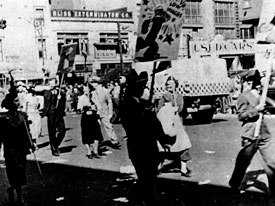
Sito describes the Disney strike in great detail. It lasted more than six months and involved most of the best artists in the business. A tent camp was set up on the field that now houses St. Joseph's Hospital. It also involved gangsters sent from the east to control the Hollywood union. The many illustrations include not only pictures of the strikers and their signs, but letters written by both sides and copies of union newsletters and a New York Daily News headline that reads, "Communists Tried to Capture Mickey Mouse, Says Disney".
The Infamous Blacklist
Chapter six is about the Blacklist. In retelling animation's part in that infamous piece of history, Sito also tells the history of the IATSE. He tells of the careers ruined in all phases of the movie business, and friendships torn apart by those who testified. Loyalty oaths were instigated and at MGM 700 people were fired. The blacklist even spread to Canada. This chapter also tells of a little known episode where a group animation people tried to form a co-op community where they could live together in the Valley. The Valley was extremely segregated at that time and the experiment failed because only Caucasians were allowed to reside in the area. After four years of unsuccessful lawsuits, the co-op plan collapsed in 1949 and the families involved lost their deposits. During this period, ASIFA was born.
Chapter seven tells of the Terrytoons strike and chapter eight starts off explaining how the laws that prohibited block booking killed off the cartoon shorts that were always shown with movies. This caused such a dearth of production that many people said animation was dead. Most of the backlog of cels, backgrounds and drawings were thrown out or burned. Very few new artists were trained; a situation that was helped later on by studio training, but not for 30 or more years would there be a supply of school trained animators.
The Runaway Years
Chapter nine tells of how runaway production came about and how that affected the union. Sito tells of the financial considerations that made moving production overseas logical to management. From that first Florida studio, to Hanna-Barbera, to Cuckoos NEST (Taiwan) to Disney Australia, the trend snowballed despite several strikes. Sito explains why young artists did not support the strikes and how Disney lawyers were able to get around contracts.
Chapter 10 relates the discord in the creation of The Fox and the Hound. Chapter 11 is titled, "Camelot," and tells about the years 1988 to 2001, when we all thought the good times would always roll. Some animators made five figures a week, but it couldn't last. Chapter 12 is about the arrival and takeover of 3D. Sito tells how the CG rendition of the Voyager flyby inspired a whole generation of digital artists. The ultimate results were that 2D artists who couldn't transition, no longer had work. The younger artists were difficult to organize, but Sito claims the business is on a, "cusp of change."
The Future of the Union
The last chapter is titled, "Where to Now?," and explores the future of unions in the animation world. This is followed by series of appendices. "The Animation Union Leaders" lists all the dates and names of those people. "Dramatis Personae" gives a short bio of all the great names in animation in the book. Then there is a glossary of terms, pages of footnotes, a bibliography and an index. Illustrations are all credited and captioned, both under the photo and in a list at the front of the book. Especially nice, is Sito's dedication, just before that.
Drawing the Line: The Untold Story of the Animation Unions from Bosko to Bart Simpson by Tom Sito. Lexington, KY: The University Press of Kentucky, 2006. 425 pages. ISBN-13:978-0-8131-2407-0.
Libby Reed started out at Walt Disney Studios in the 50s on
Sleeping Beauty as a painter. She has worked at numerous commercial studios, spent 16 years as a fashion illustrator and wound up at Film Roman as a color designer under Phyllis Craig. Libby has two children, (one is Alex Reed, animation producer at Electronic Arts) and four grandchildren.