
Iain Harvey traveled to Korea for the Jeonju International Film Festival and not only uncovered a great festival, but an enthusiastic crowd and a country on the rise.
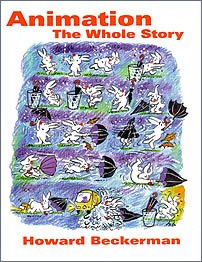
This year, Richard Williams' book The Animation Survival Kit arrived amid great fanfare, but at the same time, another animation textbook snuck in under the radar, and in its own way, it's as significant and worthwhile a work. Howard Beckerman, an independent New York animator, and teacher of animation for over thirty years, has essentially put his college course material into book form with his thorough, thoughtful and accessible book Animation, The Whole Story.
Like Williams' book, Animation, The Whole Story is more of an instructional book than a coffee table volume for fans. Beckerman's intention was to convey in written terms the material he covers in his college courses on animation drawing and theory. As a result, the book has an informal, low-tech feel that many young animators will find comforting, expansive and easy to follow. The book focuses on the mechanics and techniques of creating traditional, hand-drawn animation. It introduces the subject from the ground up, starting with such simple concepts as basic story construction and then getting into the practical concerns such as the importance of layout before actual animation begins.
A Different Point of View
The book is laid out in much the same way as Howard's course: it's broken into chapters which can stand on their own and serve as individual lessons for the reader. Each chapter, though dense, is written in a conversational style that makes the information easy to absorb. Technical terms and procedures are explained in simple, direct language and it's clear that Beckerman understands that the subject is an enormously complicated one, but that it needn't be presented as such.
The book will be of the most use to those new to animation: people who are curious to make an independent film of their own and need to know everything from script to camera. Though Beckerman worked for years at some of the major studios like Terrytoons and UPA, his most recognized and well-known films were created after he opened his own studio in Manhattan. Accordingly, he approaches filmmaking from the point of view of an independent, and the book is tailored to those who want to work on their own.
Many film books have covered this ground before, and one might argue that Beckerman's focus on traditional hand-drawn animation will limit the book's appeal to those raised on sophisticated computer graphics. However, the need for strong storytelling and a background in traditional drawing skills are still essential tools for the modern animator to have, and I can think of no other recent book on animation that covers this in as thorough a manner. Even Richard Williams' impressive book doesn't spend much time on camera, layout and storyboarding. To those interested in shooting their own films, and in being the author of their work -- through all stages of production -- I believe Howard's book will be a valuable and exhaustive guide. It even has a final chapter on the business of animation, covering such subjects as copyright, a good portfolio, the pros and cons of partnerships, and a little about the uses and importance of the festival circuit to the independent animator.
The Low Down
What comes across most effectively in the book is Beckerman's love of the field, and his desire to share the affection he has for his career with those new to it. Those looking for a glossy, richly-illustrated Hyperion volume should be aware that Beckerman's book is structured and executed as a textbook, and its visual style reflects this: the artwork inside (mostly by the author himself) is simple and direct, but decidedly low-tech. The illustrations serve the same purpose as a teacher's sketches on a blackboard, and they are often as rough. The book's primary audience is young filmmakers at the college level: as such it looks and feels like a course guide, which is what it is. The difference between this and other college texts is that the written portions of Beckerman's book are witty, playful and easy to get through. What this book has that many others lack is the author's trademark sense of gentle humor. Those who've known Howard will find his personality and affability intact within his chapters. This informality elevates what might have been something dry and intimidating. The course covers so much ground, but the book's structure dictates that information may be assimilated in individual chapters, much in the way a college education in animation is broken down into classes.
There's been much discussion lately about the longevity of traditional hand-drawn animation: many people have predicted that the recent failure of some traditional "cel"-animated films has sounded the death knell for this type of production. Howard's book comes at an interesting time for the industry, and for independent animators. Is there anyone out there who still has a passion and an interest in this kind of home-grown filmmaking? How many people are receiving an education in the kind of animation technique Howard offers in his book? Not enough, by the look of things. It might be argued that much of the animation in recent computer-generated films lacks the sensitivity, artistry and organic qualities that made the classics of twenty and thirty years ago such works of commercial art. In the race toward polished graphics and ever more sophisticated imagery, something of the art behind the art has been lost along the way. It's obvious Richard Williams has felt this as well: his book, it must be admitted, covers much the same material as does Beckerman's. Any serious student of animation should have both books, to my way of thinking. Williams' book focuses on the mechanics of drawing: walks, for instance, and the principles of follow-through. It's a book for people who want to be animators. Beckerman's book is for those who want to make their own films, and want to know how, from concept to editing. Along the way, the author discusses animation drawing, but also examines issues of humor, taste, culture, mythology, history and commentary.
Animation, The Whole Story
is an admirable attempt to put the art and the structure back into animation instruction. If you already know a lot about animation, and you're looking for something dramatic and colorful on the subject, I'd recommend Canemaker's Walt Disney's Nine Old Men, but if you're new to animation, and you want to know how it's done, Howard's book is the one. It's one of the best introductions to animation production and technique in a long while.
Animation, The Whole Story by Howard Beckerman. Mattituck, New York: Amereon House, 2001. 224 pages. ISBN: 848808673-3
Richard Gorey graduated with a degree in animation from the School of Visual Arts in Manhattan. He has written film comment for the ASIFA newsletter (east coast) and is the author of the book
The Great Rabbit Rip-off, as well as several screenplays. During Gorey's career at Young & Rubicam, he was a creative director and animator for such clients as Johnson & Johnson, Citibank, Hallmark, and Philip Morris.