
Heather Kenyon reports how Balbir Mathur and his organization, Trees for Life, with help from Frick Back, are using animation in to help people in the third world plant trees.

Balbir Mathur is a man with a mission. And no small mission at that. He wants to plant 100 million fruit trees by the year 2000. He has already helped with the planting of tens of millions of trees and his movement is gaining speed. More than three million people have participated in Mathur's vision by helping to plant trees in Brazil, Nepal, India and Guatemala. Likened to Johnny Appleseed, the enthusiastic Mathur is tireless, working toward helping others help themselves and now animation is becoming an increasingly important tool to him and Trees for Life. Mathur founded Trees for Life, a nonprofit movement that plants fruit trees in developing nations, as a reaction to many questions he was pondering while working as a management consultant. "I was thinking about, `Who am I? Am I a human being? What does that mean? How do I wish to respond to that? What do I want to do as a result?'" By 1984 he had an answer and Trees for Life was born. The newly planted fruit trees not only provide food for hungry people and protect the environment, they also become a source of income. We have all heard the Chinese proverb: If you give a person a fish you feed him for a day; teach him how to fish and he will never be hungry again. Trees for Life is even more proactive. The organization is all about self-help at a grassroots level. Trees for Life believes in educating people who will then teach others how to plant trees. So, going back to our proverb, Trees for Life doesn't just teach people how to fish, they teach people how to make fishing poles and expect them to go teach others. "Some people don't know how to plant trees. So we teach them. Some people don't have seeds. So we send them. We are here just to provide the missing elements. We look at ourselves as servants, servants to the people who are serving their communities," Mathur explains.

Pencil Test for a section of Frédéric Back's animation, The Trees for Life Story.
Animation is Key
Therefore, communication is the key to the organization's success. How well volunteers in the field communicate new ideas and techniques directly relates to the program's success. The communication tool of choice is becoming animation. Animation transcends cultural barriers and becomes a universal language that is easily understood by those who are word illiterate. "Animation is key to transferring knowledge to the poorest poor in the world," Mathur agrees. Their first animated project is a 10-minute film which relates the story of Trees for Life. It is being created by Frédéric Back, who won an Academy Award for his The Man Who Planted Trees. "Back is our patron saint," says Mathur. Back is just as complimentary of Mathur. "Trees for Life and my ideas are very similar. I was very glad to know of Trees for Life and I was happy I had a chance to work on this beautiful story and try to make as many people as possible learn what mankind could achieve." Now more than ever Back's original message is crucial. In the past 200 years, half of the earth's trees have been destroyed. However, both Back and Mathur are very upbeat and positive about the effects humans can have if they choose to act responsibly. "I believe very much in the power we have. In the long run we can make a tremendous change. We can change the world with every little choice we make," says Back.
"I find this world joyful, full of uncharted potential. We say to children, `This is not a hopeless place. This is a place we love. Let's make sure it stays this way, a beautiful planet,'" Mathur says. Trees for Life distributes educational packages to 55,000 schools across the United States, representing 2 million students. Every one of these students receives packets of seeds that they are encouraged to grow either in the classroom or at home. Then, the students feel as though they are taking part in the grand solution. Schools, churches and communities will receive the completed animated history of Trees for Life to raise awareness of the group. "Animation is a wonderful media to describe, not always reality, but a message that is strong. You can create a reality that is very attractive and you can reach everyone - children and adults. In a short time you can see an evolution, the contrasts of situations," says Back. "It shows how important the dreams of children are. It will help people to remember the dreams of childhood so that they are not lost with the currents of life. The world could be as bright as it was."
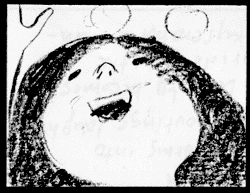
Excerpt from Frédéric Back's animation storyboard for The Trees for Life Story.
Beyond Back
Trees for Life is headquartered in Wichita, Kansas and run by highly qualified professionals and volunteers who sometimes leave behind high paying jobs in order to join this coalition. While Back is completing the key animation, Trees for Life is looking for other animators to help them finish their film. Mathur has already begun to set up an animation studio in Wichita where volunteers can learn the process and will then spread out, like missionaries, to teach. Mathur reached out to the professional animation community this past fall. He and his wife, Treva, who is just as dedicated, visited Los Angeles for a week. During their visit they met with a host of interested parties including: Ron Diamond of Animation World Network, animator Leon Joosen, educators Bruce Royer and Linda Crain, historian Charles Solomon, animator John Ramirez and Warner Bros. Feature Animation where they received a first hand look at Dave Master's new program where students are taught animation via interactive television. Mathur was so impressed with the generosity of the animation community, that he is planning yet another trip. In the meantime, however, Reeves Lehmann from New York's School of Visual Arts (SVA) traveled to Kansas for six days in January to assess how the two groups could work together. He even taught a workshop on "How to write a creative story" for the Trees for Life staff. "It was a fabulous experience for us," enthuses Mathur. "Soon Trees for Life will be joined by some of our animation faculty and students to complete their project. It is a thrill to combine our new generation of animators with such a worthy cause," says Lehmann, SVA's Chairman of Film, Video and Animation. Mathur maintains though that the organization will stay a small flexible unit in order to best utilize its limited resources.
"Traditionally, the SVA student body has taken a strong role in supporting the community," explains Lehmann. "After meeting Balbir Mathur for just a few minutes I knew that the Trees for Life animation proposal would be the kind of project SVA could assist in developing."

The Los Angeles trip has hurried along their second animated project. This film will be directed toward people in India to educate them about a remarkable tree that grows in their own backyard. Each year in India, 500,000 children are blinded and millions more die due to vitamin A deficiency. In the midst of this horror, however, a tree called the drumstick tree exists. The drumstick tree's leaves contain 10 times more vitamin A than carrots and are a commonly accepted form of food. Trees for Life has already developed an educational package explaining the nutritional value of these leaves. Now, they are teaming up with several other groups to create an animated video which discusses the use of these leaves in a healthy diet. This film will utilize paper cutouts and include artists from India and Guatemala. Production will begin on April 1and Mathur maintains that this is not an April's fool. "We already have the storyboard and Frédéric is going to be here to start us off." The project will be completed by July. But of course, Mathur's dreams do not end with these two animated shorts and US schools. As usual, he has much grander schemes. First, he realizes that they have to set up a truly working studio in Kansas. "Anyone who would like to come work with us, even for a few days, would be most welcome." Trees for Life is looking for animation savvy individuals to help train their core group of workers or donate equipment. Then "we will pass on this knowledge to others," says Mathur. He has hopes of opening up an animation studio in Allahabad, India where school children will learn to use the art of animation to express themselves and their concerns. "They have to ask and answer their own questions." More animation studios in other developing nations would then be planned based on the success of the model in India. However, whatever the future holds, Mathur feels this group is already an overwhelming success. In fact, he cannot truly count the number of trees the group has planted because the movement is so successful at working on a community level. "It just spreads. We cannot control it . . . We are people who are dancing and our life missions are already completed just when we arrive here (at Trees for Life). I don't plant trees because of ambitions, goals or dreams. I plant them because this is the gift I give to my beloved, this planet." If you would like to help or learn more about Trees for Life, check out their Web page on AWN (http://www.awn.com/treesforlife/), or in North America, call them toll free at 1-800-873-3736.

Heather Kenyon is Manager of Production Information at Hanna-Barbera Cartoons and a freelance writer.