
Mark Langer chronicles the evolution of one of the most enduring characters in animation history, the sailor man who got his start in comic strips.
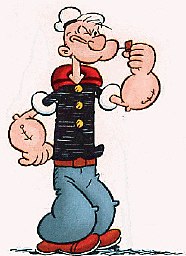
Popeye the Sailor, one of the most enduring characters in animation history, began not in motion pictures but in E.C. "Elzie" Segar's "Thimble Theater" comic strip. Born in Illinois, Segar began cartooning in Chicago in 1914. Graduating to his own strip for the Chicago American, Segar was then hired in 1919 by Hearst's New York Evening Journal to create the syndicated "Thimble Theater" strip. "Thimble Theater" depicted the adventures of Ham Gravy, his girlfriend Olive Oyl and her brother Castor. The venture was a success, expanding to an additional Sunday color page in 1924. Segar's comic strip used complex, rambling and frequently eerie narratives that attracted a devoted following, but it lacked strong central characters. In the "Thimble Theater" of January 17, 1929, Ham and Castor decided to hire a crew to sail in search of the legendary Whiffle Hen. Walking up to a grizzled one-eyed mariner on a dock, Castor asked him, "Are you a sailor?" "`Ja think I'm a cowboy?" came the reply, introducing Popeye to readers.
Move Over, Ham Gravy
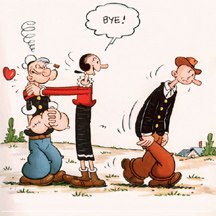
Over a period of months, Popeye developed from a supporting character to the central figure in the hunt for the Whiffle Hen. When Segar finally brought the narrative to a close and tried to retire the sailor, outraged fans contacted the Hearst syndicate demanding more adventures with Popeye. Segar obliged them: the sailor replaced Ham as Olive's love interest, Castor Oyl was reduced to infrequent appearances, and the strip was renamed "Thimble Theater, Starring Popeye."
The early 1930s was a period of keen competition among American animation studios for market share. Central to the business strategy of most studios was the development of cartoon "stars" whose popularity would ensure bookings by major theater chains. Disney followed the success of Mickey Mouse by developing new characters like Donald Duck and Goofy up from supporting roles in Mickey Mouse cartoons. Similar strategies were tried at Warner Bros., where Bugs Bunny and Daffy Duck evolved from secondary roles in films starring other animated characters. One of the earliest examples of this took place at the Fleischer Studios, Inc. in New York, where the unpopular starring canine character Bimbo was matched up with a girfriend in Dizzy Dishes (1930). The girlfriend eventually developed into Betty Boop, the studio's major character. With the popularity of Betty Boop at a peak in 1932, brothers Max and Dave Fleischer decided to introduce a new film series which would include another character to grow into a star. Fleischer rival Van Beuren Corporation had already signed an agreement to bring Otto Soglow's strip "The Little King" to the screen. Max Fleischer, who was a great fan of Segar's strip, approached Hearst's King Features Syndicate for the right to use Popeye. The two companies signed an agreement on November 17, 1932.

Betty Introduces Popeye to the Big Screen
The production of the first Popeye film took place in secrecy. Veteran animator Roland Crandall was given space apart from the rest of the studio. There, he single-handedly animated the entire cartoon, aided only by the inclusion of some Shamus Culhane animation recycled from the earlier Betty Boop's Bamboo Isle (1932). The results were so satisfying that even before the film was released, the Fleischers and King Features amended the agreement granting the studio the right to produce and release animated cartoons featuring Popeye for a five year period.
Crandall's film Betty Boop Presents Popeye The Sailor opened in the summer of 1933 as part of the "Betty Boop" series. After a prologue in which newspapers herald the sailor's film debut, and Popeye sings "I'm Popeye the Sailor Man," the film featured what was to be the standard "Popeye" series plot, re-enacted with variations by the Fleischers for the next decade. Olive waits for Popeye to disembark from his ship at the dock. Bluto follows the couple to a fairground, where the two sailors compete for Olive's attentions through feats of strength. Bluto abducts Olive and ties her to a train track. As the locomotive approaches, Popeye and Bluto fight. Popeye defeats Bluto, and, through the magical powers of spinach, is able to stop the train and save Olive Oyl. Here, we see the essential difference between the Segar and Fleischer sense of narrative. Segar reveled in picaresque plots that coursed in unexpected directions for up to two years, exploring every novel twist and nuance of narrative. In anticipation of post-modernism, the very concept of plot was old-fashioned to the Fleischers. Hackneyed and ritualized story conventions were torn apart, recombined in odd juxtapositions, and satirized in endless variations.
The Fleischer Popeye cartoons were an instant success. "It might have been just a fluke, a lucky break, that the Segar characters fit the Fleischer style so well," recalls former Popeye animator Myron Waldman. "The animation of Olive Oyl in the mid-1930s was perfect. It fit her. The character had no elbows and the most prominent knees. When she spoke, the voice fit too. This was character. That's what made her so good."

Step Aside, Mickey
Segar's characters were not the only things consistent with the Fleischer style. Both Segar and the Fleischer staff shared a fondness for a poetically improvisational language. When Popeye's original voice artist, William "Red Pepper Sam" Costello, left after the first few pictures, he was replaced by a studio in-betweener named Jack Mercer. Much of the dialogue of the Popeye cartoons was post-synched with little attention to synchronized mouth action. Mercer, Mae Questel (Olive's voice, except for the 1938-41 period, when Margie Hines was the voice artist) and William Penell or Gus Wickie, who voiced Bluto, often ad-libbed dialogue during recording sessions, particularly Popeye's "asides" and pun-filled conversations. Added to this was a progressive softening and increased complexity of Popeye's character, paralleling changes in the strip. Popeye cartoons became the Fleischers' leading attraction. By 1938, Popeye replaced Mickey Mouse as the most popular cartoon character in America.
The Fleischers rummaged through the Segar strip for supporting characters. Bluto, the animated series' antagonist, was a minor character in the Segar strip, appearing only in 1933's "The Eighth Sea." Longer-lived strip characters that joined Popeye on the screen included hamburger maven J. Wellington Wimpy, Swee'pea, Eugene the Jeep and Poopdeck Pappy. While in the comic strip, Popeye gained his great strength from rubbing the Whiffle Hen, the Fleischers added the gimmick of Popeye's power being largely dependent on the ingestion of spinach. Farmers in America's self-styled "spinach capital" of Crystal City, Texas set up a statue of Popeye in gratitude for the publicity.
As early as 1935, the Fleischers sought backing for a feature-length animated film from their distributor Paramount. Paramount refused to risk money on a feature. In an attempt to persuade the company that longer animated films could be profitable, Max Fleischer initiated the production of three two-reel color "specials" starring Popeye, beginning with Popeye The Sailor Meets Sinbad The Sailor (1936). Although these "specials" were often billed over their accompanying feature, Paramount still refused to back the animated feature.
Conditions changed after the success of Disney's Snow White And The Seven Dwarfs (1937) and the Fleischers received money for the eighty minute Gulliver's Travels. According to some sources, the film was originally to have Popeye in the role of Gulliver, but the idea was scrapped early in the planning stages. Perhaps this was unwise. According to internal Paramount correspondence, the Popeye shorts were far more profitable to Paramount than Disney's films were to his distributor, RKO. The sailor's box-office appeal might have helped the Fleischer features. Gulliver's Travels (1938) and the company's next feature, Mr. Bug Goes To Town (1941), bombed, leading to the failure of Fleischer Studios, Inc.

Post-Fleischer Popeye
The successor company, Famous Studios, continued with the production of Popeye cartoons. Many of these were remakes of earlier Fleischer films. Much of the supporting cast of the Fleischer versions were replaced by new characters, such as nephews Pip-Eye, Peep-Eye and Pup-Eye. A redesign of the major characters included white U.S. Navy uniforms for Bluto and Popeye (in keeping with their war-time service in the armed forces), and more comely fashions for Olive. Upgraded technology, including the introduction of color to the series in 1943 with Her Honor The Mare and 3-D in Popeye The Ace Of Space (1953), tried to rejuvenate the series. None of these strategies were able to breathe much life into the films. Spooky Swabs (1957) brought theatrical release of Popeye films to a close.
The success of the black and white Popeye cartoons on television in the 1950s inspired several revivals of the series by such talents as Gene Deitch, John Halas and Joy Batchelor, Jack Kinney, and Hanna-Barbera. Hampered by limited budgets and rushed production schedules, none of these came close to the Fleischer or Famous theatrical versions. The less said about Robert Altman's live-action feature with Robin Williams and Shelley Duvall as Popeye and Olive Oyl, the better. What has endured are the original qualities of the Segar and Fleischer works. In fact, Segar's strips have been reissued by Nostalgia Press and the Smithsonian Press. The earlier Fleischer films, which shared the shabby urban or surreal exotic locations and working-class orientation of the Segar originals, retain a vitality and charm that still appeal to a large group of devoted fans today.
Mark Langer teaches film at Carleton University in Ottawa, Canada. He is a frequent contributor to scholarly journals and a programmer of animation retrospectives