
Chris Robinson delves into the bizarre story of Ryan Larkin, once an Oscar nominated National Film Board of Canada wunderkind, now a homeless man living in Montreal. How did incredible talent, guilt, drugs, alcohol and the quest for freedom bring him to the last exit on St. Laurent Street?
"Being an artist doesn't take much, just everything you've got."-- Hubert Selby Jr.

Ryan Larkin. Photo courtesy of and © National Film Board of Canada. All rights reserved.
Okay, to avoid any potential construction of pathos, let's cut to the chase. In the 1960s, Ryan Larkin was a 19-year-old protégé of Norman McLaren. With McLaren's support, Larkin was given a rare carte blanche at the National Film Board of Canada (NFB) and made one of the most influential animation films of all time, Walking (1968). By 1999, Larkin was living on welfare in a mission house and panhandling for spending money. How the hell did this happen? Who knows? NFB types say one thing, Ryan says another. The reality is likely, as usual, a combination of the two stories. I'm not out to turn Larkin into a victim or a martyr. He made choices...well, actually it was his inability to choose that caused the problem. He is living with his indecision.
Cliché #1: "Must have come from a broken home." Not so. Larkin's family lived in a classic 1950s suburb of Montreal, Dorval. His father was an airplane mechanic and his mom worked as a secretary. Right from the beginning Larkin (the middle of two brothers) proved to be a special child. By the age of about 10, he was already doing oil paintings, and at 13 was accepted into the prestigious Montreal School of Fine Arts. The school was already very familiar to Larkin. As a child, his father used to drive him there every Saturday for classes. One of his early artistic influences was his teacher, Arthur Lismer, who was also a well-known Group of Seven painter. At the school, Larkin received an extensive education in classic forms: life drawing, sculpting, oil painting. Larkin excelled at the school and within a few years he was being considered for a job at the National Film Board of Canada.
Cliché #2: "He ruined his life with drugs and booze." Not quite. Yes, as we shall see, Larkin was a cokehead and drinker (but not a drunk), but there is a much deeper and more traumatic episode behind all of these escapes. Larkin was very close with his older brother. "I had a rock and roll teenage hood. I played drums, was in rock bands. My older brother was very popular in the area. He drove a convertible and always had girls around him. I looked like a greaser punk and was the typical younger brother, always hanging out with him." During the summer of 1958, Larkin, his brother and friends are playing on a boat in the lake. Something goes wrong and Larkin's brother is dead. "It was a terrible boating accident. I was unable to save him. We were very close. It hit me very hard. I was on the boat and was physically unable to save his life. It was a major block for me. I felt terrible and missed him greatly." This, more then snorts and chugs, caused his eventual spiral.

Syrinx. © National Film Board of Canada. All rights reserved.
A Bright Start
With the help of his father, Larkin got an interview at the NFB and surprisingly, given that he had no animation experience, got a job at the age of 19. He initially worked as an animator on educational films for the army and navy including the spine tingling epics Ball Resolver in Antic (1964) and The Canadian Forces Hydrofoil Ship: Concept and Design (1967). The work was generally mindless crap requiring Larkin to follow storyboards and do tracing and painting for other animators.
During his 2nd or 3rd year at the NFB, Larkin became a friend of Norman McLaren and his "gang" including Guy Clover and Grant Munro. McLaren had recently begun holding an after-hours session in a small room at the Board. The relationship with McLaren opened Larkin up to a completely new world. "They were sophisticated. They had huge libraries and invited me home and showed me their libraries. It was fascinating. I was just working class. In my house we had pictures of airplanes." Larkin absorbed books, paintings and classical music. "I was young and really impressed with all this new information."
Within the after-hours sessions, McLaren set up a project for the eager young artists (including Pierre Hebert, Co Hoedeman and Ralph Abrams). "He'd give us 16mm cameras and teach us the fine aspects like calibration and how to use our senses. He had a test that involved taking a cut-out of a round ball and shooting it single and double frame." Each artist was given a roll of film to shoot whatever they wanted. Animation came as naturally to Larkin as drawing. "Norman said I had natural control over timing and pacing over any given object." At the same time, Larkin developed a unique technique involving stop-frame action with charcoal that was easy to erase. Using a strong sheet of paper, Larkin was able to draw deeply into the paper and still erase it. Utilizing this new technique, Larkin made a one-minute test film called Cityscape. This dark, nightmarish view of the city is filled with animation and a melange of strange characters coming and going. Finally, the main character finds solace in a country landscape, alone. It is hesitant and sloppy at times, but it is also a shocking, raw and almost paranoid portrait of the cement garden.
Larkin shot Cityscape single frame and "the whole thing went whizzing by in 30 seconds." So to enhance the film, Larkin took it to an optical imager, reprinted the frames and cross mixed them while developing short cross dissolves to give the film a natural looking emotion. People at the Board noticed Cityscape and were taken by its originality. McLaren approached Board producers and asked that Larkin be given carte blanche to make any film using the charcoal technique. "They said, 'Here's a budget. You've got three months to make any film.' I spent a week wondering what I was going to do. One of Norman's friends presented me with a solo flute piece called Syrinx by Claude Debussy. A French flutist recorded it and that was my starting point." Using the flute piece, Larkin then turned to the Greek story about Pan. In this tale of stalking, Pan is constantly hasslin' the hotty Syrinx for a little love. Tired of his come-ons, Syrinx asks Gaea for help. Gaea then turns Syrinx into a clump of reeds. Pan then takes the reeds and turns them into an instrument.

Syrinx. © National Film Board of Canada. All rights reserved
Larkin faced a number of problems before completing the film. The music was a key ingredient and had to be carefully time and paced. Unfortunately, there wasn't enough money in the budget to buy the music so they were forced to find a member of the Montreal Symphony Orchestra to record it for less. Meanwhile, Larkin discovered he had to re-shoot the film. "First time I got off track and the images weren't coming off as beautiful as I wanted. I was getting nervous but Wolf [Koenig] and Bob [Verrall] said, 'Go back and re-shoot the whole thing.'" Ah, the fortune of a court artist! Larkin re-shot the film, this time concentrating more on the images and the body of Syrinx. The final product received excellent reviews and Syrinx won awards all over the world including the Grand Prize at a children's festival in Iran.
Becoming Established
Larkin was now living a princely life in downtown Montreal continuing to paint and sculpt and surrounded by many friends. "I was always good at sculpting and doing three dimensional sculptures. I began to see animation as a form of sculpting." Larkin had a few small exhibitions and many people at the NFB purchased his drawings and paintings. Larkin gleaned his inspiration in cafes and bars watching and absorbing the way people walked and talked and moved. He loved to watch people and would make sketches of people walking or get friends to pose. Larkin's friends were also doing more than posing, doing what kids were supposedly supposed to do: drugs. Ironically, Larkin wasn't into drugs at the time and instead was a Virgil to his LSD induced mates. "They would experiment and I wouldn't. I made sure they didn't fly out windows." Things would soon change. Despite the wealth of friends and success, Larkin remained lonely. The death of his brother had quietly fractured the family. "Because I was on the boat nobody knew what happened, but somehow I failed to save my brother." Something changed. "I was always the goofy little guy and they figured I goofed up again." Nothing was ever said to Larkin but he nevertheless felt eyes scorching him. Larkin, a man who could bring images to life, could not save a life dearest to him.
After Syrinx, the producers told Larkin that he had to go back to applying his talents to industrial films. He made a variety of educational films for St. John's Ambulance, an elaborate colour pastel clip on preventing forest fires, and a contribution to the NFB's exhibition at the Montreal Expo. "The Board had its own pavilion, called Labyrinth, and they had multi screens. I was asked by Roman Kroiter and Colin Low, to put in a Labyrinth, the old Greek idea, using the same style as Syrinx."
Following the Expo exhibit, Larkin put in a proposal to do a film based on sketches he had drawn of people walking around. The proposal was accepted and Larkin was given a year to do the project. However, dreading the thought of repeating himself, the film took two years as Larkin took time to perfect new techniques. "I was developing my Oriental brush work with water colours, and the human figures and the way that anatomy works, expressions of human behaviour, how funny they look sometimes when they're trying to impress each other with certain movements. I wasn't doing any rotoscoping, I was doing a lot of self-study. I had mirrors in my little office, and I would go through certain motions with my own body and was just going with pencil, ink and paper." In concentrating on motion and the details of the figures, Larkin abandoned background movement instead choosing a blank white screen.

Walking. © National Film Board of Canada. All rights reserved.
The result of this two-year project was Walking, one of the most celebrated films made at the NFB and one that remains a major influence on animators to this day. Using a combination of line drawing and colour wash, Larkin observes the movements of a variety of urban characters. Larkin weaves colours and sounds with an extraordinarily detailed visualization of faces, bodies, gestures and postures. A vivid imagining of the city and those within it.
Walking received an Oscar nomination and Larkin travelled to Hollywood with his girlfriend, Felicity. The Oscars provided Larkin with a chance to put his beatnik persona and wild wardrobe to practice. Larkin had hair that was about three feet long and made his own clothes. "I would sew together my own pair of pants in special colours. It was coming out earlier I think, I was always performing, trying to look outrageous by whatever standards were established, just being a punk." For the Oscars, Larkin selected a flashy silk, wide sleeve shirt and tight fitting pants with bright colours.
Walking didn't win. Disney, who had died a year earlier, won for Ward Kimball's It's Tough to be a Bird. But Larkin had a great time and a rather strange experience. While in a hotel lobby, a man approached Larkin and said, "Hey, I know you. I've seen your helicopter up on the roof. I want to introduce you to the senator of New Mexico." The man then led Larkin over to a crowd of people including the Senator. The man introduced Larkin to the Senator: "Well, you've seen him on the Ed Sullivan Show playing his little ukulele." Larkin of course was mistaken for another flowery figure: Tiny Tim.
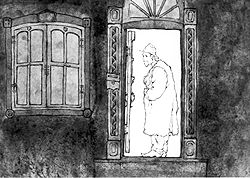
Walking. © National Film Board of Canada. All rights reserved.
Following Walking, Larkin once again returned to NFB industrial films before being loaned out to a Vancouver art school (maybe Emily Carr, but he can't remember). For eight months, Larkin ran an animation workshop. Each student worked in their own studio and Larkin would travel around visiting them, hanging out and directing them. Larkin encouraged the students to find their own voice no matter how wild their experiments turned out. Among these young voices, Larkin met a group of street musicians. "I decided that they would make a great focal point for my abstract images. There was a whole little gang of them with their own children and stuff, hippies I guess, really good musicians." Larkin's encounter led to his next film, Street Musique.
Very much a film in search of itself, Street Musique opens with live-action footage of two street musicians, before changing into an awesomely animated stream of conscious piece. A variety of creatures and figures float through the screen and undergo a continual metamorphosis. Street Musique is loosely divided into about five or six segments all determined by the pace of the music. One of the most dazzling scenes comes in segment two with a series of extraordinary landscape impressionist paintings. As with most of Larkin's work though you can feel the hesitancy. The film ends rather awkwardly with the last image stopping to wait for the music. "What happened was, I ran out of ideas and I didn't know how to end the film, so I just ended it on a strange little character, wiggling away in his little dance, in a way suggesting that, 'This is to be continued.'" Structural critiques aside, Street Musique is a toe tappin', knee slappin', barn burner of a film solidifying Larkin's talent as an artist and animator.
Street Musique did the festival circuit and won a Grand Prize at an Australian film festival. Larkin is particularly fond of this award because it was a live-action festival. "It was a ten minute film up against all kinds of complicated feature films." Larkin received $3000 with the prize, and because he had a regular salary he often supported other young artists with his prize money. "I had a nine room flat in Montreal that I was renting for $100 a month, if you can believe it, and I'd give money to certain young people to experiment with their art and their music. I'd give them free room and board to hang around. In a sense I had my own school." Sadly, Larkin's generosity with people would come back to haunt him.

Street Musique. © National Film Board of Canada. All rights reserved.
A Turn
Following Street Musique, Larkin was assigned to a feature film that the Board was working on called Running Time. Larkin was asked along with Co Hoedeman to do three short animation sequences combining the actors with animation images. However, Running Time soon turned into a nightmare for Larkin: "I was trapped into it for four years because the executive producers kept putting it on the shelf, then there were endless committee meetings. I was getting pissed off because I was on hold. I had no other budgets or work to do. Frustrated, Larkin began working at home on his next project, Ding Bat Rap. This decision has led to one of the myths surrounding Larkin.
In the book Cartoon Capers, author Karen Mazurkewich claims that drugs and depression got so bad that Larkin exiled himself to his home. For two years, the NFB sent him cheques by taxi. He was then fired. According to Larkin, things didn't quite happen this way. "Well, what happened was, I was seeing this feature film just flying away and in the meantime, I was developing my own idea, and I had my own setup in my apartment. I had two apartments, one that I lived in and one that I used as a studio. I was developing my own new film but I couldn't get a budget to work on it, and the executive producers of this feature film were saying, 'Well, wait a couple of weeks and just stand by because we haven't got the approval from upstairs.'" Rather than sit around the Board offices doing nothing, Larkin worked at home on his next film, a project he anticipated would be approved by the NFB. The situation was ideal for Larkin because if he woke at 2 am he could simply work on his film. This was something he couldn't do at the office. Larkin also notes that the producers knew that he was doing research and development for Ding Bat Rap at home while the feature was on hold. "That seemed to be okay with them since I was not able to work on the project."
About a year later, Larkin finally received a budget for Ding Bat Rap, but he continued to work at home. "I told my producers to trust me, I was working on the project, so they sent me my cheques." Larkin paid for the cab. Ding Bat Rap was to be Larkin's first 'talkie.' The film was to be set in a bar with a bunch of regulars sitting around talking nonsense with great earnest. "A lot of people talk and talk without saying anything. They make gestures with their hands, give meaningful looks back and forth towards each other." Larkin had experimental voice actors to re-create the 'babble.' He had originally hoped to record actual dialogue, but noticed that people froze up so he dropped that idea. He also selected swing music for the soundtrack: "There was a beautifully organized music library at the Board, made to provide filmmakers with soundtracks for any subject. I selected that material and edited it myself. So I had edited my soundtrack but I didn't have enough animation drawing. I had drawn my characters, about five. It was a very abstract, poetic thing. I had a storyboard and filmed still images, but there was no actual animation movement."
By this time, Larkin was a coke addict. Coke was a big attraction to Larkin. It was a magical, almost spiritual experience. "The cocaine was giving me incredible insights into human behavior and very acute sensitivities towards what constituted human behavior." But, contrary to Heraclitus' thoughts, the way up was not nearly the same as the way down. With the high, came the low. The neurological stimulation gave way to backlash. A flood of ideas drown the mind. Larkin discovered a confidence he never knew, but the pace of the magic locked Larkin into a fantasy world. A magician trapped within the allure of his illusions, Larkin was no longer able to work.
Meanwhile, the program committee was none too thrilled with Larkin's project. What Larkin saw as a satire on ethnic groups and nationalism was viewed with disdain as a reactionary, almost racist vision. "I was making sound and visual jokes against all people that were too full of pride. There was an anti-Muslim thing, and anti-Christian thing. I was trying to put down the nationalistic attitude that was happening at the time." Even McLaren backed out of Larkin's corner. "Norman was also sort of shocked by my heavy punk material." In Larkin's mind, he was making unsafe work for a conservative institution. But he also acknowledges that he was burning out. "I was losing my edge because I'd been there for too long. I was having a creative block that was probably the result of the coke." In a sense, Larkin was unable to grow up or at least fit the model of maturity prescribed by the society around him. He was pushing forty, but living like a punk. He was playing in rock bands. He was still hanging out with younger people, financing their bands, writing lyrics. He was a godfather to the punks. Nevertheless, it was clear that Larkin and the Board were no longer good for each other. For Larkin, the NFB became increasingly restrictive. A coked up, confused, talented Larkin wanted his freedom back; whatever the hell that was.
A Different Path
Never one to forget the encore, in 1975 Larkin was invited to create a mural for the NFB. What he drew was likely not what they had envisioned: an adolescent with an erection who may or may not have been ejaculating. The mural was 20 x 15 feet. "It was meant to be a satirical commentary on masculinity because at the time there was a year long festival going on about women's rights. It was supposed to be a comical relief from all their terrible, self-conscious seriousness." Ryan Larkin's tenure at the NFB ended. No one really seems to know what happened, but whether fired, resigned, whatever, Larkin was free. So he thought.
Larkin's girlfriend at the time convinced him that he should work in the private industy on feature projects. (Odd advice given Larkin's experience with Running Time.) Nevertheless, Larkin headed to Toronto where he worked for a short time as a storyboard artist at Nelvana. Larkin worked for two months storyboarding the final sequence for the feature film, Rock and Rule. Unfortunately, Larkin wasn't around to see if his work made the credits (it didn't). One night Larkin was working late, probably snorting some lines and sippin' on some beers, when something fell on his head and knocked him out. He ended up in the hospital for stitches. The next day, Nelvana quietly and quickly put Larkin on a train bound for Montreal.
It's not really clear what happened, but Larkin admits that his girlfriend would come around at night, he was still doing coke, and he was rarely without a drink in his hand. Turns out, in addition to coke, Larkin was also an alcoholic. Unlike coke, Larkin accepts his drinking condition with the greatest of ease, in fact he claims it makes him healthier. "I've been doing it ever since I was a child. When I was ten the doctor told my mother that I should drink 1-2 beers a day to put on weight." Larkin continues this ritual to this day and rightly claims, "I'm an alcoholic, not a drunkard."
Well anyway, after a brief period working on a variety of odd jobs including Heavy Metal, Larkin realized that his finances were out of whack. The gal he was shaggin' with was controlling his money and apparently ripping him off. "In the early '80s, I was getting angry with her, accusing her of stealing from me. I realized she was a thief. I tried to get rid of her, which resulted in some kitchen violence. Being a woman with a child by another man, she was able to get the upper hand with the authorities and the police. I was thrown out for being a violent man, but I wasn't."
At the same time, Larkin, admittedly without many options, gave up on the film industry: "I realized that even though I had made some good films, I was not a good filmmaker. I couldn't meet deadlines. Other people were pouring out bullshit. I was becoming disheartened with the whole process of films, I was getting paid a salary for junk films." So Larkin returned to his first love, being an artist.

Ryan Larkin with some of his works behind him. Photo courtesy of and © National Film Board of Canada. All rights reserved.
Today...
For a short time, things were okay. Larkin fell in love with a man who put him up in a studio. "I did a lot of good paintings in the '80s. I moved all of my work down to this beautiful home. This lasted for about 8 years, but he finally wanted to get rid of me. I'm very attractive, but evidently, I'm undesirable after awhile." The 1990s found Larkin, now coke free, starting over again on his own. His generosity with people resulted in a variety of folks taking advantage of his home. Paintings, drawings and sculptures were stolen by friends in need of a fix. Eventually penniless and alone, Larkin was tossed out of his home. He lived on the streets of Montreal briefly before moving into the Old Brewery Mission where he currently resides. Virtually all of his art is gone now, pawned for dope, tricks or whatever help the strangers needed to survive. He now carries only what he can: a few clothes, some books, and his little pop bottle for his daily beers. Many people have tried to help him over the years, but Larkin is either unwilling or unable to accept.
Has Ryan Larkin's life taken a downward spiral? It's really hard to say. When you watch his films, especially Walking and Street Musique, they seem to foreshadow his flaneur existence. The lack of structure, the random, carefree nature of his films seems to mirror his own refusal of order in life. Today he seems to have found some sense of freedom. He controls his time and actions. His days now consist of a regular shift outside a Montreal restaurant where he performs mime, dances and draws for change. He continues to play in rock bands as a drummer. Would life for Ryan Larkin be any better if he had remained a court artist at the NFB working away for a nice salary on crappy projects? Our conventional, constructed beliefs would be that his life has hit rock bottom, but I don't buy it. Everyday we see miserable souls drifting sleeplessly through life from meaningless job to lonely home. Unhappy travellers caught in a web of material constructions. Larkin may not have a home, he may not have a job, but he remains an artist. This is not to say that Larkin is content with his life. He isn't and still suffers from bouts of depression. Whatever may happen down the road (currently the Ottawa International Animation Festival and Quickdraw Animation Society are working toward getting Larkin back on the filmmaking track), Larkin has left the world with a quartet of passionate, delicate visual poems. Beyond that, he makes life better, if only for a second, for those walking, weary souls on St. Laurent Street. What more is there?
Chris Robinson is executive director of the Ottawa International Festival and the founder and director of SAFO, the Ottawa International Student Animation Festival. He is also a board member of ASIFA International. Robinson has curated film programs (Los Angeles, Norway, Korea, Holland, Estonia, Singapore, Vietnam and several other places), served on juries (AnimExpo, World Animation Celebration), and written articles on animation for Animation World, FPS, Plateau, Animation Journal and Take One. He prefers writing over cartoons. He also irks a lot of people with his often-inflammatory opinions about many things.

A well-known figure in the world of independent animation, writer, author & curator Chris Robinson is the Artistic Director of the Ottawa International Animation Festival.