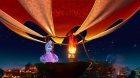
Helming the Italian animation Renaissance, Lanterna Magica and director Enzo D'Alare putting the finishing touches on their next feature film, Lucky and Zorba. Chiara Magri takes us there.

Enzo D'Alò. Photo courtesy of Lanterna Magica.
A good story is at the heart of every good film, therefore, Enzo D'Alò didn't have any doubts when, two years ago, he came across the Luis Sépulveda novel The Seagull and the Cat Who Taught Her to Fly and decided to make it into a film. He didn't even hesitate when he presented it to Vittorio and Rita Cecchi Gori, some of Italy's leading producers, who have produced amongst other programs the Cannes Festival Grand Prix winner La vita è bella by Roberto Benigni. In addition to the vitality of the characters, strong narrative and visual potential of the short story, Sépulveda is almost a household name after a string of publishing successes in Italy and Europe. Furthermore, it is a tale with a moral, a fable, calling for respect for both nature and man's differences. The story, featuring a gang of cats and a seagull, has a straightforward message, with explicit moral values which are accessible and enjoyable for all readers from children to adults.
Lucky and Zorba: A Fortunate Encounter
As a result, Enzo D'Alò and executive producer Maria Fares had a strong proposal, both in the film's story and their ability to produce an animated version with their Lanterna Magica company. It seems that it was one of those happy occasions where a valid idea comes at a favorable moment when it is in tandem with the market's requirements. However, it was certainly not by chance. The Lanterna Magica, founded in Turin in 1983, has slowly built up a wide range of animation experience in advertising production, social information with strong involvement in the education and training sectors, as well as with specials and short TV series.
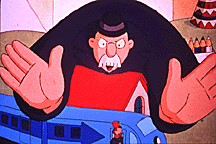
The Blue Arrow has been very successful, and will be distributed on video by Miramax. © Lanterna Magica
Above all, they had a precious ace up their sleeves with The Blue Arrow, a full-length animated film released in 1996 and produced with Monipoly and Fama Film. As Maria Fares explains, "As with the majority of European animated films, possibly worse still for Italian ones, we had enormous problems with the distributors. We had the usual complications of setting up the necessary financial backing and producing in a country that has produced little or nothing for many, many years. This is why I jumped for joy when Mikado, a relatively small but prestigious Italian distributor, took on our film. The market penetration wasn't strong and distribution investments were meager but the film cut out an important space on the quality film circuit. It was these positive results we got from The Blue Arrow that gave us credibility. I'm not talking commercial results, but rather those from critics and the media. Cecchi Gori saw the film twice. We signed the contract in three months and Lucky and Zorba was financed with 10 billion lire. Cecchi Gori has shown great sensitivity but I also think there is a lot of interest from investors for full-length animated features today. We have a good relationship with Cecchi Gori which will continue after Lucky and Zorba. We are looking at other projects both for cinema and home video."
Distribution and Production Difficulties
As Fares stated, the real obstacle for European features is the distribution. Relations between animation producers and distributors are not structured well enough to guarantee adequate promotion of the film. According to Cartoon, the animation division of MEDIA, a good 70 features have been made in Europe in the last seven years. There is no lack of talent, projects or even investors. The demand is there. What is lacking, however, is a distribution strategy capable of overcoming linguistic and cultural differences. The Blue Arrow's outcome is symptomatic: in Italy it was mediocre because of restricted showings, in France (distributed by Gebeka) it fared better and sold 110,000 tickets in 5 months.
This obstacle seems to be overcome with Lucky and Zorba since the producer can also guarantee cinema, TV and home video distribution themselves. The aim is for an international market and the prospects look promising as deals are underway with Miramax.

Zorba the cat from Lucky and Zorba. © Lanterna Magica.
Demand does certainly exist as Lanterna Magica is now working on two new films under D'Alò's direction. Momo from a Michael Ende novel for the German producer Taurus in conjunction with Trickcompany, the German animation company known for their two successful films based on the Werner comic strip (grossing $20-31 million). The second film is for the Italian state television, RAI, and will be, at last, an Italian version of Pinocchio.
Maria Fares claims, "You see, for Italy there's only one problem to solve -- the offer. What I mean is that the production forces aren't up to it yet in Italy. Our company has a strong `art workshop' feeling dealing predominantly with features, even though we also do TV productions. We've set up a solid and well-tested team for high quality productions, so in addition to D'Alò's films, we are moving ahead with other projects from other important Italian authors. First of all, we've got a film by Guido Manuli shown successfully to Cecchi Gori. The script is ready and we are developing the characters. A second project is Juanin Padan, by Giulio Cingoli, one of the great veterans of Italian animation, together with Dario Fo, actor, writer, jester and Nobel Prize winner for literature in 1998."
In other words, Fares underlined a problem which the Italian sector is facing: that of production ability. Italian animation from the `50s to the `70s was predominantly used for publicity, with a wide variety of unusual and imaginative characters, and animated mini-series. Then for a long period between the `70s and `80s it underwent a severe crisis due to the withdrawal of advertising funds and a near total disinterest on the part of both TV and cinema producers. Market growth, MEDIA Program's actions and, above all, the awakening interest of the State television has started a regeneration in the productive tissue and is bearing its first fruits in TV series as well. Lanterna Magica's features are at the forefront of this reawakening.
The Lanterna Magica Approach
A 20-minute promo of Lucky and Zorba was officially presented at the Venice Film Festival in September, with excellent reviews from the media, producers and distributors. The sreenplay is by Umberto Marino and Enzo D'Alò. The adaptation has been approved by Sèpulveda himself and his voice will be used in the Italian version. The music has an extremely important role and has been entrusted to Peter Gabriel's Real World organization and composed by David Rhodes. Prestigious, classic, but innovative, choices have been made for this film.
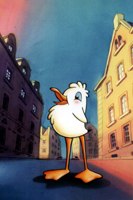
Lucky the seagull from Lucky and Zorba. © Lanterna Magica.
"Whether to release Lucky and Zorba at Christmas against Disney and Spielberg or more prudently in January? I don't know, it's a decision for the producer," says Enzo. "I only know that I want to finish the film for Christmas. This means we will have produced a feature in record time: one and a half years. I won't do it again ... but it had to be in the cinemas this year, two years after The Blue Arrow. We're doing this because our relations with the producer are very good and the team is experienced, plus dealings with Cartoonia [the company for coloring and shooting services] have got better and better. Even external help, that for The Blue Arrow was a multitude of free-lancers, has become more structured and organized with real animation services."
With Lanterna Magica's help the Italian production industry has grown and is becoming a consolidated structure. Cartoonia, a computer services company in which Lanterna Magica has a share with one of the leading video production and post-production companies, Roman Etabeta, can now, thanks to the feature experience, offer high quality services on a par with the competitive Far East.
Marco Massa, managing director of Cartoonia, explains, "There has been an enormous effort on the graphic elements of the Lanterna Magica films. We have found solutions to give both the characters depth and the backgrounds a multitude of shades. We use Pegs but I don't think it's simply a choice of software. We have to find solutions to problems continually as they come up. The quality of the film requires this. Working with Enzo is stimulating and lends a new experience but at the same time a service company can't be tied to only one producer. Cartoonia is working a lot for TV series for Italy and Europe."
Enzo's Mix of Message and Entertainment
Enzo is now an animated feature specialist and after fifteen years with Lanterna Magica he has more than a passing knowledge of animation and -- something of a rarity in the European game -- he is not an animator but rather comes to animation as a director. "I wanted to do Lucky and Zorba, like The Blue Arrow, as a film and no more. It doesn't matter that it's animation, I want, above all, for it to be cinema, that communicates with audiences as cinema does." D'Alò loves story-telling and animation is the best means. While this film is for family audiences, his films are usually a long cry from both noisy special-effects and fussy élitist authors. "I try to use a cinema language but ensure that the pictorial element of the image remains intact. The scenography was done in water-color and that's how I want them to appear. Indeed, for the whole film there's a strong element of children's drawings because the film came from a rhyme told by a poet to his daughter and from the child's imagination. It's a story of cats, real cats even if they can speak. We've tried to make them credible even though they are always and only cats. No glasses on the nose, or paws used as hands. Even the animation has followed this principle -- it's fluid, but never over the top or caricatured. In this way we've been able to get cats that are completely different from the Aristocats, even if it meant driving Walter Cavazzuti, the creator of the characters, mad."
The theme of the film is differences -- the job of hatching a seagull egg falls to Zorba the cat, who adopts the chick and brings it up in a community of cats. Once all obstacles are overcome, Zorba must then teach her to fly. To do so, the characters have to accept their obvious differences and learn to understand the value of differences and their beauty. Enzo explains, "Compared to the original story, I played down the strong ecological theme to play more on the relations between the characters, like the one between the seagull and Pallino, the kitten; their conflicts, including the less obvious ones, that help the growing up process." However, there is no shortage of spectacular conflicts like the one between the cats and some horrible mice, disgusting creatures who march to a decidedly rock rhythmed song. There are a variety of characters, but the film is about the community of cats, not one, single, classic hero. As Enzo remarks, "I don't really like heroes. Heroism, for me, is overcoming one's own limits, awareness of your own mistakes and creating your own identity. Maybe we are a little `understated' compared to some animation because I wanted to stick to reality, but I liked the idea of choosing the cat's point of view. There are human beings but they work in terms of the cat's world, just like in feline reality. Concerning the stylistic choice, I don't really like special effects. I use them if the film requires, but if not, I don't use them. Our stories don't need special effects. We have used 3D but only to solve complex animation problems." D'Alò did use special animation techniques, however, in three particular parts of the film: in the opening sequence, a dream sequence and for the vision of a dying seagull. Michel Fuzellier, the film's background designer, Mario Addis and Valter Cavazzuti all worked on Enzo's storyboard using their independent free-styles, creating a few intensely imaginative minutes of pure `art' animation. "If it had been a live-action film, I would have used animation, but as things were I used a different and freer form of animation," explains Enzo. Behind Enzo's modest tones there lies a lot of hard work and strong productive involvement. It seems that Lanterna Magica, Enzo D'Alò and Cecchi Gori have succeeded in delicately creating a balance between style, a strong message and entertainment. Both European and Italian animation is eagerly waiting to see how high the Seagull will fly. Translated from Italian by Guy Watts. Chiara Magri has worked in animation since 1984. She was responsible for the programming of the International Festival of Animated Film of Treviso. Since 1993 she has been teaching a course in animated film history at the Istituto Europeo di Design in Turin. Since 1989 she has edited and published the monthly ASIFA newsletter, the only specialized publication on animation in Italy. She is secretary general of ASIFA Italy. In 1997 she carried out an in-depth survey on the production sector of animation in Italy for RAI, the Italian national broadcaster.