
Joe Strike continues his talk with historian and filmmaker John Canemaker, who speaks about his many influences.
Read Part 1 of Joe Strikes interview with John Canemaker in which he talks about his early career and how he got into animation.

John Canemaker at Annecy 2005. Photo credit: Sarah Baisley.
The Teacher
John Canemaker: I kept making my own films, and one of my friends, Richard Protovin was an animator. He said, Im starting an animation program at NYU, why dont you come and teach a course? He started at NYUs Tisch School of the Arts in 1979 and I started teaching there in 1980. There were about four courses at the time; Richard was teaching production and giving a drawing course while I was teaching history of animation. I thought maybe I could inaugurate a course, so I started one called Action Analysis, which is still being taught there. It covered the principles of motion, why things work on the screen and looking at films frame by frame, live action as well as animation. Its based on the Disney courses they taught in the 1930s.
I started teaching at NYU full time in 1988 because Richard had retired. At some point I became tenured, and then I became a full professor.
Joe Strike: Now they cant get rid of you.
JC: We kept building the program and now we have 19 different courses per semester. Its one of the most extensive and comprehensive programs. It not only offers traditional courses like life drawing and stop motion or storyboarding, we also have a component course in 3D and 2D computer animation. I oversee it, Im the director. Ive hired about 10 teachers, some of them former students, a lot of them working professionals to teach these classes.
JS: These are all production courses?
JC: Theres one esthetics course well, the esthetics are mixed into all the courses. John Culhane gives a course on the history of animation. We have very talented students. Two of mine have won the student Academy Award. Alex Woo won last year for his film Rex Steele, Nazi Smasher. Dan Kanemoto won in 1999 for A Letter from the Western Front. Its a program that Im really proud of. Alex is now working at Lucas Animation. We have graduates at Disney, Pixar, Blue Sky theyre all over the place. My students keep in touch with me, and I recommend them for jobs all the time. A lot of stuff comes through my office at NYU and Im always willing to pass it along to my students.
A bunch of live-action students take our courses too, like storyboarding. So many of the animation courses cross over. Theres a fusion of information technology that everybody needs to know. We try to make the curriculum as comprehensive as possible, because therere just so many applications out there.
JS: Have any of those students come up and said, I wanted to come here because of you?
JC: Yes, that has happened, though most of them keep it to themselves. I think most of them come because of the excellence of the program.
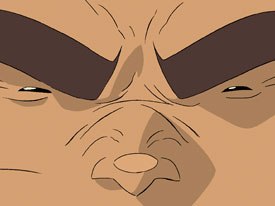
Two of Canemakers students have won the student Academy Award, including Alex Woo who received the honor last year for his film Rick Steele, Nazi Smasher (above). © Alexander Woo.
The Designer
JS: Your credits list you as the designer of your films. How do you see the role of design in your films and animation in general?
JC:
Its important to have settings and characters that work well together. I try to find ways to have that happen so theres a blend between the two. Ive experimented in my films with a lot of different techniques. Some of my films are very eclectic in terms of going from one thing to another. What it looks like determines how its going to move.
JS: Do you go into it with a design scheme in mind? You want to get a certain feeling, so this is the design approach you take, or does that come out of the work as it progresses?
JC: Its going to come out of the work and the subject matter. Ive done a number of sponsored films dealing with serious subjects that arent often done in animation, such as child abuse, cancer, teen suicide or the longings of a son for his father. It seems to be an overall theme in my career. How do you show those things in animation so that its proper for the medium, without resorting to live action?
JS: At one point in The Creative Spirit, a machine is squashing spontaneous random shapes into endless rows of identical squares: original thinking is literally being stamped out.
JC: I love doing stuff like that. Theres a scene Im very proud of in You Dont Have to Die about a kid with cancer, which won the documentary Academy Award for HBO. Its a childlike drawing of a kid getting chemotherapy, and the chemo appears as a green liquid in a bottle. A tube goes into his arm, and a childs voiceover says I didnt like it. It came down into my arm, and its as if he were an empty bottle being filled with the green liquid from his feet up. He says and my hair fell out and the liquid gets to the top of his head. Theres nowhere else for it to go, and the hair just pops out and floats down. Thats a way of using animation that you wouldnt do in live action.
JS: You did a piece about child abuse with a girl talking about her father coming into her bedroom, showing him as a big blue hand. The bedroom is done very schematically, almost like a floor plan.
JC: All of the films I do on those particular subjects involve a lot of research, both on the visuals and also with doctors and experts. That was based on a drawing by a child who was an abuse victim. They dont do perspective and I thought it was fascinating. I kind of adapted that.
JS: The large blue hand invading her life also reminded me of Jirí Trnkas film
JC: The Hand, yes. That mightve been somewhere in the back of my head because I love that film, I think its one of the great animated films of all time. The hand in my film was also based on research. Many pictures by the abused involve eyes or hands the invasion of your space, your privacy. When I did The World According to Garp I went to three different schools and asked kids to give me their ideas of what death might look like, or what a nurse might look like, or what they thought soldiers in a war might look like.
I tell my students youve got to have something to go from, youve got to have research, that how youre going to get inspiration. Youre kind of limited in your own imagination unless theres stimulus. Youve got to keep your imagination massaged, and the way to do it is to bring in imagery and words.
The World According to Garp
JS: You use a lot of kids drawings in your animation.
JC: That kind of began with Garp, because that was the idea: Garp as a child drawing his version of what his father might be like. There was also a book that he wrote about a whale. I completely illustrated it and they never really used it, they just showed a little teeny part of it. We did a pencil test of a sequence about how Garp was conceived that they didnt use; it was considered too funny.
JS: The theme of father/son relationships runs through your work, yet Garp was a project that came to you.

A demon looms up at an actresss audition in Confessions of a Stardreamer (1978). © John Canemaker. All rights reserved.
JC: George Roy Hill had seen Confessions of a Stardreamer and he liked it. He was an actors director so he liked that aspect of it as well.
He said, Heres a script, heres two paragraphs. Do you think you can do a storyboard on this? The script just said kids drawings; the father comes alive and they fly off and they fight Death together. I said, Yeah, sure. At any rate, I came back with, you know a thousand drawings, several versions, all these things mounted. They were sent out to California, they came back coffee stained, and I got the job. Those two sequences were worked up and thats it.
JS: So even though it came to you, it hit that note, it was material that you could respond to.
JC: Oh yeah, I responded immediately. I felt, what does the kid do? If he flies, does he become a bird? What kind of dangers could I get him into? There was a dragon at one point, a Nazi dragon, guns shoot the father down and he tries to rescue him. All this stuff came out.
JS: When he gave you those two paragraphs they werent that specific in terms of imagery?
JC: They were open-ended, which is great. The script said something like cut to the kid drawing his fathers pictures. They come to life. The kid flies off with his father. They have a battle It was a very general thing and I just started to put specifics into it: The kid trying to fly. He finally gets it and he takes off and then the dangers they reach, this big hand coming out that tries to grab them, the dragon at one point that swallows the father and got sick. All of these, just following the thought, just one impossible thing after another, I try to encourage my storyboarding kids to do that as well.
JS: They came to someone unknowingly, but someone who had a visceral response to the material.
JC: They didnt know what they were getting into.
I like the conceptual stage; if I were to work in a studio I think Id be good at concepts and storyboards. There are much better animators than I am. I admire great animators so much because they are so brilliant and they just make the line truly come to life. I think I have a head for conceiving how things could be done interestingly in animation.
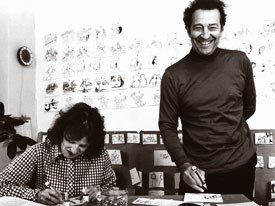
The Hubleys and the improvisational quality of their work with visuals and voices made an impression on Canemaker. © The Hubley Studio Inc.
Animating to the Voice
JS: In a lot of your films the animation is illustrating or reacting to a recorded monologue or conversation. Sometimes the film drops into lip sync of someone saying a sentence or a phrase and then leaves just as quickly.
JC: Im a big admirer of the Hubleys and the improvisational quality of their work not only the visuals but also the voices, the way they used their childrens voices or people like Dizzy Gillespie and Dudley Moore, in that thing about war The Hat. The visuals based on the voices were very attractive to me. I guess that perhaps inspired me to do it.
Disneys World
JS: Confessions of a Stand-Up illustrates the thoughts of a stand-up comic about his craft. At one point he says, Thats a damn good question John. Its the only time theres an acknowledgement that youre a participant in the film.
JC: It was a reflexive moment that I let stand. I was more interested in manipulating the image to give you an overall feeling. My stuff is not trying to be naturalistic; its more surreal, in a way. Its acknowledging that this is a drawn world. Its a world of graphics that are moving. Im trying to make you part of it and accept it on its own terms, even though Im not using Disney pull-the-wool-over your eyes techniques to convince you of its reality.

Hapless Bottom follows Titanias magical glow in Bottoms Dream (1983). © John Canemaker. All rights reserved.
Its a different kind of philosophy. Its more of a Tex Avery, Emile Cohl philosophy, whereas Winsor McCay, Walt Disney were trying to convince you of the true existence of their characters and their world. I think it happens with or without trompe loeil illusions I think it happens anyway.
JS: Its also that Felix the Cat influence. You use a lot of metamorphosis people turning into objects or cartoon animals for a few moments.
JC: I think its a unique art form that ought to be celebrated it for its uniqueness.
JS: Could you say that its an American invention, because of people like McCay and Walt Disney?
JC: Its an international art form. However, character or personality animation is an American innovation. It was created and developed here starting with Winsor McCay.
JS: Did you get away from filming to recorded conversation at some point?
JC: Bottoms Dream is basically music, so is Bridgehampton. Bottoms Dream has some lines of dialog, there is a little sync with Titania. I dont have any rhyme or reason.
JS: In Bottoms Dream [based on Shakespeares A Midsummer Nights Dream] youre acknowledging Disneys influence on your work I saw glimpses Night on Bald Mountain, Toccata and Fugue
JC: Fantasia is probably my favorite film. Its so interesting, its everything: its experimental, its mainstream, its exciting, its boring, its kitsch, its great art. Its just wonderful and its the most experimental mainstream animated feature done ever.
It doesnt always succeed. It infuriates you at some point. I think thats part of the whole engagement with the audience with that particular film. Of course I saw it when I was a kid. So those things, those primal sources when youre young stay with you, and they come out in my work obviously.

Bridgehampton (1998) shows autumn leaves scattered in eastern Long Island. © John Canemaker. All rights reserved.
JS: Which part of Fantasia is infuriating?
JC: The fact that they didnt go all the way to true abstraction in the Toccata and Fugue, that they didnt let Oskar Fischinger have his head. But even things that you would perhaps be infuriated with such as the Pastorale, the kitschy images, I have great affection for them. I also know now who did what in the film, I know what the original sketches were like; its too bad they couldnt have kept more to the idea of what those designs looked like.
But there are some things that are just perfection, like The Sorcerers Apprentice. I think Night on Bald Mountain is great and of course Dance of the Hours. Thats one of the pieces I think almost everyone agrees is great. Im sorry they didnt put the Nutcracker into Fantasia 2000 like they were contemplating its such an exquisite and beautiful piece sheer fantasy.
JS: [German illustrator] Heinrich Kleys animal drawings were the inspiration for Dance of the Hours, but they cleaned up his sketchy pen lines into very pure forms.
JC: But still the satire of it and the whole staging of it is just brilliant. T.S. Sullivant was a big influence on Dance of the Hours too. He was one of the early Life when it was a humor magazine illustrators.
JS: I once read that Frank Lloyd Wright visited the studio. When they showed him animation pencil tests he said, You should put these in your movie, put these onscreen. Walt was like, What, are you crazy?
JC: Wright said [profound voice], You too can be a prophet Walt Disney. The last thing Walt wanted to do was to have those [disparaging voice] lines all over the place that would say they were drawings. When xerography was introduced at Disney with 101 Dalmatians in 1961 or so, Disney liked it because it saved money, it got rid of the ink-and-paint department, but he hated the look of that film because you could see the animators rough lines; but to me that was just magical.

Although Fantasia is one of Canemakers favorite films, there are parts that infuriate him. © Disney Enterprises, Inc. All rights reserved.
JS: It almost sounds like you have a love/hate relationship with Disney when you talk about Fantasias inconsistencies or Walts distaste for lines.
JC: Its not exactly a hate, but it is a divergence of opinion. I was totally adoring of Disney when I was a kid, but now that I have experienced animation from all over the world, I have my own preferences for things. I can appreciate his philosophy and take on animation, which was to convince you of its reality. My take on it is that I prefer to see something that is really graphic, in terms of graphics and lines, something that is obviously a cartoon yet you still go with it, you still believe in the story and the characters.
I admire the Disney legacy and what they forged in the 1930s. As Chuck Jones said, All the tools we have came from that period. Winsor McCay started very early on without codifying it. The early animators at Disney really studied it, and said This is stretch and squash, this is anticipation, and this is how you can bring life to the work, and it doesnt have to be naturalistic, it can be abstraction as well. Tex Avery always used Disney principles in his animation.
JS: Disneys desire to make it as real as possible helped him to grow the medium.
JC:
Of course. To see those films today is to look at a genius at work. I totally admire them, but I have a difference of taste, or opinion. Some things work well in the same film, and some things dont. Fantasia is perhaps an extreme example of that. Its a sacred monster.

Chuck Jones remains one of Johns favorite directors. He admires the subtlety of Jones characterizations, his razor-sharp timing and pacing.
Looney Tunes and Merrie Melodies
JS: Weve talked about Disney and Fleischer, but not Warner Bros. Theyre also a touchstone of American animation; does their work not speak to you as much, or we just havent gotten around to it?
JC: I love the Warner Bros. stuff, particularly Chuck Jones work, and Chuck was a friend of mine for 30 years. The subtlety of his characterizations, his razor-sharp timing and pacing such incredible stuff. Were so lucky to have two books by Chuck that talk about his approach to directing. He was one of the greatest directors ever, I love his films. I love Bob Clampetts stuff too, just for the wild humor and exaggeration that he puts into it, the sheer manic energy. Tex Avery was the one who mentored both of those artists, and who went on to do incredible stuff at MGM. He really defined the Hollywood cartoon and the almost surreal abstraction that it became.
JS: What about Friz Freleng?
JC: I like Friz, he had a very good sense of timing. But in terms of admiring sheer directorial skills, I would say Chuck Jones is still my favorite.
When you think of Disney animation you dont really think of the directors, because Walt was considered the overall director; you think more of the animators, the early animators and then later on the Nine Old Men. But at Warner Bros. it was the directors and their different styles that spoke to people.

The Wizard shows his son a trick or two in The Wizards Son (1981), a homage to Sorcerers Apprentice. © John Canemaker. All rights reserved.
The Wizards Son
JS: Its interesting you mentioned The Sorcerers Apprentice as perfect storytelling, because your films by and large arent into linear narrative. But The Wizards Son, the film that introduced me to you is a story that has a beginning, middle and end. Was it a homage to Sorcerers Apprentice?
JC: Yes, it was. Interestingly enough, it seems Ive done three films on father/son relationships. Perhaps it was a precursor for The Moon and the Son, but even before that was The World According to Garp, which is a kid gaining a father, in that case one he hadnt known. The Wizards Son is about the relationship and the disagreements about potential, what one wants to be, the rebellion against the father figure and all of that, but told in a more cartoony, funny way. Whereas The Moon and the Son gets down to the truth.
JS: Is there sort of an element of wish fulfillment in The Wizards Son that at the end they have a mutual rapprochement?
JC: Its a wish [laughs]. Its a cartoon wish, and I think in terms of story The Moon and the Son probably has more of a traditional story structure than any of my other films. It goes through my fathers life and history, then comes to some kind of conclusion.
The Wizards Son was a learning film for me. Ive done non-narrative work like Confessions of a Star Dreamer and various commercials, but the more I was learning about the history of animation, the more I felt I really should know what these artists went through. I particularly admired Silly Symphonies, which, for the most part, told the story in pantomime.
So The Wizards Son was a way of my trying to do a traditional film. I didnt have a staff; I didnt have the knowledge, I was really learning as I did it. I was having trouble with the narrative, worked it out in the storyboards, and used it to learn something.
JS: There are a lot of very nice touches in the film: the housecats reactions to whats going on around him; the wizards hat has a personality of its own even Walt didnt think of doing that in The Sorcerers Apprentice; theres a wall of family portraits and one of them looks like Maleficent from Sleeping Beauty.
JC: The one with the horns? She was a distant cousin.
Check back next month for Part 3 of AWNs interview with John Canemaker in which he discusses his latest work The Moon and the Son and working with Yoko Ono.
Joe Strike is a NYC-based writer/producer with a background in TV promotion and a lifelong interest in animation. He is writing a childrens novel.

Joe Strike has written about animation for numerous publications. He is the author of Furry Nation: The True Story of America's Most Misunderstood Subculture.