
Alain Bielik unmasks the 3D tricks for blowing up London and other terrorist activity in the explosive political thriller, V For Vendetta.

When seminal London buildings are destroyed in the fascist England depicted in V for Vendetta, Cinesite produced the sequences. Above, Big Ben was created in a 30 miniature. All film images courtesy of Warner Bros.
Hollywood takes yet another stab at adapting an Alan Moore graphic novel, V For Vendetta (released by Warner Bros. on March 17 and playing simultaneously in IMAX), this time by producers Andy and Larry Wachowski, who actually wrote the first draft of the script before directing The Matrix trilogy. Not surprisingly, Moore has not only distanced himself from the project, but has also removed his name from the credits, while illustrator David Lloyd has endorsed the political thriller for its complex and cunningly topical depiction of terrorism.
The Wachowskis awarded the directorial duties to James McTeigue, their first assistant director on The Matrix movies, and selected Dan Glass, also a veteran of the Matrix adventure, as production visual effects supervisor. The filmmakers initially designed the film with remarkably few visual effects shots. We set out with a plan to tackle 120 shots, but ended up with just shy of 500, Glass recalls. Although a large increase, it was a naturally evolving process working with the director, and not a case of things spinning out of control. James was great to work with. At my first meeting with him, he produced a list of all the vfx moments he envisaged in the script, but, from there on, he left it all very much in my hands. The underlying stylistic approach was always to keep things very grounded in reality and to that end, achieve what we could in camera as a first resort.

The films production visual effects supervisor Dan Glass (left) worked with Cinesites vfx supervisor Matt Johnson (center) and CG supervisor Thrain Shadbolt on more than 150 shots involving 2D and 3D technology.
Four vendors, all based in London, were contracted to produce the visual effects: Cinesite (Europe) was the lead house with more than 150 shots involving 2D and 3D technology; Double Negative looked after the majority of the monitor/TV inserts; Framestore CFC assisted the digital intermediate with atmosphere addition and mask shadow work; and Baseblack executed miscellaneous but often tricky wire removal and fix-it shots. Technically, the challenges on V For Vendetta were mostly our timeframe and budget: we had nine months to complete the film from start to finish, and only seven weeks to complete the vfx once the edit was handed over, Glass notes. From an artistic point of view, our biggest challenge was the end explosion sequence, which needed to be [dramatic, convincing and leading to almost magical].
At Cinesite, part of visual effects supervisor Matt Johnsons assignment was to oversee the creation of a slightly retouched London. Even though the story is set in the near future, James didnt want a futuristic cityscape, Johnson comments. Instead, we moved buildings around, erased advertisements, removed any recognizable sign or corporate logo, and slightly altered the skyline. It was done within Photoshop on a shot-per-shot basis. The main addition to the skyline was a forest of antennas that was composited over the actual British Telecom Tower. Also, we added a major feature to Piccadilly Circus, a landmark location in London where some facades are covered with large billboards. We first removed these and replaced them with one giant screen on which we digitally projected images related to the story. The whole location was heavily retouched with numerous matte-painted elements projected onto cards and tracked into the plates to get the perspective right. The screen itself was modeled in Maya and tracked to the facade. In order to simulate the look of billboard images, we created a node within Shake our main compositing package with Inferno that took our images and generated a pixilated look. We also incorporated some broken pixels to make the image look more realistic, and added highlights to suggest the curvature of the screen. The goal was to create a view of Piccadilly Circus that only Londoners would be able to pick out as unreal. For any other viewer, the screen had to look like it was an authentic feature of the location, which required seamless compositing.

For a major vfx sequence in which thousands of V look-alikes confront the police force, Cinesite built the crowd in layers, taking shots from different plates and takes, rotoscoping them out and adding them in behind other crowds in other plates.
Blowing Up London
Cinesite also tackled an environmental effect challenge with the sequences in which the terrorist V destroys three seminal London buildings: the criminal court (nicknamed Old Bailey), the Houses of Parliament and Big Ben. Cinesite model effects director José Granell and his crew created the three buildings in miniature. Old Bailey was constructed at 1/7-scale and reached 20 feet (six meters) high, while the other two edifices were replicated at 1/10-scale, with Big Ben reaching 30 feet (nine meters) high. All were shot high speed in front of a greenscreen.
For the background plate, rather than shoot a film plate, we went up on a roof overlooking the real location and took a lot of high resolution digital stills of the cityscape, Johnson explains. The camera was mounted on a head that allowed us to nodally tile stills with each image overlapping the previous one. We used a variety of lenses and rigged the camera to do bracketed exposures, going three stops up and down. This allowed us to compile images that had a high dynamic range. Once the stills were tiled together, we modified the skyline according to James specifications and used the final matte painting as the background for the miniature explosions. Matte painting supervisor Dave Early oversaw this part of the project. Since we had photographs taken at various times of the day and under varying light conditions, we had a range of exposures to choose from in order to create the interaction of the light of the explosions with the environment. For a long shot on the House of Parliament, we composited the model directly into a live-action plate of the real location.
The explosions were heavily augmented by other pyrotechnic elements and water splashes that had been shot separately, either on black or on green black being preferred to extract smoke. The CG department also contributed to the shots by generating debris, sparks and splashes in Maya. As the building detonates in a series of powerful blasts, fireworks burst off in the air, forming the trademark V sign of the rebel leader. The majority of the fireworks were actual stock shots from the Warner Bros. library. Photographed on a black sky, they were keyed off the plates and then flopped, warped, rotated in any possible way to fit in the explosion shots. They were combined with CG fireworks generated in Mayas particle system.
A Crowd of Freedom Fighters
Apart from the bombing sequences, the other major vfx sequence of the movie is a scene in which thousands of V look-alikes confront the police force. We wanted to avoid using a CG crowd as much as possible, Johnson recounts. The sequence was shot on location in London over the course of three nights. We had about 400 extras costumed as V. The problem was that we were in the summer, and the nights were very short. As a result, we didnt have the time to move the extras around and shoot them in tiles. We just shot what we could and then worked very hard to make it work in 2D. We took crowds from different plates and different takes, rotoscoped them out and added them in behind other crowds in other plates. By cutting and pasting and massaging all these elements, we eventually managed to build the crowd, layer after layer. The compositors, led by Mark Bakowski, Campbell Rose and David Sewell, did a brilliant job of putting it all together seamlessly.
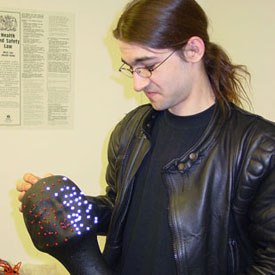
To create realistic walk, run and climb cycles for the freedom fighter crowds, Artem Digitals Sean Hince (above with a head model) used an 18-camera Vicon motion capture system and shot up to three performers at a time, each sporting 45 markers
For three aerial shots of the enormous crowd, traditional cut and paste techniques couldnt be employed. Cinesite opted to create the shots in 3D. The first step was to build a highly detailed model of V. We didnt know how close the characters would be seen on camera, recalls CG supervisor Thrain Shadbolt. Plus, early on, we were expecting to use this model as a digital stunt double, which turned out not to be necessary in the end. We built about 20 different models, male and female, with different heights and builds. Although they were seen only from a distance and all looked exactly the same, the variations in body, height and mass created an uneven mass of people, just like with a real crowd. The mask was a scan of the actual prop. For the close up on the bridge, we ran full cloth simulations for the entire crowd, using Syflex within Maya. For the distant shots, we still ran cloth simulation, but pre-animated these as a series of generic clips that were then randomly applied to different agents. Character animation was created with our in-house crowd simulation software called REACT. We had first developed it for King Arthur and then re-used again in Charlie and The Chocolate Factory. The animation was then rendered in RenderMan.
In order to create realistic walk, run and climb cycles, Cinesite contracted Artem Digital to set up a motion capture shoot. Team leader Sean Hince used an 18-camera Vicon motion capture system and shot up to three performers at a time, each sporting 45 markers. Once captured, the data was mapped to a Biovision Hierarchical skeleton for Cinesite to import into their pipeline. In the end, about half an hour of motion capture data was delivered, providing CG artists a large palette of animation to choose from to populate the scenes.
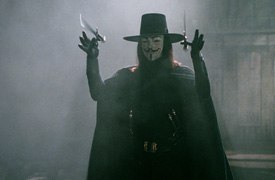
To create Vs uncanny ability to throw knives quickly, Cinesite built an exact 3D replica of the real knife and animated it to rotate elegantly through the air, leaving a translucent wispy trail behind. Photo credit: Juliana Malucelli.
When Reality Meets Art
Although the movies visual effects are firmly anchored in reality, one 3D effect necessitated a stylized approach. V has the uncanny ability to throw his knives faster than his opponents can unload their weapons on him. In order to suggest the high speed of the action, the knives slowly rotate through the air, leaving a translucent wispy trail behind them. James wanted a very surreal and abstract look, Shadbolt relates. We built an exact 3D replica of the real knife and animated it to rotate elegantly. We had about seven or eight different passes, mostly created by a custom script, to generate the trail. Production also provided us with separate footage of the environment, which allowed us to create and add refracted blade reflections to the knives during compositing.
For a crew fresh from the light-hearted effects of Charlie and The Chocolate Factory and The Hitchhikers Guide to the Galaxy, the dark imagery of V For Vendetta came as an abrupt departure. The movie definitely hit a special chord in all of us, Johnson concludes. Right when we were working on the bombing sequences, real terrorist attacks occurred in London it was kind of weird because what we were doing creatively in a film studio was happening in the real world around us. I think it focused everybodys mind on what we were doing. It also made the movie even more timely.
Alain Bielik is the founder and editor of renowned effects magazine S.F.X, published in France since 1991. He also contributes to various French publications and occasionally to Cinéfex. Last year, he organized a major special effects exhibition at the Musée International de la Miniature in Lyon, France.