
Joe Strike chronicles the long journey Over the Hedge took to make the leap from comicstrips to the big screen.

DreamWorks Over the Hedge, the latest star-powered CGI entry in 2006s animated feature sweepstakes, opens this Friday on the heels of Foxs Ice Age 2 and just ahead of Pixars Cars. Unlike the films bracketing it, Hedge is adapted from a pre-existing work an 11-year old daily comicstrip featuring a cast of funny-animal characters observing and interacting with suburban sprawl and American consumerist culture.
The film succeeds in a rare-for-Hollywood balancing act translating a property from another medium without destroying its spirit or alienating its creators perhaps because they were heavily involved from the films conception. And while the strips critters have made the leap from newsprint to pixels, Hedge the movie is a different animal from Hedge the strip a number of different animals, as a matter of fact.
Over the Hedge was born in 1995, the brainchild of writer/cartoonist Michael Fry and childrens book illustrator T Lewis. The pair had worked together on King Features Mickey Mouse comicstrip and tried to launch The Secret Life of Pigs, a strip of their own. We thought it was destined for cosmic greatness, Lewis recounts, two pigs on a farm secretly observing humanity. We were told its a great idea, but nobody likes pigs. Then Babe came out.
Fry and Lewis tried again. They replaced the pigs with a trio of suburban animals suave raccoon RJ, worrywart turtle Verne and manic squirrel Hammy. Instead of a barn, the critters lived on the outskirts of a suburban development rich in wasteful consumption and human absurdity. The retooled strip was snapped up by United Features Syndicate and today runs in some 250 newspapers, but back in 95 it caught the eye of animation producer/writer Jim Cox. Cox, whose credits go back to Oliver & Company and include story development on Beauty and the Beast (and now co-producer of the Over the Hedge movie) contacted the pair via the e-mail address wedged between the strips panels.
A partnership was quickly born. Cox, Fry and Lewis put a pitch together and made the studio rounds. According to Lewis, Fox, Henson and DreamWorks were the most interested. A bidding war actually broke out, we were really rooting for DreamWorks look at the personalities involved, c'mon. Fox ultimately won, the power of sheer money won. It was only a year or two after DreamWorks formed and they were not able to throw the money around that Fox was back then.
The project wound up on Foxs shelf and stayed there much to the frustration of Tim Johnson, its ultimate co-director. I was aware of it, I knew it was sitting there. It was making me crazy. Even eight years ago when I was making Antz, I knew Over the Hedge was there and just the seed of a fantastic film. I loved the characters and the opportunity to comment on suburban living. When Fox let the option expire in 2001 we grabbed it at DreamWorks and put it in development right away.
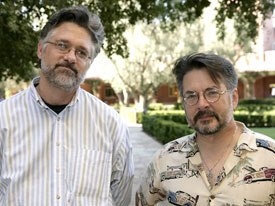
Rumor has it that when Fox optioned Hedge, DreamWorks Jeffrey Katzenberg predicted, those people will never make that movie, and when they dont, I will. Lewis attributes Foxs failure to make the film to the fact that Hollywood is wiggly everything is always changing. We had a champion who brought us into Fox, Jon Jashni [most recently exec producer of the Poseidon remake]. Then he got shuffled somewhere. In a big studio system like Fox, as opposed to a boutique operation like DreamWorks, when you lose your champion, you pretty much get lost.
We were at Fox when there was a lot of wringing of hands Whats going to happen to family films, whats going to happen to animation? They were trying to break in with Anastasia and we were sort of this odd little duck. It was actually pitched back then as a Babe-like thing, where we were going to have live-action and then the animals would be computer generated, kind of like Garfield. When we came on board at DreamWorks for a month or two we were thinking Hedge was going to be a 2D movie. At one point they were talking about claymation because they had this contract with Aardman. Ultimately those were just run it up the flagpole ideas.
The original Fox story pitch (which Lewis describes as a series of set pieces more or less strung together) was refined into a how it all began tale, recounting RJs first meeting with Verne and the blended family of animals he looks after the excitable Hammy, a porcupine couple and their kids, a father and daughter opossum pair and a lady skunk with serious self-image issues. Other than Hammy, its an extended family that doesnt exist in the comicstrip, whipped up for the purposes of the films feature-length narrative.
The new characters are fine with us, says Lewis. We totally understand this was a story beyond the comicstrip and you had to add stuff. When we pitched the script early on we had this clan of animals wasnt exactly as it is now, but we had come up with more animals too, realizing the story more or less dictated it.

Co-director Karey Kirkpatrick shares Johnsons enthusiasm and respect for the original comicstrip. Tim and I are both huge fans of the strip and what it has to say. Its point of view on society is what attracted DreamWorks to the project. We would constantly run stuff by [Fry and Lewis] to make sure we were in the right ballpark tonally and Hey, do you have any jokes were missing? For her part, production designer Kathy Altieri praises the comicstrip duo too, They were great, they worked with us a lot on potential ideas. They were really gracious about sharing our [version of Hedge] with theirs and finding the place in between where the match was perfect.
According to Fry, writer of the Hedge comic, the filmmakers mined the strip for individual gags, working them into the script at appropriate moments. They really got the sense of the characters and their spirit Im really pleased.
Verne however underwent a not insignificant accommodation to the demands of the films narrative, one that met with Fry and his partners full approval.
In the movie, its necessary for the characters to be rather innocent and naïve and for Verne to be their leader, Fry explains, whereas in the strip Verne is a leader, but more in his own mind. Theres a certain tension there between him and everyone else. Verne is the smartest turtle in the room and unfortunately no one appreciates that. They kind of, sort of ironed that out a little bit in the movie. Lewis is even more unsparing of Verne, Hes a lot more dysfunctional in the strip hes a mess. Hed love to be the leader of the group, he might think that he is from time to time and may for a moment be, but hes lot more a boiling kettle of disdain and despair.
Kirkpatrick credits Fry and Lewis for keeping on us to make sure [the movie version of] Verne was smart and funny. What tends to happen in development is the character carrying the movies emotional core can be a one-note whiner if youre not careful and all hes doing is saying lets not go over there. They were really great about pushing us to not fall into that.
Everyone involved with Over the Hedge credits the relationship between RJ and Verne as the heart of the film and the quality that set Hedge apart from any number of other talking animal strips on the comics page. Verne and RJ are best friends in the strip; theyre such a great odd couple, Johnson says. Someone whos always worried about tomorrow and someone whos always seize the day, the ultimate party animal. I loved that because all of us have that battle do we do the smart thing and think about the future, or do we sit around and play videogames and eat nachos all day? Kirkpatrick compares the pair to Felix and Oscar, Lucy and Ethel the man-child vs. the nudge the id vs. the superego.
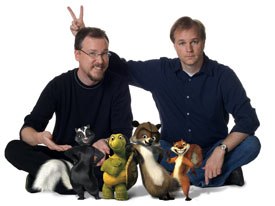
For Kirkpatrick (whose scripting credits include Chicken Run and Hitchhikers Guide to the Galaxy), the film was both a screenwriting job and his first directing assignment. DreamWorks had approached me to write Over the Hedge months before, but I was busy with other scripts. They came to me six months later: How about directing it? When I came on, two writers were already on board, Lorne Cameron and David Hoselton who were doing a fine job. I was actually a little tired of writing, my first thought was this will be great, theres no typing.
Len Blum was the first writer who tackled translating it from the comicstrip. Lorne and David came on and gave the film its current structure. When they were done with their contracted stuff they moved on. I was the typist, it was on my résumé so I assumed writing responsibilities.
Kirkpatrick recalls that it was Katzenberg himself who asked him to co-direct Hedge, a challenge he was eager to take on. After Chicken Run hes been trying to get me to direct, he had no doubts. I was at all the Chicken Run recording sessions; I worked closely with some of those actors through Nick [Park] and Pete [Lord]. It really wasnt that big a leap. Jeffrey saw me at meetings, working with storyboard artists. A lot of it is how good a collaborator are you, how good are you at communicating your thoughts, how strong is your vision?
Tim was already on the movie. We knew each other; wed been consulting on each others projects. Wed been circling and wanted to work together. This was great for me because Tim had already directed a couple of movies; any rookie mistakes that I might make, he was there to fill in that void.
In some directing teams you handle this and he handles that side of it, but for me and Tim it was a straight partnership/collaboration. We were both at 98% of the meetings. On occasion when you get into the heat of it youve got 350 people on crew and the day is broken into 15-minute increments. Sometimes you literally need to be two places at once and thats when two directors come in handy. In those cases if there was something that required more tech expertise than I have, and Tim comes from a computer animation background, Id say you should take that one.
Johnsons CGI background reaches back some 18 years into the dawn of the digital age when he joined the staff of Pacific Data Images, one of the very first computer animation shops and the company that would eventually become PDI/DreamWorks. (That PDI badge means something, at least in our world, so they kept that name, which is great.) While production of Hedge was based in DreamWorks Glendale studio, a satellite crew operating out of the original Silicon Valley PDI facility pitched in with additional animation, effects and lighting support. We share everything, its really amazing, Johnson enthuses. Weve all got the same software and the distance disappears once you get the video conferencing going. We had animation dailies and all the team would be sitting with us in a screening room and thered be bunch of people in northern California synched up on a huge screen at their facility so were all watching the same thing.
From Lewis perspective, the synergy between directing partners was to the films benefit. Tim has a good story sense, but Kerry has a great writing background. When he came on and partnered with Tim the picture really started taking off. They really had a good chemistry, never losing sight of that sense of fun you need to bring to a project like this.
After redesigning the strips 2D characters for CGI, Kathy Altieris next job was the films environment, recreating the world from the perspective of the films foot-high stars. We were trying to create a world that felt like it was in our backyard. Every one of us has gone out, gotten down on our belly and crawled around with a camera so we can feel what we felt in the movie. Meanwhile, Johnson and Kirkpatrick were wrestling with the films story and structure, and the evolution of RJs character from self-centered con artist to someone who cares about others. A turning point in the film comes when RJ is about to take off with a red wagon-load of goodies hes tricked Vernes family into helping him gather.

We always sort of likened to RJ to Harold Hill in The Music Man, that he was a bit of a traveling grifter, Kirkpatrick explains. We always thought thered be a scene called RJ Gets a Home, where the other animals would give him the thing hed never had, a place to come back to. What we liked about it structurally was when they tell him, RJ come here we want to show you something, had he said, You guys go on and hopped in the wagon and left, he would have been home free. The fact that he let his guard down and was emotionally hooked further complicated things.
What never worked about it, it used to be too maudlin until we twisted it. Just as its getting a little sappy, thats when we yanked the carpet out from his happiness. The carpet-yanking consists of a barrage of TV soundbites on the subject of betrayal that triggers RJs dormant conscience while the camera stays on the raccoons guilt-ridden face. We always knew conceptually we wanted something like that. I think it was David Soren, one of our storyboard artists who came up with TV idea, and I think I added the Dr. Phil punchline.
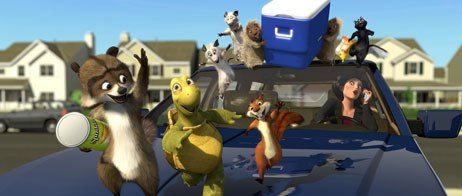
A trio of high-energy slapstick set pieces punctuate the film Vernes traumatic initial foray into the suburban development over the hedge, Verne and RJs encounter with a slobbering, extremely playful dog that ends in a kerosene-powered rocket flight and an apocalyptic battle aboard a runaway truck. While the first sequence was part of the film from its earliest days, the second originally featured a ferocious dog who swallowed Verne in one bite. Then it was up to RJ to perform a canine Heimlich, recalls Johnson. That scene was in the film for a surprisingly long time, before we conceived a friendlier dog and funnier chase about 20 months ago. The truck battle entered the picture after several third act experiments; we only settled on that scene a year ago. The script was not written around any of them they were all created to serve the overall story.
Like all contemporary animated features, Over the Hedge s voice cast is a mixture of high-profile stars and accomplished character actors, led by Bruce Willis as RJ. Johnson says having Bruce voice the character meant you could have a con man, but theres something he brings to it that keeps RJ sympathetic and lets you go on the ride with him. RJ was based on the character in the comicstrip, but when we approached Bruce we said we missed David Addison from Moonlighting. He said, I kind of miss him too, Ive been busy saving the world for the last 12 pictures.

While acknowledging that name-brand actors are crucial in giving an animated feature visibility among higher profile event movies, Kirkpatrick admits that he keeps certain performers in mind from the get-go. Who am I thinking of when I write this character? Coming up with an opossum who dies big Shatner! Or you think Albert Finney thats what I want, Shakespearean. You kind of think of that voice while youre writing it, and you wonder if hell do it. Then you call Shatner and he says yes!
We have a powerful head of the studio in Jeffrey who can get anybody on the phone and get them to agree to be in one of his movies but he wont do it unless the voice is interesting separate from the face. There are some stars out there that weve listened to that just arent good voices. When youre not seeing their face and just picturing the character, sometimes that voice just doesnt work.
We never do star for stars sake. For instance, there was early inclination with the Verminator (the orange-suited exterminator pictured prominently in the films advertising) to do some stunt casting with a really big name. But I was working with Thomas Haden Church on Charlottes Web. Hes a big name to me, he was Oscar-nominated but hes not on the Tom Cruise level. But when I heard his voice I said, you guys have to hear this. Hes great, hes perfect and he made that character. Or you take someone like Garry Shandling. No ones used him, but he has a strong, distinctive voice and a phenomenal sense of humor. If we can tap into that weve got something really special.
For his part, Fry offers special praise for Steve Carells voicing of the high-strung squirrel Hammy. Steve is really incredible, he gave a great voice performance. The most impressive acting from him is the moment he says, Im not stupid. He says it once as Hammy and it just pulls your heart. Then he walks away and says it in his own voice. In that moment it gives you a little bit of the depth of the character somewhere inside theres this Steve Carell lurking about whos really wounded.

Johnson denies that any of the characters in the film were deliberately drawn to resemble their voice actors, but suggests the impression may result from the way we recognize motion in people. We videotape the actors recording their lines and some of the animators like to look at the tapes for how theyre going to do their motion. I think its amazing and a tribute to the animators art that even though none of the characters were designed to look like the actors, in a way they all do a little bit. I think Eugene Levy was captured very well by the animators and ended up looking just like him, although if you looked at the freeze frames [of his character Lou the porcupine] I dont think Eugene would be very flattered.
Johnson looks at his voice actors as collaborators. Theyre not just reading lines. Theyre actually helping us design and discover the character. We mold and change and adapt the story, rework scenes around what we discover. Its so important to match the performance to what the actors bring its really like workshopping a play or a Broadway show, but in slow motion.
That slow motion sped up near the end of the production cycle, with new dialog added as recently as the end of March. We made a ton of changes, Johnson recounts. Its amazing how you can fly in new lines of dialog. Garry saw the picture and wrote something like 12 new lines, things like, Id thought wed be dead by step two, so this is going great! You cant show him the whole film because you dont have it, and when you finally have it its almost too late so you scramble to get these great ideas in.
One of the most interesting things about Over the Hedge though, is whats missing. In a film swimming with fast food and merchandise, there isnt a single instance of product placement, and hardly any self-conscious pop-culture references. Johnson admits that the film is making comment, not always flattering, about the world of consumer products. I dont know if any company wouldve wanted to get involved with us. The other thing we realized the parody was part of the fun.

One of the first scenes to really come together was that Trail Guide Girl cookie heist. We had a little competition among the staff of who could come up with the funniest name for cookies. We ended up with Love Handles, Smackeroons, Neener-Neeners, great names. Kerry and I got really excited and remembered those old Wacky Packages stickers. We thought thats where were going to go with this thing, we dont want real products. The way to make a comment and hold up a funhouse mirror to this consumer culture is to make up all the names we want. It goes by so quick too. One of the things I want to put on the DVD is all the work that Kathy [Altieri]s department put into the product design.
The only product thats in the movie? The THX logo [seen briefly on a TV set]. Do you know we had to pay for it? We had the joke and we asked Lucasfilm if we could use it. They said yes, but and we said, wow. It didnt cost that much, though.
Like the best of Pixars films, Over the Hedge has the feel of a classic animated feature, one where we eavesdrop on the animal world to see our own through different eyes. Unlike Disneys overly literal The Wild, Hedge is replete with cartoon exaggeration characters squash, stretch and speed so fast they distort time and space; they survive the worst sort of physical misadventures with only their dignity injured; and one classic cartoon image that hasnt been seen a while, a turtle who wears his shell like a removable suit of clothes.
Johnson and Kirkpatrick look at Over the Hedge and other animated features as continuing a tradition thats lost ground in Hollywood in recent years. As Johnson puts it, Hopefully were taking animation to where I think live-action films used to be whole family entertainment. Live-action films get so stratified teen-slasher, superhero movie, big-budget special effects films I feel animated films are now the general entertainment films you dont see in live-action. For his part, Kirkpatrick finds himself upset a little bit when somebody says I wouldnt go see this, animation isnt really my thing and it gets relegated to something just for kids. Some of the smartest, best archetypal storytelling out there in the movies is being done in animation, movies like The Incredibles and Toy Story and Shrek, theyre as good as any movie that comes out all year long.
Regardless of what happens to Over the Hedge s critter cast when they enter the multiplexes of the human world, their comicstrip counterparts will continue to go their own way. We talked with DreamWorks about folding some of the movie characters into the strip, Lewis admits. We both very independently, very stridently thought no. The movie and the strip ought to be two parallel distinct things. The power the strip brings to this is that it has its own integrity; its its own separate thing. You start merging the two, itll look like the strips just shilling for the movie.
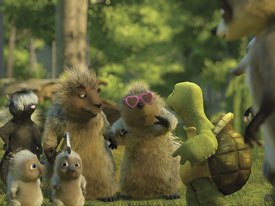
Lewis art for the strip has evolved since its 1995 debut, due both to his desire to keep the strips look fresh, and the addition of computer toning to his arsenal of tools. When asked, he admits the characters big screen redesign has also influenced their look on the printed page. Around 2000 when I started working on the movie a little bit [contributing concept art for new characters] the strips animals became more naturalistic. (One character Lewis particularly regrets not making it to the big screen is an owl that would have been voiced by Gene Wilder.) When I started doing those characters for them it jostled the illustrator in me because I come from that background. Ernest Shepherd, Winnie the Pooh s illustrator, hes like my hero, Tenniel, that late 19th, early 20th century is my style.
That change was inspired by my work with the folks at the studio. Theres such high quality of work youre surrounded with there. When you know your stuff is being looked at by these guys and a lot of them would get our strips e-mailed to them every day by the syndicate Id say to myself Ive really got to be on my game here.
If Over the Hedge the movie achieves the success its creators are hoping for, will there be a sequel in the works? Its a question one hardly needs to ask of DreamWorks, considering Shrek 3 is due out next May and a fourth Shrek is already in the works. However the studio may have already tipped its hand early on in the movie when RJ shows Verne and company a map of the suburban development thats sprung up around them, an arrow reading FUTURE DEVELOPMENT is pointing to their small, unspoiled patch of green. Stay tuned for future developments
Joe Strike lives in New York City and writes for and about animation. He has recently completed a childrens novel.

Joe Strike has written about animation for numerous publications. He is the author of Furry Nation: The True Story of America's Most Misunderstood Subculture.