
Flinch Studio is turning heads with such beloved hits as Stainboy. Gregory Singer takes a closer look at this intensely Flash-loving group that walks the careful line between business and art.

Chances are you've already been entertained by the hard work and creative excellence of Flinch Studio. But maybe you haven't met properly. So consider this your polite and privileged introduction to an animation house which is not only surviving the hesitations and half-starts of the new media revolution -- but is, in fact, helping to pioneer it.
It's a common, and fair, assumption that San Francisco and New York City are the two hubs of the Internet hubbub. But with clients like Warner Bros., Jim Henson Productions, 20th Century Fox, Disney Online, Adam Sandler and Tim Burton carved into their bedpost, it doesn't require a huge leap of faith or imagination to know that Flinch Studio is doing something right. Founded and functioning by the "sweat-equity" of traditional animation artists, the Santa Monica-based studio is a new media entertainment company located in the backyard of Hollywood.

In the Beginning...
The Flinch story may have its beginnings as far back as the ancient, Atari-waning years of 1985. A young up-start kid, Chris Takami, had just gotten a job in the mailroom of DIC. But by 1990, Takami was already producing his own shows, and running his own boutique animation studio, Lil' Gangster Entertainment. Soon after merging with a programming group called Strategic Vision, the two companies became Vortex Media Arts -- which was the original fire out of which Flinch's future founders would be forged. Vortex was unique among the companies of its time for creating animation-based and graphically-driven CD-ROM games, churning out such titles as the million-unit seller Tonka Construction for Hasbro, Madeleine's European Adventures for Electronic Arts and Virtual Springfield for Fox's The Simpsons. In 1996, Vortex was tapped by Disney Online to create a Winnie-the-Pooh book for the fledgling World Wide Web, and Tony Grillo, an Atlanta-bred animator working on the project, was using FutureSplash to build it. At the time, even in its infancy, Grillo realized the latent promise and potential of the software. In four or five years, he insisted, "This program is going to be huge," and he thought it would behoove him to learn it.
Interestingly, during their work for Disney, the artists and programmers of Vortex consulted directly with the people of FutureWave, providing technical and artistic feedback. Future Splash, of course, was soon to be bought out by a company called Macromedia, and retooled into the Flash program that we all know and love today. During the last few years of the 1990s, with the market for CD-Rom games slowly saturating, Vortex Media Arts closed up shop, and its principal members went on to explore other directions. Grillo, unsurprisingly, continued to delve into the Flash software, learning how to 'reverse engineer' the traditional animation for which he was trained. Grillo became an expert with the program to the point he was teaching it at the university level, at Santa Monica College's Academy of Entertainment and Technology.

Will Amato, the art director on Tim Burton's Stainboy, recalls: "I went to the Academy to scrape the rust off my drawing skills, and to become a traditional paper animator. Tony was such a free-roaming personality. He was making this stuff come alive as he was demonstrating it, and you could see his delight in it. It was happening in real-time; he was actually making these things come to life before my eyes."
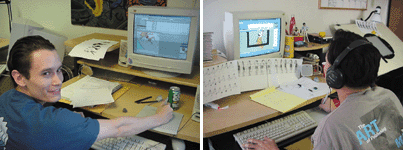
About a year-and-a-half ago, during the spring of 1999, as the rest of the world was steeling itself for the millennial meltdown, Grillo decided "to get the band back together." The principals from Vortex Media Arts, Chris Takami, Mike Viner and himself decided to translate their vision of blending technology with animation to the burgeoning Web. The three partners started the company with artists gathered from the Vortex days, a few of Grillo's "stars" from Santa Monica College and others from a range of diverse backgrounds. Grillo wanted to create an environment where artists would have more control over the content they were breaking their backs on. This was the birth of Flinch Studio with Grillo as CEO and creative director, Takami as president and Viner as the hands on senior producer. There were more than a few people happy and willing to leave the factory-style production of TV and feature animation.
Flinch Studio began its work doing small, freelance projects: the Website and online gaming, for example, of Doug's First Movie; and other short animations for Kellogg's, the Muppets and Warner Bros. Each project helped to hone the skills and sensibilities of the studio's artists and programmers. When an assignment came, it was an opportunity for everyone to push the boundaries and explore the possibilities of the medium. In fact, part of Flinch's success is that they have refused to settle into becoming a one-trick animation house. From complex Web design, to creating challenging interactive projects (e.g., mixing music tracks live in real-time, with interwoven character animation), it became apparent that "the Internet is only limited by how we can deliver the information to you," explains Grillo.
Building A Rep
By this time, Warner Bros. was beginning to establish its own online presence, Entertaindom.com. Previous work with Bugs Bunny had demonstrated to Warner Bros. that Flinch could competently and faithfully care for its properties. As Amato says, "They jealously guard their material. We had handled them well, so they had a good feeling about us." When Adam Sandler wanted to create a stand-alone animated segment (The Peeper) for his then upcoming album, he chose Tom Winkler, from Doodie.com, to be the Webtoon's director. Tom needed a full-fledged studio to handle the six-minute production and out of their earlier association, Warner Bros. unhesitatingly pointed to Flinch Studio. Tom provided Flinch with the characters and storyboards, and Flinch did the rest. Eighteen million downloads later (the most for any Internet show to date), The Peeper created a huge growth curve for the studio artistically and commercially.
Following projects with Z.com and others, Flinch again found itself in cahoots with Warner's, but this go-around on a project that won't officially premiere until February 2001. Animated by Film Roman, The Oblongs is a television series that no one has really seen yet, not even Flinch, and yet there are over thirty sequences on the Internet which Flinch has created "based on model packs, audio recordings and whatever feedback we could get from the show's creators," explains Flinch senior producer Viner.
This kind of collaborative freedom and creative latitude comes from Flinch's growing reputation as an adventurous, high-quality studio, where they are not just given a project to execute, but they are often co-creators in it. Nothing could be more emblematic of this collaborative success than Flinch's realization of Tim Burton's Stainboy for shockwave.com.

When Tim Burton wanted to animate for the Web some of the characters from his book, The Melancholy Death of Oyster Boy & Other Stories, the William Morris Agency introduced him to Flinch Studio. Apparently, it was a natural fit. Burton came to the studio with watercolor designs of his characters, and Amato remembers: "He was really concerned with it not looking like your standard Web cartoon. He emphatically did not want that. He really liked the idea of it being, as Tim put it, 'No big deal.' Meaning a few artists could do it, on a few computers; he could work with us very directly, in a very informal way; there would be no budgetary committees, no big overhead producer. It would be almost like we were staying up all night making a funny comic book together. He liked that do-it-yourself scale."

When Amato did some Flash-based watercolor versions of Burton's work, Burton then realized he was in good hands. Amato continues, "He felt he could relax a bit. I think he felt that Flinch was concentrating and noticing things that he had put a great deal of care into: like texture and line. We were putting other things that a lot of studios might have considered important -- like wacky character movements and bouncy motions on the back burner. If they were ever going to be used, they were going to be used sparingly."
While Burton is certainly the catalyst for the show, it has been a very open and evolving process in terms of looks, techniques and storylines. Burton has been very supportive and encouraging of Flinch to be adventurous with the narrative style of the show, and the production has moved forward, episode to episode, in a very challenging and organic way. (Flinch has completed 6 of the 13 scheduled episodes of Stainboy, and will resume production once Burton has concluded location filming for his upcoming live-action adaptation of Planet of the Apes.)
In commenting on Flinch's success in maintaining the integrity and charm of Burton's vision, senior producer Viner describes the initial collaboration as a "moment of osmosis." Yet this is, despite its being a lean operation of about 20 people, the secret strength of Flinch Studio its emphasis on artistic sensibility.
Where There is a Will, There is a Way
So far Grillo's plan of putting the power back in the artists' hands is working and Flash appears to be a major part of this coup. Amato elaborates on the parallels of innovation and revolution in this new digital media: "I think Flash is kind of epochal. A guy like me can create a whole show, conceivably, given enough time, with a program that costs about 250 bucks. And that, to me, is a radical, radical thing."
Brian Chin, background and layout artist for Flinch, concurs: "If you can write, draw the pictures, do the sound and put it together yourself, you could do it. That's not to say anybody's going to pay you for it, but at least you can get that far, which is light-years beyond what any of us would have been able to do a mere five or ten years ago."
Brian comes from an almost two-decade history in television animation, most recently at Warner's. The freedom and independence of working in a Flash-based studio is a welcome change as Brian comments: "You can create your own film, right here, you don't need to have a staff overseas." Brian's first animation job was working on Filmation's He-Man: Masters of the Universe. He remarks on the irony of coming full circle in his career: "The funny thing is that we used to say how bad it was -- the stock system. It was the cheapest, and it's very similar with what we try to do with Flash now." But Brian notes that working on low-budget projects has helped him to economize his work, and achieve things in a more efficient manner. "We try to get the most mileage out of something that could be very minimal."

Amato echoes this sentiment: "It's a case where sometimes the limitations are hidden strengths. A lot of times you put a so-calledlimit on a creative person, and it fosters the most inventive solutions."
With respect to using Flash, Amato remarks, "There's a standard Flash look, which is flat colors placed into single-width lines. Butthere's this plastic aspect of it, there's the beauty of abstract shapes, of 2D shapes that can be pushed and pulled sculpturally. Flash is this reservoir of effects that has not been challenged much." Amato is quick to point out that the artists at Flinch are doing somejaw-dropping stuff -- even people without a deep background in fine arts, "whose talents have just blossomed because of this onetool called Flash."
For instance, Brian didn't have much experience with Flash, when he first came to Flinch. He practiced intensively for a month, before he officially came on board. "Of course what they do here is not really the type of thing that you would ever find by going through a book," he says.
Lead animator Rob Lilly, who hails from Michigan and studied at the Union's Local 839 American Animation Institute, freely admits to the merits of Flash -- how, for example, it speeds up the process of production. But when he was first introduced to the technology, he thought, "No way, I'm not going to touch a computer. I want to stick with traditional animation, the old-fashioned way, pencil and paper." After a time, he relented: "Alright, let's look at this damn thing and see what it can do." Rob still begins most of his work on paper, for inspiration, but about 80% of Flinch's work is drawn directly in the computer. Lilly explains: "Flash is just a new tool for animation, that's all it is. You're going to see more and more traditional animators come to this artform, because there are not that many jobs out there in traditional." Having come from Sony himself, Robenjoys working at Flinch because it is always pushing him, creatively. He agrees that one of the attractions of working at a smaller production house is that he gets to have his hands in a little bit of everything: character designs, storyboarding, keyframing.

Setting Up for the Long Run
Flinch Studio is not only artist-driven, but, in a nutshell, eclectic Grillo explains: "The principals of Flinch have the widest variety of backgrounds I've seen in an entertainment studio. There are roots in prime-time animation, Saturday morning cartoons, commercials, edu-tainment, broadcast design, underground comics, electronic gaming, independent film, studio feature film, alternative journalism, advertising and industrial video. The combination of knowledge and influences that these past careers bring to Flinch has allowed us to quickly adapt to a decidedly multi-directional industry." Mary Jane Amato for example, who alternately (and with equal grace) wears the hats of chief financial officer, secretary and production coordinator at Flinch (and is Will Amato's sister), comes from a history of ten years in theater, and, most recently, six years at the Museum of ContemporaryArt.
If Grillo is, as Lilly describes him, "energetic, happy andslappy," then Takami is, in a word, passionate. He sees, with the clearest vision and imagination, the future of Flinch and for him it's just a matter of stepwise and patiently translating that vision to the television or computer screen.
What distinguishes Flinch among online animation studios, and what has helped it to survive the recent Internet shake-out, is that, as Takami explains, "Flinch is not a portal. We didn't create our studio as a portal." Flinch does not focus its energy and resources in creating an exclusive channel for people to find and go to. Rather, Flinch provides its services directly to entertainment, Fortune 1000, and educational content companies. Flinch's goal is to make the Web a more entertaining, engaging and unique place to be. "Websites are generally used to house or to exhibit entertaining content, whereas our belief is that the Websites themselves are part of the content."

Using its work-for-hire model to evolve with the industry, Takami summarizes Flinch's vision: "We believe that the future of online entertainment lies somewhere between the games that we play and the television that we watch." Flinch draws on its strong background in interactive media to produce character-driven, immersive environments, to pull viewers into the world that it creates. The current wisdom is that content online will ultimately be an integration of the old and new paradigms of entertainment, a hybrid of the two styles of media. Content will be interactive when and if you want it to be, without encroaching on your freedom to navigate through an environment as you choose. When Takami demonstrates prototypes of Flinch's Websites to different groups of people, children oftentimes want to play with and to interact with the characters, again and again; whereas sometimes adults don't have the time or patience to deal with them. With a click of the mouse, the characters are gone, and Takami acknowledges it's a balance. Who is the target audience, and what is the experience you're trying to create for them? The application varies for each client.
Flinch continues to push its research and development in pursuing novel ways to use the Flash software. Moving more toward intensive database-driven strategies of design, coupled with AI (artificial intelligence) programming, Emil Petrinic, Flinch's inhouse programming and technical genius, explains, "We have basically invented a lot of ways of using the technology and tools: new ways of Flash interacting with a database, different ways of conceptualizing how to interact with the next generation of Websites." He adds, "I know that others are going in that direction, as well, but we're putting it together as a whole, instead of little bits here and there."

Flinch Studio is also positioned to introduce Flash technology to the traditional animation houses as a viable option for them to produce their shows at a lower cost. Not all cartoons, of course, are suited for Flash, but certainly a lot of them could be achieved therein: Johnny Bravo, King of the Hill and South Park are a few that come immediately to mind.
With projects in the works for J. Walter Thompson, an advertising firm, and 20th Century Fox's forthcoming stop-motion animated feature Monkeybone (bitemymonkey.com), Flinch Studio takes its work very seriously, in helping to define the model for new media entertainment. Viner expresses his appreciation that companies are taking the risk to explore this new medium, and that they are trusting Flinch with their creative goals: "It's always good to see people be brave enough to say, 'Hey, nobody's done this before, but I think it's a good idea. Let's put some money behind it.'"

Regardless of the industry's present vacillations and hiccups, there will always be a market for animation online. Viner comments, "I don't think in 2 years, 5 years or 10 years from now, people will look back and say, 'I remember that year when there was entertainment on the Web.' It's simply not going to happen. People may look back and remember before broadband was popular, when animation was only three minutes on the Web."
Inspired by a lot of the undersung, underground work being done, Amato remarks, "There are a few Flash artists fighting to get interesting work out there before the corporate gates close on the individual spirit." He adds, "Flinch tries to successfully bridge the two an independent, creative spirit matched with the needs of a client, which often exists in a corporate milieu."
Grillo agrees: "Flinch has been able to maintain a healthy balance of creative and corporate clientele, and that's not an accident. After all," he concludes, with his characteristically buoyant humor, "if it stops being fun, I'm the first one to bail."
Gregory Singer is an independent animation producer living in a small hut on the edge of the known visible universe. No animals were harmed or consumed in the writing of this article.