Terrence Masson discusses how he's a vfx supervisor in reverse on UFO Hunters.

Now in its third season, History Channel's UFO Hunters (Wednesdays 10:00 pm/9:00 C) continues its emphasis on hard science, which began last season with animation/vfx vet Terrence Masson coming aboard as image analysis consultant. Masson, who's "directed award winning short animated films, was the sole developer of the original South Park CG animation technique, built a previs department for Douglas Trumbull, fed Boba Fett to the Sarlac and flew the Millennium Falcon for George Lucas," is also director of game design at Northeastern University and is Conference Chair of SIGGRAPH 2010 (to be held in L.A.). He recently spoke with VFXWorld about his role on UFO Hunters.
Bill Desowitz: Tell us about the show and what you do.
Terrence Masson: It's pretty hard science. They investigate a lot of cases sent in from the public -- either still frames or video -- and they also look at historical cases as well. For me, it was interesting because it's the same as being a visual effects supervisor only in reverse, because what I spent 20 years doing was photorealistic stuff: how to integrate CG fake stuff into live action footage and basically fool people. I'm looking at the finished product and saying, "Yeah, this is fake." Or, "OK, that's real and here's why." And it's important to say on camera while running image processing algorithms and image stabilization, motion schemes, spatial analysis doing matchmoving.
BD: How does the image analysis work?
TM: If you isolate what somebody's been shooting in the sky, you can pretty accurately determine its relative speed, the distance, if it's making any turns or hovering like a helicopter or moving in a straight line… I always try to find out what the local airport traffic is like because people are often oblivious to that. They don't know that they're standing just a quarter of a mile away from a military base or a commercial airline.

BD: What tools do you use?
TM: I use Maya for 3D scene reconstruction, SynthEyes for image stabilization and tracking, MATLAB for image processing and a whole lot of Google maps to place airports and sight lines of the locations.
BD: How much of what you analyze is a hoax?
TM: Very little is fraudulent. The stuff that I get is pretty much 100% "real" in terms of it being a real photo [or video] of something that was actually there. That's not to say that everything is explainable, known objects. Maybe that's a little more than 50/50 and it's almost always aircraft because part of the analysis that I do is basically performance envelope, meaning flight dynamics and capability. I've always been pretty much of a flight nut anyway: I'm pretty familiar with aircrafts, statistics and performance. To take the simplest case, if you get somebody shooting video of something on a clear sky or at night, you can always get the camera stats. It's like doing camera surveying for visual effects on a live-action set. So you have an exact … field of view, depth of field, all that.
BD: What have you been working on recently?
TM: There was one episode off the coast of Connecticut that had some really wild stuff. It was very faint and he had to use high gain settings to make them visible. I triangulated all of his locations very accurately on how he was beaming and shooting his footage based on his verbal description of where he was standing and the actual visual things in the frame he was shooting, matched up with visual landmarks and I took about seven or eight of these vectors and [they] absolutely bulls eyed one of the three major airports that was down there. And so knowing that, having the camera data, I realized that the lights are actually 30 miles away and not five miles away, and that's why they looked like they're moving a lot slower but behaving differently. Then it became apparent that this is actually a number of planes all on approach in landing patterns.

BD: What are some of your favorite episodes?
TM: Probably one of the most dramatic episodes is called "Tinley Park." It was an Ozzy Osbourne concert that had just gotten out and there were thousands of people driving home witnessing this stuff. We were able to triangulate the three video sources and estimate the overall size of these three lights pretty accurately, again using image stabilization techniques. And the fundamental question that we have to ask of these many, many sightings is: "Are these flying triangles really part of a single craft or are they three different aircraft flying in formation?" And this was a perfect example of a really popular sighting by hundreds of people. There was no doubt that it was something up there simultaneously videotaped by several people. And it was a combination of pure trigonometry with triangulation and image processing and we were definitively able to call it a UFO. What I do is lock to one of two points and the key is to leave the rotational channels free. What that does is, with one of the two points perfectly locked, any kind of rotational movement happening in the other two points, you'll see instantly if it’s a single craft (if rock solid) or three different kinds of craft (if there's the slightest bit of deviation).
And on camera they pressed me, but I wasn't going to admit that it was an alien spacecraft. I would never go that far.
BD: What about a more historical episode?
TM: The "Heflin" photos are some of the most famous stills in all of UFOdom. They are a series of Polaroid shots that basically look like somebody threw a hubcap into the sky and photographed it. And these have been analyzed to death since the '60s. And they asked me to re-analyze them using the original Polaroids from the photographer's family, which no one ever had access to before. And they were scanned in high-res with a level of detail never attained before.
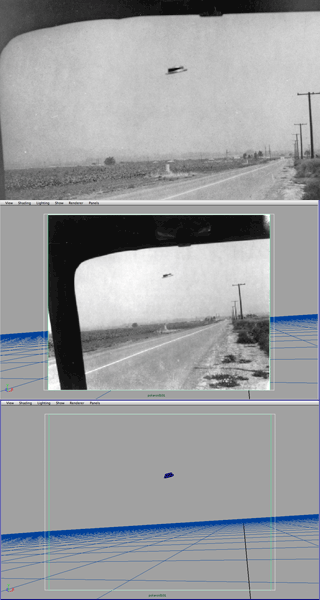
But I was still skeptical about shedding any new light on this after all the analysis done by the Air Force and scientists. So what I did was the matchmoving set up in Maya: I did a very simple layout of a ground plane and a road and telephone poles and horizon line and put in the lens and some back characteristics of a Polaroid Land Camera: it had a fixed lens, fixed aperture and F-stop , all that. I locked down all of the matchmoving environment precisely and the additional amount of info was the estimates the photographer provided about the craft when he shot it. This was the basis of my analysis: If you were trying to fake this, you just can't estimate the perfect diameter and distance to an object on an image plane and nail it. What I did was make an object similar to the one in the picture and scaled it to 70 real world feet, which was the exact size that this guy said it was, and then, in realtime, while the cameras were rolling, I slid it along a vector away from the camera. It either was going to resolve itself on the image plane, exactly to the right size of the image in the picture, or not. But what was a big jaw dropper was it lined up to the pixel, which proves mathematically that there was something in this picture that he snapped.
If that wasn't definitive enough, what was even more dramatic was that the Air Force technical team had analyzed this optically back in the '70s as part of "Project Blue Book" and called it a [photographic] hoax. So the host asked me to explain it away. Lo and behold, I put in the exact size object that the Air Force claimed this really was at the exact distance that they claimed it was and it matched up perfectly along that vector. So what that means is the math was perfect. What it proved mathematically without a doubt is that the Air Force was right in estimating that if it could've been something that was 2 feet wide and 20 feet away, but with an absolute equal likelihood mathematically that it was the exact size and distance from camera that the photographer said it was.
BD: So you proved this wasn't a hubcap?
TM: Yes, my point is that there was no way that anybody could've guessed or pre-calculated that. That was a big aha moment. And I never expected this kind of outcome from analyzing these very famous photographs.
Bill Desowitz is senior editor of AWN & VFXWorld.

Bill Desowitz, former editor of VFXWorld, is currently the Crafts Editor of IndieWire.