
Renee Dunlop describes the vfx tale that brought Garfield back to the big screen in Garfield: A Tail of Two Kitties.

Two cats are better than one. All images TM & © 2006 Twentieth Century Fox. All rights reserved. "GARFIELD" and GARFIELD Characters: TM & © Paws. All rights reserved. Not for sale or duplication. Courtesy of Rhthym & Hues.
The days of 150-shot vfx shows are long gone. Now its more like 1,000, and studios usually need to share the load.
Two women from two production companies in two countries oversaw a feature about two identical cats that couldnt be more different. Betsy Paterson of Rhythm & Hues in Los Angeles and Charlene Eberle of Rainmaker in Vancouver took on the task of bringing a variety of talking animals to life. Together with animation supervisor/associate producer Chris Bailey, they created the four-footed cast for Garfield: A Tail of Two Kitties (opening today, June 16, 2006).
Paterson, an industry vet, has been at Rhythm & Hues for more than 10 years. Her tasks as vfx supervisor on the Garfield/Prince characters ran from bidding to deciding how to shoot the effects and working out details with the director and dp, tracking the animation, lighting and compositing, and checking the film dailies. Its very busy during post. Production is actually relaxing; long hours, but the prep for the film is where the action is.
There was definitely action. Rhythm & Hues' scope of work consisted of 390 finalized shots featuring the 3D-animated Garfield and/or his alter ego, Prince, accomplished with a crew of approximately 280 people in the U.S. and India. Pre-production began in July 05 and ran through early November, and principal photography started in late August and wrapped in early November 05 as well. Post ran from early November till May, a very short turn around. There were four sequence supervisors in animation and four in lighting / compositing. Paterson worked with the supervisors while each managed a team of approximately 20 people. There were roughly 50 animators and 35-40 tech animators, 40-50 trackers and about 30-40 each in lighting and compositing. Rhythm & Hues used their own proprietary softwares: Voodoo for animation and lighting, Wren for rendering and Icy for compositing. An improved lighting / compositing pipeline for Garfield enabled them to make adjustments to color and lighting without having to go through a time consuming re-render each time, and a 2D motion blur in the comp stage significantly reduced rendering time.
Bailey handled the dual role of animation supervisor/associate producer while dividing his time between Rainmaker and Rhythm & Hues. He worked closely with director Tim Hill, supervising and boarding the film much like an animated movie while Hill contributed gags and added business.
Bailey explains I wanted to make Garfield cartoony while the technology could make him believable. Garfield is rather crass, where Prince is royalty, used to the finer things. He also focused on the gait and posture. Garfields paws are further apart and his hips move side to side, where as the Princes moves are streamlined and his toes are closer together. Garfield holds his head lower and has the flat upper lids on his eyes, while the holds his nose a little higher showing a bit of arc to his brow.

Bringing together two identical cats and giving them their own personalities was one of biggest challenges. Courtesy of Rhythm & Hues.
The Dual Cat Challenge
Improvements were made to the original Garfield rig so that he moves more naturally in the second film, and on the muscle and skin interaction showing increased definition. Rigging has progressed to the point where you rarely need multiple models for a single character, even one that moves from four legs to two. There were, however, separate models for Garfield and Prince because of very slight differences between them.
Garfield looks great when he is on four feet, but on two feet he looks a lot like a guy in a suit. It takes a great deal of sensitivity on the animators part to pull it off, and we had to beat on it till we could get it to work. Those are the toughest to do.
Subtleties in individual personality need to be addressed as well, such as in a scene where Garfield is riding a skateboard. Garfield starts out with the feel of a cartoon human, but he ends up with the posture and attitude of a cat. Throughout, he has a human brain, with a thought process that takes him through being the cool cat / expert skateboarder to feeling dejected, back on all fours as a cat again.
A great deal of the film had the Prince discovering his inner Garfield. Bailey explained the difference between an external gag and an internal gag, as someone slipping on a banana peel as opposed to an internal gag that is subtler. Its like the Prince lounging on the bed after wolfing a full bowl of lasagna, staring at his bloated belly as if its a foreign object, tapping it to verify its real and seeing it jiggle like a water balloon.

3.3 million hairs on Garfield have to stand up against real animal fur. Courtesy of Rhythm & Hues.
Making it Convincing
There were 3.3 million hairs on Garfield and the fur had to work in a variety of conditions, from groomed to wet and covered with mud. Using painted maps to determine clumping, the pre-lighter set up the look. Better techniques for fur interaction with the live-action actors were developed as well. Paterson had the actors carry stand-in beanbags to simulate the weight of cats. Cyberscans of the actors limbs were rigged and hand tracked, and the CG model interacted with the fur.
Another challenge was when Garfield or Prince stood on the bed, where the CG cat had to appear to sink into the practical surface. A combination of texture maps and cloth simulation combined with artistic talent made the scenes convincing, and the process was automated to a degree.
In one scene, Garfield is running down the steps and is snatched up in a cloth bag and tossed into a dungeon cell. Using her own bag of tricks, Paterson combined a variety of solutions. It begins with Dargis, played by Billy Connolly, pretending to catch an imaginary Garfield in the bag. Using a trained dog, they filmed Dargis with the dog wiggling in the bag as he runs for the dungeon. This cuts to Dargis tossing a weighted bag into the cell, then it cuts back to the dog climbing out of the bag. The dog was then painted out and replaced with Garfield. Once edited together, the effect was seamless. Its the old Mary Poppins trick, says Bailey. You keep mixing up the gag so no one can figure out how it was done.
Bailey elaborated on the kitchen lasagna scene with Rhythm & Huess Garfield and Rainmakers talking animal / live action cast. There were a lot of different ideas, like a suggestion for Garfield to catch thrown eggs. But the question came up of who is throwing them. They brainstormed about spoons in rat traps and the rats triggering the traps one at a time, or the chickens sitting on the traps and standing up like the Rockettes, revealing the eggs in a row ready to launch. It was a tricky scene requiring an animated Garfield and the live action barnyard cast working together with practical effects. The task is to wrangle all the animators to maintain consistency, Bailey said.
Eberle of Rainmaker might have been spared the complexities of CG cats, but she had a different set of hurdles. Unlike a full CG character where you have the option of animating the entire rig, taking the essence of the living animal and adding its characters voice and personality presents its own set of challenges. Eberly had to accomplish this with about 200 shots. Perhaps its a union issue, but just because a scene calls for the character to be excited doesnt guarantee the animal will do much more than stand there. It was up to Rainmaker to give the scene life by pushing the eyes and mouth to show the desired expression. Often times the voices arent locked down till later and dialogue will change, adding to the challenge.

Winston the bulldog was one of the most difficult of all the CG-enhanced animals to accomplish. Courtesy of Rainmaker.
The Bulldog
Winston, the bulldog, turned out to be the most difficult character, quite literally from all angles, plus he was in at least 130, or roughly 90% of the shots.
At first, Rainmaker was relieved Winston (voiced by Bob Hoskins) was a short haired animal, since long hair tends to be problematic. But they didnt account for Winstons facial structure, with so many folds and attributes. They discovered Winstons panting made him appear to have a big smile while at other times he didnt, and viewing him from different angles or lighting completely changed his features. In order to make the facial animation work, Eberle had her team re-create Winstons face and key to a wrinkle around the top of his nose that folded into another wrinkle that described the corner of his mouth when he was smiling or breathing, or a marking on his lower jaw.
For that reason, it was often difficult to lock down the mood of the character. Eberles team spent hours tweaking the model, the folds and the lighting to make sure the facial animation blended with the real dog. Winstons real life counterpart wasnt always cute, either, Eberle adds. He had gnarly teeth and sometimes the folds in his face were not attractive, so an added task was to make him cute, yet photoreal.
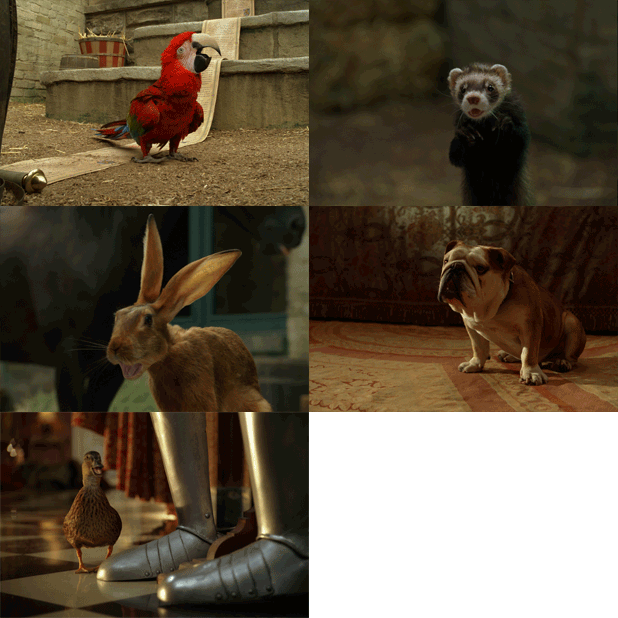
For this adventure, the visual effects artists had to bring to life a barnyard of animal sidekicks. Courtesy of Rainmaker.
Supporting Roles
Another difficult character was the bunny. He wasnt the store bought fluffy bunny; he was more of a jackrabbit. The features tended to be structured and again, various angles implied different rabbits, so he was constructed on more of a shot to shot basis.
Eberles contributions were hardly finished. With a barnyard cast of 10, she still had several animals to wrangle. From modeling to acting, and following the scene through lighting and compositing, she had to monitor all the animals at different phases of production, keeping track of the status of each. Working closely with CG supervisor Nick Boughen who had worked on the first Garfield, the team worked as a tight crew, seven days a week in split shifts, days and nights. There were also daily 11:00 am calls with Bailey, working remotely using Cinesync to view the files.
Paterson enjoyed her role. We are at the point now where its difficult to imaging anything we couldnt do, it just all takes time. We are already moving towards the point where we need fewer and fewer people, and simplifying it enough that you dont need MIT grads to operate the software. We always want to push the envelope, want to do more and they want us to do more.
Eberle agrees: We came out at the end appreciating the challenges that Winston gave us. With any show you love those challenges because they teach you how to be better.
Renee Dunlop has worked in film, games and multimedia since 1993. She currently works at Sony Pictures in Culver City, California, and freelances as a Maya lighting digital artist and as a writer for several trade publications.