
Disney vet Mark Kimball will be honored at the Sci Tech Awards on Saturday for helping the industry move into the digital age. Ellen Wolff learns more about where he's been.

Mark Kimball.
This Saturday night the Academy of Motion Picture Arts and Sciences will honor a technology expert who has helped the film business move into the digital age. Mark Kimball, who co-chairs the Digital Imaging Technology Subcommittee of AMPAS' Science and Technology Council, has been named the recipient of the 2008 John A. Bonner Medal of Commendation. Kimball, a 30-year industry veteran, has been a technology contributor to such films as Beauty and the Beast, The Lion King, Aladdin, The Hunchback of Notre Dame, Hercules, Pocahontas, The Rescuers Down Under, Fantasia/2000, Dinosaur and Tron.
The Bonner medal, bestowed at the annual Scientific and Technical Achievement Awards dinner at the Beverly Wilshire, was first awarded in 1977. Kimball joins a list of honorees that includes luminaries like special effects pioneer Linwood Dunn and John Whitney Sr., the father of computer graphics. "I'm thrilled to be included in such a group," admits Kimball. "I'm completely dumbfounded to be singled out."
Kimball's career traces an arc from the traditional 2D animation that Disney was producing when he joined that studio in 1980, to the work with digital cinema and stereoscopy that has occupied him in the last four years as an independent consultant. Kimball has served as one of Disney's representatives to the Digital Cinema Initiative, the consortium of six studios tasked with developing specifications for digital standards. "So much work went into that," he recalls.

Kimball received his first award from the Academy in 1991 for the CAPS system. © A.M.P.A.S.
"Everyone came in with ideas about the way it should be, and as a group everyone had the right ideas. Which is not to say all the problems have been solved, but over the long run the equipment will get more cost-effective and the problems will be worked out."
The Bonner Medal isn't Kimball's first honor from the Academy. He previously received a Scientific and Engineering Award in 1991 for the design and development of the CAPS production system for feature film animation, an award that was shared by a team of technologists from both Disney and Pixar. During his 20-year Disney tenure, Kimball served as the CAPS logistics system lead, a senior software systems specialist, a consulting engineer and finally chief technologist. "I headed the infrastructure part of the project," he explains modestly. "I focused on how to track and manage the millions of files that were being generated, and to make sure that they got to the workstations quickly."

Multiplane camera effects used in 1940's Pinocchio were revived with the CAPS system that Kimball helped design. © Disney Enterprises, Inc. All rights reserved.
The significance of the CAPS system to Disney animation, Kimball notes, "Was that we regained a lot of the traditional capabilities that we'd lost over the years due to costs -- like multiplane camera effects. Think about the multiplane effects in Pinocchio, where the camera is zooming in on Pinocchio. That was a 25-second sequence. I knew how much work it was to shoot a single frame of multiplane. So to be able to again see long sequences of multiplane in dailies was a thrill."
Through the technology that was developed at this time, he adds, "The Rescuers Down Under could be 100% digitally produced. Artists still drew the artwork, but from beginning to end it was all scanned in and colored on computers and composited."
Kimball recalls that among his many technology responsibilities at Disney was putting computers on the animation cameras for the studio's exposure control systems. "It allowed for a lot of automation for setting lights and making sure that you turned over the shutter the proper number of times." This technology was used to create Disney's in-house contributions to Tron, the first feature containing significant 3D-CGI. The film's CG work was subcontracted to such fledgling companies as MAGI, Robert Abel & Associates and Digital Prods., because, as Kimball observes, "For Disney to have even imagined it could do that itself would have been like saying they could land on the moon!"
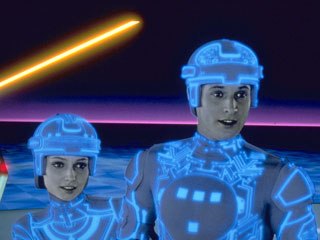
Kimball wrote software to produce the halo effect that surrounded images of the live-action characters in Disney's CGI breakthrough Tron. © Disney Enterprises, Inc. All rights reserved.
For Tron, it was Kimball's job to write the software that produced the halo effects that surrounded images of the live action characters. "They had been photographed in black-and -white and transferred to Kodalith images," he explains. "We had to figure out how to make that come into color underneath the animation cameras. That was where the exposure control system was used. To get what were -- at that point -- small desktop computers to run all the elements on the Disney camera was kind of a breakthrough. I always felt pretty honored to be allowed to mess with equipment that had such a legacy."
Kimball didn't have the opportunity to work extensively with one of Disney's most famous alumni, John Lasseter, but he does recall seeing the digital test Lasseter created for Where the Wild Things Are with animator Glen Keane. "The two of them showed it to me and I was flabbergasted," he recalls. When Lasseter left Disney to join Ed Catmull in George Lucas' computer department, Kimball observes, "You could see the forces aligning."
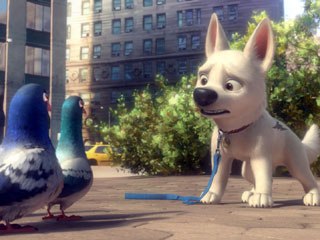
Disney's Bolt is a 3-D accomplishment Kimball is proud to see in the industry. © Disney Enterprises, Inc. All rights reserved.
While Kimball had left the studio himself to become an independent consultant before the return of Lasseter and Catmull to Disney, he was thrilled to see what the studio accomplished with the 3-D stereoscopic release, Bolt. "I remember back in 2003 or 2004 seeing the original story for what was then called American Dog. Movies continually go through refinement processes and this took large leaps. I think the collaboration between Disney and Pixar is good, and the companies are relatively close. I see a restructuring of the engineering efforts there to take advantage of what the different groups can do."
The stereoscopic advances at Disney are of particular interest to Kimball, who first got involved in 3-D decades ago. "I worked on a motion control system called ACES -- which stands for Automatic Camera Effects System -- back in the 1980s. We needed to create a shot for one of the pavilions at EPCOT. It was a shot where the camera had to fly towards a spacecraft, and we had to have left eye and right eye takes of that. That was my first introduction. I'm hopeful for stereoscopic films, especially in live action. Within the Digital Cinema Initiative it was a push of mine, among other people, to make sure that we had the ability within digital cinema to be able to foster this. I believe that the mechanism within the equipment is there. But we'd have to set up the specifications that the equipment would need to support being able to put out that many frames."
Kimball isn't surprised that digitally animated films are leading the way in 3-D stereo, however. "From what I have seen, we have such good storytellers in animation and they are really extending the art. Any animated film is planned to such a degree that you could set your environment and the staging and the props to be able to extend the 3-D notion. The ability to have soft boundaries gives you additional flexibility and avoids the problems that we used to have with 3-D. There's been great progress made, but there are still challenges, like with subtitling, for example. That's still very difficult."
There's a certain collective impetus that moves forward ideas whose time has come, and Kimball has seen several breakthroughs driven by technology. "Someone will come up a really good idea for changing their rendering pipeline, for example, and you then see that work its way into the rest of the industry. I thought all seven films shown at the visual effects bakeoff this year were really good examples. I was pleased that the three that were nominated were fine representations of what you can do today. The digital head replacement done with Benjamin Button is really a wonderful process. The push to move digital further into emulating humans is both scary and challenging. It will be interesting to see where we go next."
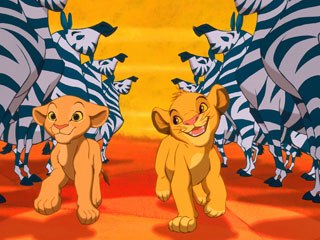
Kimball was in technology development and support on 1994 feature The Lion King, one of many films he oversaw in that capacity for Disney. © Disney Enterprises, Inc. All rights reserved.
Kimball recalls that one of the precursors for the current focus on digital humans actually happened at Disney with the work that CG pioneer Lance Williams did for the Human Face project. "That was for The Genesis Man," says Kimball, referring to a never-made film that required visualizing different ages of an actor's face. "A lot of what Lance was working on then has been picked up. I'm sure that what he described has fed into work elsewhere. The thing about good ideas is that they will eventually make it out."
As co-chair of the Digital Imaging Subcommittee at the Academy, Kimball stays very current on the latest technologies, many of which are regularly considered for Scientific and Technical Achievement Awards. "I got involved with the founding of this subcommittee along with Ray Feeney and Dave Inglish and others. People sitting in that room are competitors on one level and yet we come together to do these investigations. It is a passion within the group that we have to get this right."
In recent years as the Academy has honored larger numbers of software innovations, an effort has been made to honor foundational research as well as the applications that are put forth by visual effects companies. This has been particularly notable in areas like water and cloth simulation and subsurface scattering. "We want to find out the roots of an idea and to look for the 'aha moment,'" says Kimball. "That's what we're looking to honor."
It can be a painstaking process to trace technological breakthroughs back to their source, and Kimball notes, "The Digital Imaging Technology Subcommittee works year-round when needed, and then brings recommendations back to the awards committee. Digital systems are extremely complex and hard to evaluate in the standard six to eight weeks from the time that applications come in to the time we have to make determinations. But we're in a fortunate position, because unlike the arts side of the Academy, we don't need to award 'The Best Technical Innovation of 2008.' The time horizon is too short for that. Very often we are looking at things that are a few years in the past."
But Kimball admits, "You can see several things on the horizon. We have typically 16 or 18 members spread out across the industry in technology areas. We have an amazing span of leads where we are looking. An area of investigation that was taken on this year is the studios' underlying technologies for digital intermediates. It's a very big area."
When Kimball reflects on how much his career interests changed since he left the Jet Propulsion Laboratory in 1980 to join Disney, he has to laugh. "It's been gigantic. When I was working on the Deep Space Network at JPL, I was worrying about getting signals back from Mars and needing to carry things out to 14 decimal points. Then I found myself in an environment where I didn't have to carry out anything out to any decimal places. I just had to make things look good.
"From a career perspective, it's been a fascinating timeline, watching technology come of age and be able to see what artists could do with that technology and move the art forward. It took a real push very often to be able to do that. I've always believed that those of us centered in technology have been able to offer advancements, and I don't see that progression slowing down."
Ellen Wolff is a southern California-based writer whose articles have appeared in other publications, including Daily Variety, Millimeter, Animation Magazine, Video Systems and the website CreativePlanet.com. Her areas of special interest are computer animation and digital visual effects.