In this months Animators Unearthed, Chris Robinson profiles the influences behind Theodore Ushevs Tower Bawher.
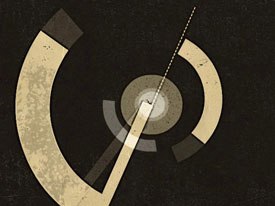
Tower Bawher is about our frustrating drive to fight through the muddle of mediocrity in search of the stuff that makes us. All Tower Bahwer images © 2005 National Film Board of Canada. All rights reserved.
Influenced by Russian constructivist artists like Dziga Vertov and the Stenberg Brothers, and featuring the dynamic score Time, Forward by Russian composer Georgy Sviridov (which Canadian filmmaker Guy Maddin also used effectively in his short film, The Heart of the World) a litany of lines, shapes, colors and sounds storm across and around the screen of Theodore Ushevs Tower Bawher. They go up. They go down. They come together and just as quickly fall apart. Tower Bawher is an intense existentialist film about our often frustrating and restless drive to fight through the muddle and clutter of mediocrity and suppression in search of the stuff that makes us. In the end, though, the paradox is that no matter how far we climb, seek, or find, everything falls apart. Things come together, but only for a moment. Thats the route of the ride.
Incredibly, Tower Bawher (For the record, bawher is a bit of a nonsense word. Tower in Russian is baschnia, Ushev explains. But because of the Cyrillic alphabet, a foreigner will read it like bawhr, so Tower Bawher was perfect (Bauhaus, Bauer ) was made in just a few weeks. I start doing it one night in April [2005]. I was in a deep depression. My movie [Ushev was making a childrens film for the National Film Board of Canada] was not going well. During a particularly restless night, Ushev woke up and remembered an idea he had to use the score, Time, Forward, by Russian composer, Georgy Sviridov. For many years, remembers Ushev, this piece was the music for the evening news of the Soviet state TV. This program was broadcast every Friday.

Tower Bawher was born out of filmmaker Theodore Ushevs deep depression when a film he was making was not going well. He was inspired by Time, Forward, a musical piece from his childhood.
While the television hummed in the background, Ushevs father worked on his own personal drawings and paintings, and also on more conventional propaganda posters that he made solely to earn a living. The memories of these Friday nights struck a chord with Ushev. It was like an absurdist stage decoration. Before the news, there was usually a Russian childrens program on. Typically it featured very, very slow Russian animations like Norsteins Hedgehog in the Fog. Id fall asleep immediately. Then, suddenly, Id be awakened by the uplifting Sviridov music, with turning globes, and the lines of the dynamic building of Communism.
And so it was during a sleepless night in April that Ushev decided to make the movie. Five weeks later the finished film found its way to my desk. I was not able to sleep during the entire process. It was like being in a trance, like I travelled back 30 years with a time machine. I didnt think about festivals, or if the movie will be finished. I was just diving into my memories, like a Cartesian theater. It was like a letter. I was in a hurry to show it to my father, because I planned to make a short vacation in Bulgaria. It was done for him.
Before Ushev hit the road back to Bulgaria, he showed the film to producer Marc Bertrand of the National Film Board of Canada (NFB). Bertrand liked the film immediately. Théo showed me the film with the Sviridov music, recalls Bertrand, and I was really moved by the perfect marriage between the picture and the music. Théo was working at the NFB Studio at the time on Tzaritza [the aforementioned childrens film], so he was not eligible for a FAP [Filmmakers Assistance Programme] grant. When Bertrand asked Ushev want he planned on doing with Tower, Ushev had no answer. My only goal was to show it to my father. Bertrand convinced him to finish the film with the NFB. It felt natural, adds Bertrand, to finish the film in the best condition possible and to finally produce it. Ushev agreed.

In an ironic turn, Tower Bawher, which deals with the uneasy relationship between art and state, was caught in the Russian bureaucracy over copyright issues.
Bertrand showed the film around the NFB and everyone was impressed. There was just one problem no one could determine who owned the copyrights to the music. Sviridov died in 1998 and, according to a Copyright Canada document, dated Sept. 13, 2005: the person who inherited his copyright has since passed away (and) that the copyright entitlement over the works of Sviridov is the object of a dispute before the Russian civil courts that will not be resolved for some time yet. After Copyright Canada rejected the application, the NFB decided to negotiate directly with the Russians.
It became a nightmare, says Ushev, but the NFB helped me enormously. Their entire legal department was involved into the process. It is really incredible how difficult is to deal with the Russians. Everything that seems easy becomes complicated. So, even when the bureaucrats tease an artist, he cannot live without them. It is like a family, they hate each other, but cannot live without. And the next morning are in love again.
Fortunately, the copyright issues which somehow seem appropriate for a film that, in part, deals with the uneasy relationship between art and state were solved just in time for Tower Bawher to have its world premiere at the Ottawa 2005 International Animation Festival last September.
Ushev credits the NFB for more than just taking on Tower Bawher: Before starting at the NFB, animation was a hobby for me. I made Internet movies, put them online and forgot about them. Suddenly I felt responsible. I couldnt do this movie if I was not working at NFB. If there were not people at the NFB like Marcel Jean, Marc Bertrand, Christine Noël, and Michèle Bélanger, it couldnt happen.
Tower Bawher was a therapy, admits Ushev, who moved to Canada from Bulgaria in 1999. I did it to cure myself from my memories. Every child of an artist tries to escape from his mighty shadow, and to create his own world. And almost no child can do it.
Tower is more than just a search for self and an ode to a father. It is also a tribute to those artists who continually struggle to escape from the ominous and numbing shadows of bureaucracy and censorship. Its appropriate that Tower Bawher has become an NFB film. For more than 60 years, the NFB has struggled, successfully and unsuccessfully, with that precarious relationship between artist and bureaucrat. And, really, its the struggle that counts. Its the struggle thats life.
Im a big fan of coincidence. As I sit here writing this text on Jan. 31, 2006, a package just arrived. Inside is Ushevs latest NFB film, The Man Who Waited. Including his upcoming childrens film, this is Ushevs third film in under a year. Based on a Franz Kafka story, The Man Who Waited continues Ushevs quest for truth. Its like the man said: I cant go on, Ill go on.
Chris Robinson has been with the Ottawa International Animation Festival since 1991. A noted animation critic, curator and historian, he has become a leading expert on Canadian and international independent animation. His acclaimed OIAF programming has been regarded as both thoughtful and provocative. In May 2004, Robinson was the recipient of the Presidents Award given by the New York chapter of animators for contributions to the promotion of independent animation.
His books include Between Genius and Utter Illiteracy: A Story of Estonian Animation, Ottawa Senators: Great Stories from the NHLs First Dynasty, Unsung Heroes of Animation, Great Left Wingers, and Stole This From a Hockey Card: A Philosophy of Hockey, Doug Harvey, Identity & Booze.
An anthology of Robinsons Animation Pimp columns will be published in 2006. He is currently working on Fathers of Night, a novel about angels, devils and everything in-between. Robinson lives in Ottawa with his wife, Kelly, and son, Jarvis.

A well-known figure in the world of independent animation, writer, author & curator Chris Robinson is the Artistic Director of the Ottawa International Animation Festival.