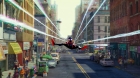
In a world where image is everything, why has it taken advertising so long to embrace digital cars? J. Paul Peszko finds the answer and why Digital Domain was the company for the job.

A high-tech steel machine otherwise known as the Pontiac Grand Am eats up the pavement of "Metal Citys" streets. © General Motors. Images courtesy of Digital Domain (Pontiac).
While the clash between the Old Economy and the New Economy continues on Wall Street, in corporate circles the contrast between old styles and new has reached even greater proportions. With dot-coms springing up faster than you can download the latest browser and brick and mortar retailers quickly trying to learn the clicks of the e-trade, Madison Avenue finds itself embroiled in an old versus new controversy of its own, namely live-action or digital animation. This, too, is an outgrowth of another battle that has been going on for years: film versus videotape.
Though animation of one kind or another has been a mainstay of television commercials since the early days, it had always played second fiddle to live-action. Since a photo-real box of cereal or can of cleanser could hardly dance across a counter, sing a jingle or smile with delight, production houses integrated live-action with animation more out of necessity than choice. But even Tony the Tiger and the Pillsbury Doughboy would be the first to tell you that live-action was where the prestige and big bucks were to be found.
A few years ago, I represented a Denver production company that worked with several live-action directors. One of these was a superstar of soda and beer commercials. After seeing his reel, a prestigious East Coast agency asked for a bid on a dog food commercial. When I called for his availability, he told me quite bluntly, "I don't do dog food." Sorry, Rover. How about washing down those beef chunks with a six pack of Bud?
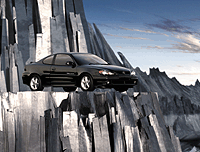
A black roadmaster admires her steel kingdom in the commercial spot "Steel Desert." © General Motors. Images courtesy of Digital Domain (Pontiac).
The Best is Required
Advertising agencies have always craved live-action film directors who could give their products that winning edge -- even if it is dog food. So, when it comes to products that are bought especially for their style and looks, it is no wonder creative executives have fawned over hot niche directors for years. They want the real product, and they want it shot on film with subtle lighting and a riveting style that lends itself to trendy, fast-paced editing usually around a catchy jingle or slogan. There may be an animated logo or a CG starburst, but the product itself has to be one hundred percent photo-real and filmed at its creative best.
Automobile commercials were a perfect case in point. Until recently, one might have expected electric cars to replace gas-guzzlers before any of the Big Three national ad campaigns ever replaced a real car filmed live with a digital one created on tape. It just wasn't done. Car spots had always featured slick, live shots, fast cutting, awesome backgrounds whether on a butte overlooking the Grand Canyon or on a winding mountainous road bordered by tall pines. Then along came BBD&O in Detroit. They came up with a Plymouth campaign that called for a Neon on a trampoline. Not the easiest location to place a car -- even a subcompact. Enter Digital Domain (D2) of Venice, California. They showed how the spot could be done with a one hundred percent digital Neon.
Although it became a groundbreaking commercial, "Trampoline" was originally conceived and bid as a live-action spot and Terry Windell, a noted car director at A Band Apart, was selected to shoot it. But after exhausting all the possibilities, the creative team could not come up with a relatively uncomplicated, inexpensive way to rig the car to make it bounce up and down on a trampoline.
"It was going to be a long, expensive shoot," states Eric Barba, a visual effects supervisor at Digital Domain. "So, one our other effects supervisors pitched Terry to do it as a CG car. We did some tests to show him we could do it. Then we moved ahead and did the spot."
But ad agencies were still not thinking digital cars. "This was an example of a live-action director having the confidence of the agency already," Barba points out. "The spot was already in his hands."
Proving Digital Might
Right after "Trampoline," BBD&O produced a live-action spot entitled "Time" to show off the new line of Dodge vehicles including the Viper GTS, a sleek, high-powered sports car. All the vehicles were the same color -- red -- so one could dissolve into the other as it passed through a glass wall. But the red Viper also had two white racing stripes. When Dodge decided not to produce Vipers with stripes, the agency had to find a way to remove them. But it was impossible to paint the stripes out. Pleased with the results of "Trampoline," they once again called on Digital Domain, which in turn did away with the original Viper completely and replaced it with a digital one. BBD&O loved it. When they decided to do "Time 2," adding the Durango and the Intrepid to the original spot, they had Digital Domain do the honors rather than incur the expense of shooting the new models.
"That was really the break-through usage of digital cars in advertising," Barba emphasizes. "That got them [ad agencies] to buy that we could do fully photo-real digital cars, and from then on we've been pitching the idea."

In "Metal City," its metal thats mighty! © General Motors. Images courtesy of Digital Domain (Pontiac).
Next came the two impressive Pontiac Grand Am spots, "Metal City" and "Steel Desert," produced by D'Arcy, Massius, Benton and Bowles, which have a Grand Am maneuvering deftly through a virtual all-metal environment. The idea was to show that the Grand Am was built stronger and tougher and had more maneuverability than ever before.
"Last year's Grand Am was a brand new vehicle," explains Mark Zapico, group creative director at DMB&B. "It was really new from the ground up. It had a space frame design made out of hydroformed steel. It was built to be a lot more rigid and a lot stronger [than previous models]. So the idea of the steel world manifested itself out of the brand and the product, itself. We wanted a way to truly bring the steel landscapes to life."
Working with D2
Why did the agency decide to go all digital and why did they choose Digital Domain?
"It was not an easy decision," Zapico admits on both counts. As to the first question, the agency had seen a lot of digital cars, but they were static. They had not seen a digital car move along the road like a photo-real one. What changed their minds? Again, the answer was the brand, itself, the Grand Am. According to Zapico, "Since the technology for Grand Am was to build a car that was cutting edge it was worth a try to see if we could make digital cars work."
As to the second question, the agency team had to educate themselves about the world of digital production. They looked at the work of several digital houses including Digital Domain. "After talking with them [Digital Domain] a number of times, we felt confident that the full brunt of their artists, animators and designers could bring it to life, and we had the backing of our clients. Digital Domain had done work before for General Motors...So, we felt it was a risk worth taking," continues Zapico.
DMB&B sent an agency team to Los Angeles to work closely with Digital Domain and their in-house director, Ray Giarratana. And the results were very encouraging. "We put every one of our best people on it," Giarratana states, "...and when it was all said and done, the clients got something that really showed off their product well and in a very interesting manner that was different in many ways."
From the very start, Giarratana felt to achieve the creativity demanded in the clients' storyboard the spots would have to be produced digitally. But while creativity may be enhanced using digital effects, what about quality? Besides putting their top people on the spot, to insure a quality equal to live-action, they hired Bill Bennett, a top live-action director of photography for auto commercials, to consult with Ray and Eric and their team. They wanted to be able to match the angles that have proven over the years to show an automobile at its finest.

Blackmobile cruises through "Metal City" at sunset. © General Motors. Images courtesy of Digital Domain (Pontiac).
"I knew this was going to look different from the viewer's perspective because you don't see a desert...or a city completely made out of metal ever," Giarratana explains. "So, one of the things I really set out [to do] from the beginning was to make sure that we photographed the automobile using somewhat established photography. There are angles that look good on a car and have been used before. Lots of very talented [live-action] directors have shot cars before and have come up with a visual language that is beautiful on an automobile. Just because we could move our camera anywhere and in any way without the limitations of a live-action production didn't mean we should."
Being Sensible
Though early on his clients may have thought that with animation you can move the camera anywhere you wanted and go zipping through everything, Giarratana felt otherwise. "It still needs to be beautiful, and there needs to be reasons to motivate moves...I was very much of the opinion that, wherever possible, to try and use the camera in a way that we could almost do [the shot] in live-action. I wanted to stay within some realm of believability from a photography point of view."
While the spots would have been impossible to produce in live-action, they were by no means an easy order even digitally. "In the city spot one of the challenges was the sheer magnitude of information," Giarratana admits. "Just to present a city with that much detail was certainly a challenge. The desert spot, that wasn't quite that big of a deal because it was a lot more sparse and, therefore, not as populated. But they both presented very tough lighting challenges because it's metal on metal on metal, and it needed to look really beautiful and yet realistic as well."
Both spots have been heavily rotated and have received remarkable acclaim. So much so, that when Pontiac wanted to emphasize their solid frame design in this year's ad campaign, DMB&B did not hesitate to go back to Digital Domain. The idea was to keep the original spots running but to pass the Grand Am through an x-ray showing its chassis and edit that in. D2 responded quickly and economically.
A Trend?
Does this mean we can expect to see a lot more digital cars replacing real ones in the future? It depends on the creative team at the agency and the director they select.
"We just finished another spot in the same campaign...and we shot real cars in a CGI environment," states DMB&B's Zapico. "And, the feeling that we're getting is it's even a better looking marriage between a real-looking car and this [digital] environment. So, we'll probably go in that direction next."
"Each creative guy has his own feeling," Barba explains. "Most of them, because they've been in the business for a while and have been shooting cars for a while, prefer to shoot cars with a camera and lens, the old-fashioned way. They feel they get what they want. The digital thing is kind of new to a lot of them, and they don't really warm up to it until you show them repeatedly that you can make a digital car look every bit as photo-real as you can with a real car. And then after a while, they warm up to it, especially when you compare the expense involved in shooting a car on a motion-controlled stage with multiple passes versus doing it digitally."

"X-ray" reveals explosive colors under metal surfaces. © General Motors. Images courtesy of Digital Domain (Pontiac).
Good point! How much did DMB&B save altogether on the three spots? A bundle. D2 used a total of ten artists and two compositors on the "Metal City" and "Steel Desert" spots and only two artists and one compositor on the "X-ray" segment. Compare this to renting a stage with a turntable, hauling a couple of Grand Ams in and out, hiring a DP, a gaffer, a legion of grips, prop people, carpenters, painters and the like. Not just once but three times. And afterward, they would still have to go in and edit all the footage.
This is another instance where digital production pays off big time. It gives one more flexibility and freedom in the editing room, where one can quickly alter a scene or add nearly anything that is wished. How about a new set of wheel covers? Or a sports rally package? No problem.
"One of the endings we did with these new spots for "X-ray," we changed the wheels and added a sunroof to the vehicle. So, we could render it with two different wheel packages," Barba states. "Well, once you've shot with live-action, you're kind of stuck with it. You can't change it unless you go back and reshoot. However, we have taken live-action vehicles and added CG components to them. We did that for a Blazer spot, where it was originally shot in live-action, and the next year they wanted to come back and have us replace the headlights and bumper parts with CG ones, so they could continue to use the commercial."
On the negative side, DMB&B had the expense of keeping their creative team in Los Angeles for nearly four months while the first two Grand AM spots were being produced. This may change, however, as agencies grow more comfortable with fully digital productions.
Should Have Gone Digital
Ironically, the most complicated vehicle spot that D2 has done used a photo-real vehicle instead of a digital one. It was their "Off Road" spot for Dodge Trucks. Nick Piper of Plum was picked by BBD&O to direct the spot. The idea was to see an entire forest actually spring up around a Dodge Truck. So, Piper and the production company decided to shoot a live truck on a turntable. They propped it with a small stream and a smattering of plant life in the foreground. From that point, D2 took over and grew an entire alpine environment around the truck. In the spot, we see trees, ferns and plant life, a mountain and a sky growing from scratch.
"Up until that point, it was something we hadnt done in CG -- actually grow a forest," Barba states. "We had done plenty of CG plants and CG trees and a CG sky, but to grow one was a whole new ballgame."
Although the truck, itself, was originally photo-real, D2 made so many changes to it that it was virtually digital. In order to get the effect they wanted, they had to layer the truck with over forty composites. "We did all the work and could have replaced it if we wanted to," Barba admits, "because, to match all the reflections and get it set up properly, we had to create an essentially full CG vehicle and then only render the parts and then composite the parts we needed. So, we did all the work but we didnt really get to use it to its fullest. In fact, it would have saved us a lot of compositing time had we done it that way." Aside from getting another great looking spot to add to their reel, all that work on "Off Road" enabled D2 to come up with some valuable proprietary software that they are using in-house right now.
But what about D2s future? Does Barba think that there will be more national auto campaigns coming their way? "Ultimately its up to the director. Most live-action directors would rather shoot (a photo-real car) because thats what theyre familiar with. But, if they get something from an agency thats real expensive to shoot or they wont get the flexibility they need or they cant quite figure out how to shoot it, then we offer them the flexibility of being able to get the quality they want and still get the creativity the agency wants."
In the battle between quality and creativity, when it comes to national advertising, quality wins out time and again. It has been this very lack of quality in some digital cars that has caused Madison Avenue to throw out a caution flag. But at Digital Domain, where they have stressed quality along with creativity, their photo-real digital cars are at present lapping the competition and look primed to get the checkered flag.
Remember to search the Animation World Magazine Archives to find more articles on commercials, digital production and related topics.
J. Paul Peszko is a freelance writer and screenwriter living in Los Angeles. He writes feature articles, interviews and reviews for regional publications. He currently has two scripts under option and is working on a feature comedy, in addition to just completing his first novel. When he isn't writing, he teaches communications courses.