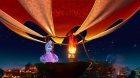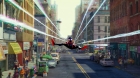
Fantasia/2000 definately pushes the technical limits of animation, creating visuals we have never seen before. As a special treat, David Bossert, the film's artistic coordinator and visual effects supervisor, takes us deep into the process.

In the late 1930s, during the golden age of animation, there was an enormous amount of innovation and invention of animation techniques; many of which are still in use today. The Disney Studio's animators experimented with different animation techniques and the technology of the day on many of the short animated films that were being produced. Shorts such as Through the Looking Glass and The Old Mill became laboratories for the effects department. It was during this time period that much advancement was made including the development of the multi-plane camera, ripple glass, as well as sophisticated matte and optical techniques. Some of these techniques were used for the first time in Fantasia, which was released in November of 1941.
Fantasia stretched the boundaries of animation art and technology in 1940; it blended sights and sounds to a degree never before seen. This theme of blending art and technology is continued with Fantasia/2000. In this newest version of Fantasia, a team of Disney artists and technicians have again pushed the envelope; this time with art and "digital" technology. Each new segment presented the team with different challenges that required inventive solutions. "The Steadfast Tin Soldier" segment uses some cutting edge dynamic software for the hair and skirt movements of the ballerina, one of the main characters. In the "Pines of Rome" segment, a color modeling tool was developed to help the art director define the color of the ocean water surface. Morphing software was used to create a stormy ocean surface in "Pomp and Circumstance, " a new Donald Duck piece. Houdini, an off-the-shelf software package, was used to create the defining elements of one of the main characters, the sprite, in the film's finale, "The Firebird."
A Nimble Ballerina
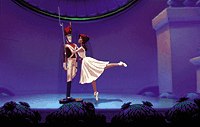
In the "Tin Soldier" segment, physics-based methods were used to create the animation of the ballerina's skirt and hair. This hair dynamics frame work and skirt dynamics was the brainchild of Umakanth (or Uma) Thumrugoti. A single NURBS (Non-Uniform Rational B-Splines) patch defined the cloth geometry of the skirt and a skeleton structure was created to approximate and map this geometry. The animation applied on the skeleton deforms the skirt geometry through a cluster mechanism. The shape of the skeleton structure almost resembles that of a tapered cylinder, with the exception that the upper half of the structure has some puffiness built in. A spring/particle mesh represents the skeleton structure, with a particle at each joint and a spring at each bone of the mesh. There are also diagonal springs connecting the particles for a greater scope of movement.
The ballerina was animated first without the skirt. Then the topmost joints of the skeleton structure (spring/particle mesh) inherited the animation from the ballerina. Physics-based methods, coupled with behavior-based functions controlled the motion of the skeleton structure and consequently the skirt. Also built were some post-animation controls for refining the skirt animation after the physical simulation was done. The animation for the ballerina's hair was done in a similar fashion using dynamics; the same idea as the skirt, only in a more simplified version. Over 140 feet of skirt animation was required for this segment, with the ballerina performing a complex range of movements. Using dynamics the team was able to get 80 to 90 percent of the animation completed. Peter Palombi did the rest with post-simulation tweaking, along with the hair collision. Dave Tonnesen assisted in this process.
What a Whale of a Job!
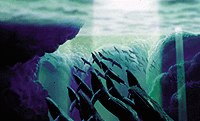
The "Pines of Rome" segment combines CG whales and water surfaces with traditionally animated water, backgrounds and other effects elements. Blending the CG water surfaces with hand-painted backgrounds proved to be visually challenging.
Susan Thayer and Umakanth Thumrugoti came up with the idea of using a color modeling software tool for defining the color of the water surface. The art director would have one window with an image of the water surface, a second window with a curve in 3D space and a third window with red, green and blue sliders. The curve is used in the Renderman shader to assign a specific color to the water surface. This was implemented by Uma and Sergi Sagas. The first CV (control vertices) on the curve relates to the closest point of the water surface and the last CV relates to the furthest point of the water surface. The X, Y and Z values of the CVs represent the red, green and blue colors. By moving the CVs on the curve, the art director can change the red, green and blue values of the associated point on the water surface. Alternately, one can assign a specific color to the water surface by adjusting the sliders in the third window. There is an immediate feedback in the image of the water surface with the new colors. Once the desired colors are assigned to the water surface, the application generates a curve that is used in the Renderman shader for defining the color of the water surface. As a side note, Susan Thayer invented the water surface as a spring/mass mesh that was animated dynamically. When the whales break through the water surface, along the elliptical curve of the intersection between whales and the water surface, particles are generated and are given an initial velocity in the direction of the normal to the curve. The particle generation is adjusted in such a way that there are rings of particles formed around the intersection curves which expand in size as they radiate out. These particles were rendered and used as displacement maps in the shader for the water surface.

Note the Water...
In "Pomp and Circumstance," the director Francis Glebis wished to create a massive ocean storm. The desire was to create the impression of a realistic ocean surface, complete with blowing spray and a translucent quality.
The director pointed to various artists' paintings, including the marine paintings of Carl G. Evers. Normally in a traditionally animated film the ocean surface would be animated by hand, similar to the whale sequence in Pinnochio or the water animation in Fantasia's "The Sorcerer's Apprentice." Our main difficulty with this method was the inability to create the translucent look associated with a realistic water surface and yet, still have it blend in with the traditional look of this piece.
The solution was to paint the water surface exactly as the director wanted and then morph the paintings to create the animation.
We designed the key frames keeping in mind that this method needed to blend with the traditional animation. Once the key drawings were approved, they were then passed on to the traditional background department.
After receiving final approval of the paintings, from our director and the art director, this artwork was then scanned hi-res into our CAPS system. Then the images were transferred over to our 3D system and scene set-up was completed by one of our TDs. Morphtool, which is a proprietary morphing software package developed in-house at Walt Disney Feature Animation, was used to create the "animation" of the paintings. The main advantage to using this software is better animation timing controls and a very useful x-sheet editor.
The final animation was then transferred back into CAPS with the images bound to the scene's digital x-sheet. The morphed ocean surface, along with a 3D arc, live-action rain, a traditional background, hand-drawn blowing spray and some lightning were then composited together to create the final shot.

The Grand Finale
Several methods were used to create seamless 2D/3D effects for "The Firebird." Most of the effects were created using primarily the Houdini software package. Other 2D paint packages including Photoshop, and Disney's proprietary drawtool and morphtool, played a supportive role. The 2D/3D mixture that created the sprite character was accomplished by bringing scans of the 2D drawings of the sprite animation into the computer, and then adding the particle effects of streaming grass, pollen, flowers and magical dust. A 3D simplified version of the sprite was built and hand-tracked frame by frame to match the 2D animation. Particles were emitted along a flat plane in one direction. Forces were added, and once the desired behavior was achieved, a process called "creeping" was used to conform the particle simulation to the shape of the 3D sprite, which gives the impression of particles flowing down the contours of the sprite's body. The 3D sprite was hidden before rendering so the particles could be composited with the 2D sprite and create the final effect. Every shot with particles contained tens of thousands of particles. The final shot of the piece, in which the sprite dissipates, contains over 1 million particles.
Several scenes contained growing plant life from particles being dropped from the sprite. To achieve this effect, particles being thrown from the sprite were programmed to detect when they landed on the ground, which was a 3D grid modeled in the computer to match the background paintings. Once one of the particles connected with the ground, its program caused it to stop moving and trigger a short "animation event" of a growing plant in the exact spot the particle landed. Every particle would randomly select from several animation events of different plants at different growth speeds and colors which gave the impression of thousands of different plants coming back to life over the landscape. These animation events were traditionally animated and then painted by our background department. Finally, one of the great things about working on the Fantasia/2000 project was that we had the ability and resources to use existing and custom software with traditional animation techniques in new ways. One of our goals was to blur the lines between digitally and traditionally created animation. When colleagues have trouble distinguishing between the two techniques then I think we have successfully blended art with technology! I would like to thank my colleagues Uma Thumrugoti and Michael Kaschalk for their input and comments on this article. David Bossert was artistic coordinator and visual effects supervisor on Fantasia/2000.