
The origin of Logan becoming Wolverine required a myriad of vfx by 17 vendors, and here are the highlights.

Originally, he was just one part of a major ensemble cast, but the character made such a strong impression on viewers in the first X-Men movie (2000) that he is now getting his very own feature film. In X-Men Origins: Wolverine (from Twentieth Century Fox), director Gavin Hood explores the troubled past of rebellious mutant Logan, his complex relationship with former team partner Victor Creed, his encounters with a series of outcast mutants and his conflict with Colonel Stryker, the man who ultimately turned him into a war machine known as Wolverine.
Fox enlisted Overall Visual Effects Supervisor Pat McClung and VFX Producer Greg Baxter to manage the ambitious vfx effort. When the shot count reached unexpected heights, just under the 1,000 mark, Additional VFX Supervisor Craig Lyn joined the team in January. Due to the late addition of extra shots, X-Men Origins: Wolverine ended up with a whopping 17 vendors. Hydraulx and Soho were lead vendors, Luma Pictures, Method Studios and Rising Sun Pictures worked on key sequences, while additional vfx were created at Matte World Digital, Frantic Films, Fuel, Lola, Hatch FX, Café FX, Cinesite, Cosa and Image Asylum. Cinedev, Persistence of Vision and Frantic provided previs services.
Lyn says that there was a tremendous amount of work that needed to get done in a very short space of time. "Also, some houses were better suited for specific types of work than others. In addition, there's always limited capacity in every house at any given time. So, that explains how the work was spread among so many different facilities."
X-Men Vets
Some 386 shots were assigned to Hydraulx, the only vfx company that had significantly contributed to all four X-Men movies. "Our main task was to recreate the Three Mile Island nuclear plant for the end sequence -- and then to partially destroy it," says in-house VFX Supervisor Erik Liles. "Initially, we received 3D geometries from another vendor, as the nuclear plant appears in three sequences that were assigned to different vendors. During the course of production, our sequence grew, and Hydraulx became the main vendor for that specific model, so we eventually became the driving force of how the model would work. We built the whole power generating plant, the island it is built on, and used matte paintings for the surrounding landscape and the sky. We couldn't actually get to the real location. So, we used photographs of the plant that we found on the internet, and also reference photographs of other facilities. What we ended up with was an amalgamation of multiple places. We also had to modify the environment and make the island much shorter -- one mile instead of three."
The nuclear plant environment plays a major role in the climax of the movie, when Wolverine confronts archenemies Sabretooth and Deadpool on top of one of the cooling towers. "For the hero close-up work, we used greenscreen elements of the actors performing the scene on a narrow 30-foot section of the cooling tower top in front of a greenscreen," Liles explains. "We then extended the practical set digitally and added the environment. For long shots, we used computer-generated doubles that were 100% hand-animated using Maya. Production gave us 3D scans of the actors, and we used that data to model the characters in extremely high resolution. The hair and costume were simulated using Maya."
The climactic confrontation ends with the disintegration of the cooling tower. In order to create a realistic collapse, Liles and his team (including Lead Dynamics Animator Josh Hatton) built a breakable tower that could be destroyed via a combination of techniques. "After watching several videos of cooling tower demolitions, we noticed two main things they had in common when they fell. It should be noted that we also looked extensively at building demolition, which was quite different, and used a lot of what we saw to augment the effect. First, these cooling towers had a very unique destructive behavior, folding in on itself rather than shattering. It was very reminiscent of a Styrofoam cup with some weight on it. Secondly, the overall collapse wasn't very interesting, with the whole tower basically 'falling' to the ground straight down as if the floor wasn't even there. There is also a large dust cloud at the base that essentially covers up all the cool stuff. We had been given direction not to 'cover up' the tower as it collapses, and we needed to come up with our version of what happens down under all that dust and smoke."

During the R&D phase of the sequence, Hydraulx investigated different off the shelf software packages that specialize in procedural destruction of 3D geometry, as well as Maya's native rigid bodies and nCloth. While they showed promise and produced some interesting effects, Liles says their limitations became present early and forced to abandon them for the most part. "We then tried to extrapolate the methods we liked about these programs and implemented them within our current Maya pipeline with some custom plug-ins and Mel scripts. The most successful method was to use Maya's nCloth to simulate a semi-rigid mesh tear and fold like the reference videos. This provided gross movement that felt right, but produced less-than-ideal geometry 'shards'. We then took procedurally shattered geometry and parented them to this cloth simulation."
The results of this approach were very encouraging, but very hard to modify in case the director requested adjustments. Eventually, the team modeled the pieces by hand, and animated them by hand as well, using the nCloth simulations as reference, in addition to tower and building collapse videos. This allowed for real compositions of the shots that didn't rely on time-consuming simulations that may not be entirely successful.
The dust and smoke effects were mainly particle effects using a combination of instanced geometry, points and sprite particles, and custom volumetric mental ray shaders. Maya fluid simulations were used as secondary elements and for motion reference. Secondary 'hero' debris animation was created via rigid body simulations. Finally, RayFire was employed to break up the larger chunks of debris in specific shots, such as when Deadpool blasts the tower with his laser eye beams. The various elements were then assembled on Flame workstations.
Hydraulx also handled another mutant, called Gambit, for a brutal fight with Wolverine and Sabretooth in an alleyway. Gambit has the capacity to charge any object with a tremendous amount of energy, which he uses to dispose of his enemies. "We animated CG cards to show his powers, and also created all the mayhem that he generates in the alleyway with his energy-charged staff weapon. We used a mixture of simulations and practical elements to complement the practical effects that had been filmed on set. On all these mutant effects, we had to find a delicate balance between trying to make it look cool, but also keeping it based in the X-Men universe."

Slicing and Dicing VFX
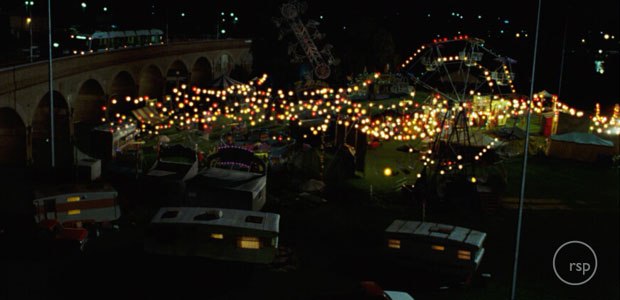
Some other sequences featuring Wolverine were tackled by Rising Sun Pictures. The Australia-based facility delivered 37 shots that included the infamous adamantium (a high-tech indestructible metal) injection sequence. During the operation, Logan is suspended in a surgical theatre on a metal rack that is lowered into the water. There's a rig around him with metal injection guns. The needles are super-heated, so the water boils as they hit it, and they start spinning like drills before plunging in to his body.
Due to safety reasons, the guns and needles were not on the practical rig. "There were a few practical needles in there, but these were mostly removed in 2D," notes in-house VFX Supervisor Tom Proctor. "There was also a lot of object tracking that was required to track the needles to Logan's body. Since the needles were done in CG, they were being matched to reference. We built our model to match a practical gun model that was provided as a reference. As we needed to articulate the movement to match Logan's thrashing, we embellished the joints and built in extra hoses to accentuate that. In some shots, the entire rig was replaced with our CG model. Additionally, there were some practical bubbles rising in the tank in the foreground. We needed to remove these bubbles, add the CG rigs, then add the bubbles back over the top. There was a lot of 2D layering over the rendered guns, needles and bubbles."
Once Logan is injected with adamantium, he escapes by using his new claws to slash his way out. The claws are seen punching through an external door, then tear out a highly symbolic 'X'. CG Supervisor Dan Bethell and his team had to create a door rig that would in effect 'unzip' between being a completely healed clean door and a door with a very pronounced slash and ripped metal. "We modeled up a slashed pronounced edge door, and then rigged together a door that would unzip in time with the claw animation and do a reveal. That was then rendered out as series of passes which were all brought together in 2D. To help bed the claws in the shots, the reflections of the environment were crucial to get the level of realism that was required. For all of the shots, we were provided lighting reference (gray ball, chrome ball, etc), but there were also practical models of the adamantium claws that were turned around on set to give us an idea of lighting and reflections."
Rising Sun created a different set of claws for the dramatic scene in which they first appear on young Logan. Most of the plates were shot with the actor wearing practical bone claws built by Amalgamated Dynamics. "The intention was originally to keep the practical claws in-shot, but the design was changed throughout, and there eventually became continuity issues that needed to be resolved through CG. We were provided with assets and turntables from other vendors to assist in this process, in addition to receiving the prosthetic for reference. The main thing was to ensure that the look was correct with regards to the continuity of the film, and the other vendors. Although we ended up removing the prosthetic claws, they did provide a perfect reference for tracking, animation and placement."
The appearance of the juvenile bone claws on Young Logan required a specific interactive effect. As the blades slowly emerge, the skin on the back of the hand starts rising and moving. The team rendered a series of 3D passes and applied the warp in 2D. "We also went through some iterations where the skin would peel back as the blades come out, but that was deemed to 'gory' for the rating," Proctor says. "In the end, you can see the bones traveling under the skin, but it's fairly clean for the exit of the blades. We don't see any blood. The ratings really drove that look -- it needed to be creepy, but not gruesome."
The majority of work was created using a Maya/3Delight/Nuke or Shake software pipeline, with additional work being carried out in Houdini associated with Mantra.

Mutant and Airplanes
Other mutant effects were handled by Soho VFX, Toronto, where Allan Magled served as vfx supervisor and Keith Sellers as digital FX supervisor. A crew of 50, including artists and support, spent over 16,000 hours on the project, working on more than 230 shots. Part of the work focused on Wolverine's claws (bone and adamantium), but the team also provided CG augmentations and/or effects for Creed, Deadpool, Gambit and Wade.
Meanwhile, Cinesite, London, was involved in creating a series of shots featuring an entirely CG plane, clouds, ground and sky. VFX Supervisor Jon Neill and VFX Producer Ken Dailey oversaw the project that was completed in just five weeks. The plane was modeled from scratch using Maya, and included navigation lights, landing lights (with interactive glow to the surrounding clouds), vapor trails engine glow, and heat haze. The surfaces were rendered via standard in house metal shaders rendered through RenderMan.
The clouds were generated by designing geometry in Maya, and then running it through a custom Houdini volumetric cloud system, which was rendered through Mantra. "The clouds were shaped as volumes filled with metaballs in Houdini," Neill notes. "Each metaball has a density attribute to control the opacity, and so get a nice wispy layer above the clouds. These metaballs were rendered in Mantra with a volumetric shader and a 3D fractal displacement shader to add noise and details. The volumetric shader makes a nice fade when going through the clouds."
For the spectacular "Powers of 10" shot that ends the film, production turned to Matte World Digital. President and VFX Supervisor Craig Barron took inspiration from the famous Powers of 10 short from Charles & Ray Eames. "Starting on Logan, the camera rises up thousands of feet revealing all of the Three Mile Island aftermath, and finally into the clouds. Matte Painter Eric Hamel made five 3D matte paintings to create the illusion of a continuous pullback. The biggest matte painting was being 16k wide for the terrain elements. Luis Hernandez, Morgan Trotter and Glenn Cotter made additional 3D elements, including arriving fire engines, military vehicles and police cars. To complete the shot, Geeta Basantani composited in many drifting smoke and fires elements that were tracked into the shot including a digital double for Wolverine."
Last Minute Challenges
In some ways, the whole Wolverine production process was a slight learning curve for Hood as to what was possible in terms of the visual effects. "It's commonplace to both underestimate as well as overestimate the challenges involved, as well as the scope of the work for any given shot," Lyn concludes. "Just about every director in the world asks for the moon, and it's the job of vfx to try to deliver. On this movie, the main challenge probably was establishing the look of specific sequences very late in the project cycle. That was particularly true for the cooling tower fight, as well as the post tower collapse. These were two very extensive greenscreen shoots -- and the two scenes were the last in the schedule to complete."
Alain Bielik is the founder and editor of renowned effects magazine S.F.X, published in France since 1991. He also contributes to various French publications, both print and online, and occasionally to Cinefex. In 2004, he organized a major special effects exhibition at the Musée International de la Miniature in Lyon, France.