Joe Strike talks to animators at Rough Draft Studios about how they took on the challenge to take the Springfieldians' simple, stripped-down designs and their flat, 2D TV origins into CinemaScope for The Simpsons Movie.

Once upon a time the TV set was referred to as `the idiot box.' It's taken more than a few years, but Homer Simpson, TV's number one idiot has finally broken out of the box and made his way to the movie screen. The Simpsons Movie (opening July 27, 2007) is far from the first animated TV series to travel from living room to multiplex; at the peak of their popularity Hanna-Barbera stars Fred Flintstone and Yogi Bear made the journey, and more recently SpongeBob and South Park have done so as well. Like those shows, The Simpsons is faced with the same challenge: making sure their characters look as much at home on the big screen as they do on the TV screen.
One way to make sure is to bring as much as of your creative team with you as possible, people who know the Simpsons so well they could live a few houses down Evergreen Terrace. Rich Moore is one of the movie's four main sequence directors (working under director David Silverman) and oversaw most of the movie's slam-bang climax. A regular director on the show's first five seasons, Moore jumped ship to join Gregg Vanzo's Rough Draft animation studio in Glendale, California, where he served as visual designer for The Critic and supervising director of Futurama. With Rough Draft and Film Roman (the TV series' production studio in Burbank, California) sharing animation duties, Moore has returned to Springfield.
"The TV show is pretty much limited animation, and we knew from the beginning that trying to add too much slickness would take away from what people know about the characters. We tested different levels of animation -- we tried going all the way to really fluid, all done on ones animation -- not Disney style or making them Disney-type characters, but fully done. Basically, that was going too far. It started not looking like The Simpsons and seemed foreign. "
"There's definitely animation on ones in the movie," adds Claudia Katz, Rough Draft's producer. "We're making sure to use it at the right time. The main difference is that we kept more of the animation here in the U.S. than the TV show does. It gave the directors more control and allowed for better acting. We were able to capture some subtle, observational details and get more nuanced performances."
Moore admits that thanks to Homer's usual brain-dead stare, some of those subtle details may be products of the viewers' imagination -- which is just the way the movie's creators want it. "Depending on the camera angle, we could use a Homer's blank face to say he's hungry or sad. The audience does a lot of work for us.
"We studied The Muppets a lot during the first season. Kermit is just a piece of felt with two ping-pong balls for eyes, but there's something within the situation of the moment that with the slightest change of expression on his mouth, the audience projects the right emotion on him."
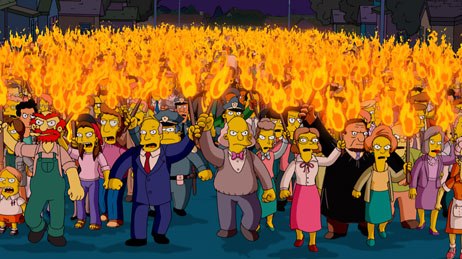
The biggest difference between the TV Simpsons and the movie Simpsons is the size of the canvas their adventures are set on. "We're working in CinemaScope," Katz explains, "this ridiculously widescreen format, the widest there is. It's a very different palette from a composition viewpoint. It sets a very different tone right off the bat; on a subliminal level you sort of go `this is a movie.'"
"They wanted to make it as different as possible from the TV show," Moore adds. After doing the show for so long, you're used to over-the-shoulder angles, closeups and wide shots. Now you have to figure out how these work in CinemaScope. It took a few days, but once we got the hang of it I loved working in that aspect ratio. I thought it was terrific.
"We studied a lot of `Scope movies from the '50s and `60s," he continues. "They're just beautifully composed and we kind of just followed their lead, but if you have a really tall guy onscreen, you're out of luck." When Katz suggests, "you've got to be far away, I guess," Moore agrees: "Really far away."
In keeping with the Springfieldians' simple, stripped-down designs and their flat, 2D TV origins, only a simple shadow level was added to the characters. It's a touch of shading designed to help them pop a bit out of that CinemaScope frame -- and away from the backgrounds. "They're handled differently than in the series," says Katz. "On the show they're just flat-colored, one light-source backgrounds. Everyone agreed that wasn't going to play on a 100-foot screen."
"You're going to see deeper looking compositions," agrees Moore, and when asked if that includes multiplane effects, he enthusiastically adds "oh, you know it."
Production-wise, another upgrade is the movie's merging of CGI and 2D animation. It's a technique that's responsible for much of Futurama's futuristic feel, but new to The Simpsons. As key players on Matt Groening's sci-fi spoof (and key creatives on the upcoming direct-to-video Futurama movies), Moore and Katz are 100% comfortable going the hybrid route. "It's definitely a challenge to bring 3D in without it getting too fancy or losing the hand drawn look," Katz cautions," and we're trying to protect that." Homer's run-in with a construction crane was a highlight of the movie's earliest TV advertising; while that sequence was directed by Mike Anderson and animated at another studio, Katz says the CGI was produced at Rough Draft.

The Simpsons Movie has been a long time a-borning, with creator Groening back in the show's earliest days promising its eventual arrival. In a 1995 interview, series writer/producer David Mirkin commented, "there's always a lot of pressure on us -- " presumably from 20th Century Fox " -- to do a Simpsons feature." The show's creators resisted, worried that a movie might cannibalize the series' audience, while at the same struggling to develop a script capable of sustaining a feature-length film.
The voice talent's 2001 contracts for seasons 13-15 included an option for two movies (which grew to three in later contracts), but according to one website's catalog of rumors about the film, the first script reading didn't take place until 2005. Finally, in 2006, Groening told USA Today that the producers had come up with, "a script that would be worthy of people actually paying to see The Simpsons.... We felt the time was right for a movie... and for Milhouse to win an Oscar."

Now a year later in 2007 -- a remarkably quick turnaround time in the world of feature animation -- the movie's IMDB credits list 13 writers for the film, including Groening, exec producer James L. Brooks and an assortment of show veterans from Al Jean to Jon Vitti. Early on many people thought a Simpsons movie would follow the end of the show's TV run, but, instead, both the movie and the series were produced simultaneously.
Katz says only two series animators joined the movie's production staff, but in a May AWN interview, veteran series director Mark Kirkland reported that Film Roman (where the series is animated) had to recruit new talent to cover both the show and their portion of the movie's animation.
The film revolves around a Homer-instigated catastrophe that threatens to destroy Springfield. According to Moore, "Every character that's ever appeared in the show" will put in an appearance." When asked if that included Roy, a Simpsons `houseguest' who briefly appeared in one episode as a gag about tired series adding new characters, he admitted "except for him." And "Poochie," a similar, canine add-on to The Itchy and Scratchy Show? "We can't say. Oddly enough Lenny and Carl get a lot of screen time; if you like Lenny, you're going to like this movie."
For her part, Katz hopes The Simpsons Movie will spark. "a real resurgence in 2D animation now that there's been enough CGI flops so that CG is no longer seen as a magic bullet that guarantees instant box office success. There's a million great stories to be told and family comedies are a great genre for 2D animation that hasn't really been tapped yet."
Joe Strike is a regular contributor to AWN. His animation articles also appear in the NY Daily News and the New York Press.

Joe Strike has written about animation for numerous publications. He is the author of Furry Nation: The True Story of America's Most Misunderstood Subculture.