A new director, a darker turn and a new vfx direction underlie the third Harry Potter installment. Mary Ann Skweres reports.


The highly anticipated third film in the phenomenal fantasy saga, Harry Potter and the Prisoner of Azkaban, features the return of the regular cast of children, teachers and guardians, as well as a number of new characters and creatures. This time around, a shadow is cast over Harrys third year at Hogwarts with the news that mass-murderer Sirius Black (Gary Oldman) has escaped from his prison in Azkaban, apparently intent on finding and killing Harry.

The darker material, Alfonso Cuarón's direction and vfx supervision from Roger Guyett and Tim Burke drove the creative choices on this movie. Alfonso is a very passionate director. He just didnt want things to look fake or effectsy. He had a philosophy that if it looks too flashy and too much like a special effect, then it cheapens it... He is such a unique director. Most directors want if as big and spectacular as we can do it. He was much more about subtlety, reveals Industrial Light & Magic vfx supervisor Bill George. Reportedly anti-CG going into the film, Cuarón wanted to ground this film in a reality. The effects needed to be organic, driven by the magic. The CG not only had to be photorealistic, but also needed to behave more mechanically. According to Simon Stanley-Clamp, vfx supervisor for Cinesite in London, He didnt want a Terminator-look. That was his term for anything CG.
To create the magic for Azkaban, five different visual effects houses supplied more than 750 vfx shots.
The Moving Picture Co. (MPC) supplied 230 visual effects shots the highest number awarded. Their contributions include the Grim a menacing photoreal CG dog, a Werewolf and a reprise of the Whomping Willow.
With a team of about 100, ILM broke 200 shots with the Quidditch game, the Dementors, the Boggart and others.
From Cinesite 167 shots made the final cut. It felt like more because some of the shots are so long, explains Stanley-Clamp. Commonly, 10 seconds is your average. The first shot the team did was a two-minute long steadi-cam shot in the Leaky Cauldron, where the wanted posters of Sirius Black are animated and there are reflections in mirrors and things.
In total, Double Negative completed around 130 shots: more than 90 on the Knight Bus sequence, 20 on the Hogwarts Express and some more miscellaneous shots that cropped up along the way, the most notable being two floating CG lolly-pop shots.
A 90-strong Framestore CFC team labored for 15 months to deliver more than 80 Buckbeak, the Hippogriff shots in both daylight and at night and in a variety of scenes wary, playful, resting, fighting and flying.
Most of the vfx work was divided up by sequences with each house working on all the effects in their assigned, self-contained sequences, with a few notable exceptions. MPCs Werewolf interacts with Framestore CFCs Hippogriff. In order to achieve a believable fight between two digital characters, it was necessary for the two companies to integrate elements into each others shots so close collaboration between the two teams was paramount.
There a little bit of crossover on some establishing scenes that ILM had to match, such as the stormy skies and color outside the Hogwarts Express created by Double Negative. Whoever was taking the lead and was the furthest along in their work would provide a clip or some sort of reference to use. Cinesite worked with new Soho facility, Base Black, which supplied CG crows for a long tracking shot that ended in the courtyard. Cinesite shared camera tracking data and a reference for the latest comp with Base Black and received the path of the crows, matching the data.
The larger the crossover, the more flexibility that was necessary from both sides. More important, the need increased for a very defined schedule and a clear plan for how to exchange animation and elements.


Buckbeak
Created using digital vfx, as well as some ingenious mechanical wizardry to complement the computers, vfx supervisor Karl Mooney and his team at Framestore CFC created Buckbeak, the Hippogriff. A mythological creature with the head and wings of a bird of prey and the body of a horse, Buckbeak worked as a hybrid creature, was convincing in close-up and took off and landed believably.
A character in his own right, the creature interacts with the actors and is even ridden by several of them.
The huge challenge to Framestore CFC was creating realistic feathers and fur. Buckbeak appears in tight close-up, in full daylight, so the look and movement of the feathers had to be indistinguishable from the real thing. Detailed studies of the construction and interaction of real horsehair and feather types were undertaken to achieve the specific horse-cum-bird-of-prey look. A big challenge was to develop a wing that could move from fully outstretched to fully folded without interruption, says vfx supervisor, David Lomax, The grooming and packing of the feathers have to be precisely correct.
Another headache for the team was reconciling the fact that, as drawn, Buckbeaks wings were 20 feet long when at rest, but 28 feet when the Hippogriff took to the air. Being a digital creation definitely gave the team an edge over animatronic models. The technology was flexible enough to allow changes to the animation on the spot. Mooney says, From the outset, the goal for the R&D team was for there to be no limitations placed upon the animators or the director by the technology. We wanted to provide an invisible technological framework, inside which the creative people could work freely.
Animation supervisor Michael Eames recalls, As well as the enormous technical challenges, here we had a creature with more to it than simple, animalistic behavior. It was necessary to bring some character to Buckbeak. Eames and his team studied both birds of prey and horses on film and during visits to zoos. Cuarón had a clear idea of both what Buckbeak was like coltish, a little dangerous, a bit of a wild adolescent and of the nature of his relationship with Harry The Black Stallion was cited as a reference. Though accepting of Harry, its an animalistic acceptance, based on mutual respect. The film did not allow for a leisurely exposition of the boy/bird friendship. There are real difficulties with creating character in a creature such as this, in the limited scenes you have available, adds Eames. It has to live in the space to be real. It doesnt talk and it has a beak with all the lack of expression implicit in that. So you look for everything that can help you convey what you want. We used cues from the actors interaction points. For example, when Harry and Buckbeak first meet, we used a slight slip in Harrys posture, bouncing it off Buckbeak as a reaction.
Whomping Willow
Initially developed by MPC for Harry Potter and the Chamber of Secrets, the Whomping Willow returns as a more gnarled and twisted version, now located in the wild countryside beyond the walls of Hogwarts. Accurate previs data was used by both the physical effects team and the visual effects crew to plan for sequences where Hermione and Harry are swung around by the tree, and in another where Ron is dragged along the ground by the Grim. The physical effects team engineered Hermione onto a rig, which swung her around, and the digital team tracked her motion and built the swinging branches around her. Fully digital versions of the children or parts of their bodies were used for shots that would have been impossible to shoot in the studio.
For both the Whomping Willow and the Grim drag sequences, MPC visual effects supervisor Paddy Eason filmed in studio before bluescreen. The studio was of a limited size, so the team, led by CG supervisors Simon Clutterbuck and Peter Muyzers, built a digital landscape. They extended the set out to the horizon, mirroring the real exterior shots with elements, including rocks, ferns, heather, a lake, forests of pine trees, mountains and the sky. Because of Cuarón's highly mobile camera technique, the environment needed to be in 3D rather than a traditional matte painting. The digital landscapes were also used elsewhere in the film during flashback shots and in three establishing scenes, where the Whomping Willow and Hogwarts exterior are seen in spring, summer and fall.

MPCs other work includes the metamorphosis of Peter Pettigrew to alter ego Scabbers the rat and back again, and the transformation of Professor Remus Lupin into the Werewolf. They created the invisibility cloaks, a digital matte painting of Hogsmeade village, a photoreal bird, wand effects, digital snow enhancement and many other effects for the movie. The team also developed the films characteristic title sequence, encompassing live-action plates composited together with miniature 3D models and a 3D animated flying Harry Potter logo.
Dementors
The big challenge for ILM was the character of the Dementors. Some tests had been done using a puppet under water and Cuarón really liked the look, so production asked ILM if they could use the current technology of cloth simulation to mimic the tests. Most cloth simulation software is meant to simulate how cloth normally moves in gravity. Because the tests were shot under water, however, they had a slow motion feel, much slower than normal. It was necessary for the team to adjust the timing of the cloth movement. It was supposed to be spectral, so the team turned the gravity way down. The material floated, like seaweed. They used digital wind sources and other techniques to move the fabric around and get it to go in the desired direction. The tendrils were such an important character piece we really had to do whatever it took to get them where we wanted them, shares George. David Andrews was the animation director. It was very hard for him to animate a character that has no face, no eyes, just body movement. The Demetor was only fabric over a skeleton armature. The initial tendency was to give the creatures frenetic actions. Alfonsos direction was, no, these guys know theyre going to get you and theyre not in any hurry. They move like royalty. They go very slow. Theyre a force that you cannot stop, says George.
ILM also developed the Boggart, the creature that changed into what frightens you. The most challenging aspect was the design work. For characters such as the Boggart there was no direct path from the design to making it happen. It was experimentation, trying other things. The director didnt want it to be solid, but he also didnt want it to be a spirit. It took a long time to get the directors vision.
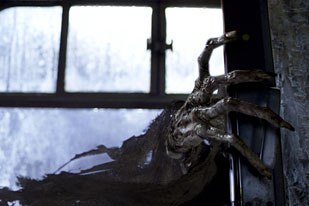
George credits vfx producer Sandra Scott, compositing supervisors Dorne Huebler and Tom Rosseter and CG supervisors Michael DiComo, Euan MacDonald and Kevin Sprout for their key roles.
Time Travel and Other Marvels
Cinesites biggest achievement in the film was the time travel shot a mixed bag of disciplines incorporating motion-control, bluescreen compositing, time-warping, steadi-cam blending through into CG-animated camera, live-action footage changing into full CG environment, coming out onto a motion-control miniature shoot backed up by a digital matte painting and ending in live action. Pretty much covers the gamut of all disciplines apart from character animation, lists Stanley-Clamp. The team always knew the shot would be a challenge and was prepared. Early on they had a previs approved by Cuarón so there were not too many variations. The previs drove the motion-control rig that shot the plates. All movement had to be matched to the live action. Therefore, if the action followed the kids, the speed would have to be matched to the speed of the steadi-cam.
In the previous films, the look had been set for the Great Hall and the candles. It is a very incidental effect that is everywhere. The team at first thought to go with the usual formation, but they actually came up with several subtle designs for arranging the candles from an arch to a starfish, finally settling on a combination spiral and birthday cake formation. For the individual candles, five models were made and the size, width, rotation and how much they burnt down varied so that no two candles were alike. Six different cycles of flames also helped to avoid repetition. Although the live-action scenes were lit without the candles, the flambes bowls of fire along the side had electric lights that shown up through the base of the fire to give the hall the warm rich glow associated with candlelight.
Cinesite created the Lumus wand effects. Stanley Clamp wanted an optical look. The team enhanced the practical effect with animated pulsating colored hoops and by tracking optical starburst effects over the top of the wand. The ghost figures were all created by Cinesite, also with an optical look, loosely based on time-lapse photography, with streaky motion trails broken up with transparent areas where youd see through the glow with a slight distortion displacement to the kids behind. They were composited with a combination blue screen, green scene and motion-controlled location plates shot with and without the actors. Also provided by Cinesite was the Marauders Map sequence. Initially offlined on inferno so production could determine the timing of the footprints, the effect was a combination of CG-animated feet and CG banners with textures applied in a 3D world then composited in Shake.
The most enjoyable aspect of the process for Stanley-Clamp was completing whole scenes. Its been quite unusual for us that weve had runs of shots that fit really well together 40 shots in the cut which ran almost back-to-back with a couple of non-effects shots in between. That was very satisfying to see all of those go together.

Magical Travel
This was the first Potter film that Double Negative had worked on, but the effects were similar to work they had produced on previous films: CG vehicles, particle animation, fx animation and composite work. According to vfx producer Dominic Sidoli, There was a great deal of trust from the production in awarding a new vendor the Knight Bus and Hogwarts Express sequences and we wanted to show them that we were up to the challenge.
According to Sidoli, the company spent the most time on the first interior squeeze Knight Bus shot that pushes into Harry as everything begins to deform. This shot both technically and creatively drove the following squeeze shots. For vfx supervisor Mark Michaels, the challenge was selling the exterior close-up shot of the Knight Bus unsqueezing from between the two red buses. You dont realize how many parts go into making a bus until you put one together from CG, especially one with an added deck. Also, because many parts were moving individually during the animation, all the pieces needed their own passes for lighting and compositing.
Double Negative built interior and exterior models of the Knight Bus. For interior shots, geometry was built for everything inside the bus, including Harry. This geometry was deformed via a lattice surrounding the model, causing the squeeze to travel through the bus in a wave of motion. Double Negative repainted much of the on-set footage to provide a series of over-painted plates that could be projected onto the geometry. When deformed, these could reveal new areas of previously unseen bus. The original curtains were removed and new curtains animated to react with the squeezing walls and beds. A number of lighting and shadow passes enhanced the changing shape and lighting conditions.
The interior squeeze is book-ended by two exterior shots where the bus first squeezes and then unsqueezes from between the red double-deckers. A complex 3D model was built using set plans, measurements and photographic references of the real bus. Textures were hand painted for complicated details such as the wheels. Larger flat areas of the bus were realized with shader solutions and hand painted dirt maps. The windows used footage from the reference plates where the real bus was driven past camera. The squeeze is driven by the lattice with some smaller bus details being animated by hand for the final touches. Maintaining an overall seamless integration of the effects within the Knight Bus sequence was a major achievement for the Double Negative team.
Although the Knight Bus contained the more difficult effects work, Sidoli liked the Hogwarts Express sequence because the effects are invisible and the sequence was about creating a mood prior to the arrival of the Dementors. Sidoli credited supervisors Richard Clarke and Charlie Noble with spending a great deal of time on these shots to get the look just right.
For two exterior shots, Double Negative turned broad daylight into an overcast, rain-swept evening. The shots were graded to a more ominous tone. More than 120 passes of rain and mist were added to a single shot to get the correct density. Finally, CG smoke was used so that the camera would be swallowed as it flies toward the window for a cut to the interior. These shots proved difficult because there was very little reference of flying through rain, so it was tricky to find the right look.

For the interior window composites, each shot was blocked out as a rough composite, then extra details were added with an eye to find the right balance between elements. Backgrounds were darkened considerably. To match the exterior shots CG mist was added to the far distance. Practical rain was used just outside of the train window and condensation was tracked to the glass. The resulting sequence had a feeling of low visibility beyond the train, making the Dementors arrival all the more menacing.
Software
In the various vfx houses software preferences run the gamut from off-the-shelf to proprietary programs developed to solve specific problems or meet certain creative challenges.
Framestore CFC developed techniques and software to realize Cuarón's vision of a Buckbeak that you do not question on the screen. "It was a fantastic opportunity to bring to life such an interesting and complex creature," recalls Lomax. The M-Rig, a proprietary tool for the equestrian flying sequences, is a sort of digitally controlled mechanical bull. It enabled animation information to be fed into the animatronic model on which actors are seated and filmed in front of a blue screen. The model responds to the animations that have been planned and created.
MPC modeled and animated key creature characters for the film in Maya, but wrote proprietary plug-ins to achieve an extra level of realism not possible with out-of-the-box tools. Delilah, MPC's 3D fur system was developed to re-create the properties of natural fur and hair and simulate how these react to different physical forces. The team also developed an in-house muscle system to realistically portray the muscular anatomy of creatures in motion. PR Man was used for rendering.

Double Negative used Maya, Shake, RenderMan and Photoshop, because their shots were an extension of effects that they had done previously using this software which had worked well for them in the past.
Because the character of the Dementors is so much about how the robes flow, ILM had to adjust the software used to animate them. It was a case of dialing parameters in to make the software work the way it is needed to work. Cloth simulation requires a massive amount of processing power for the computer to calculate how each of the little facets move. And unlike other processing intensive processes, like rendering, it needs to be done on one machine because the program needs the frame before and the frame after. Its one of those technologies, thats so new, there arent a lot of people that are really, really good at it, shares George.
For compositing, Cinesite used Shake and inferno, but in-house programmers wrote some modules for the animated portrait inserts motion analysis software for tracking the live action. This allowed them to add textures such as digital varnish and paint brush strokes over the image while mimicking the movement creating an actual living painting. The key thing was getting the paint to actually move, which is harder than it sounds, explains Stanley-Clamp. What we wanted was the paint actually moving around the face...you can actually see the cracked texture in the paint moving as [the painted character] talks. Cinesite refined the way motion-control data was handled and supplied a lot of data back to production to run the motion-control rigs.
The level of detail in Harry Potter and the Prisoner of Azkaban is phenomenal. How much of it is actually perceived varies from shot to shot, but there is an argument that says, If it wasnt there, it wouldnt look authentic. For this film no detail was spared and the resulting real magic is proof of the exceptional work by all involved.
Mary Ann Skweres is a filmmaker and freelance writer. She has worked extensively in feature film and documentary post-production with credits as a picture editor and visual effects assistant. She is a member of the Motion Picture Editors Guild.